Girnar
Ten thousand steps. That is the traditional pilgrimage to the summit of Girnar, a cluster of ancient peaks rising from the plains near Junagadh in Gujarat. For Jains, this is among the holiest places on Earth - the mountain where the 22nd Tirthankara, Lord Neminath, attained omniscience and later nirvana at the highest peak, alongside 533 other enlightened sages. For historians, the mountain's significance begins even earlier: at its base sits a boulder bearing fourteen of Emperor Ashoka's Major Rock Edicts, inscribed around 250 BCE in Brahmi script, marking the beginning of Junagadh's written history.
Words in Stone
On the Girnar Taleti road, about two kilometers east of the ancient Uperkot Fort, an uneven boulder with a circumference of seven meters and a height of ten stands inside a small protective building. Etched into this rock with an iron pen, in a language similar to Pali, are Ashoka's edicts - commands from a 3rd-century BCE emperor who ruled most of the Indian subcontinent. But Ashoka was not the last to write here. Around 150 CE, Mahakshatrap Rudradaman I, a Saka ruler of the Western Satraps dynasty, added inscriptions in Sanskrit to the same rock. Three centuries later, text referencing Skandagupta, one of the last Gupta emperors, appeared alongside them. One boulder, three empires, seven hundred years of layered inscription. A smaller replica now stands outside the National Museum in Delhi, and another recreation sits inside Parliament Museum - acknowledgments that this rock at Girnar's base is one of India's foundational historical documents.
Sixteen Temples Above the Clouds
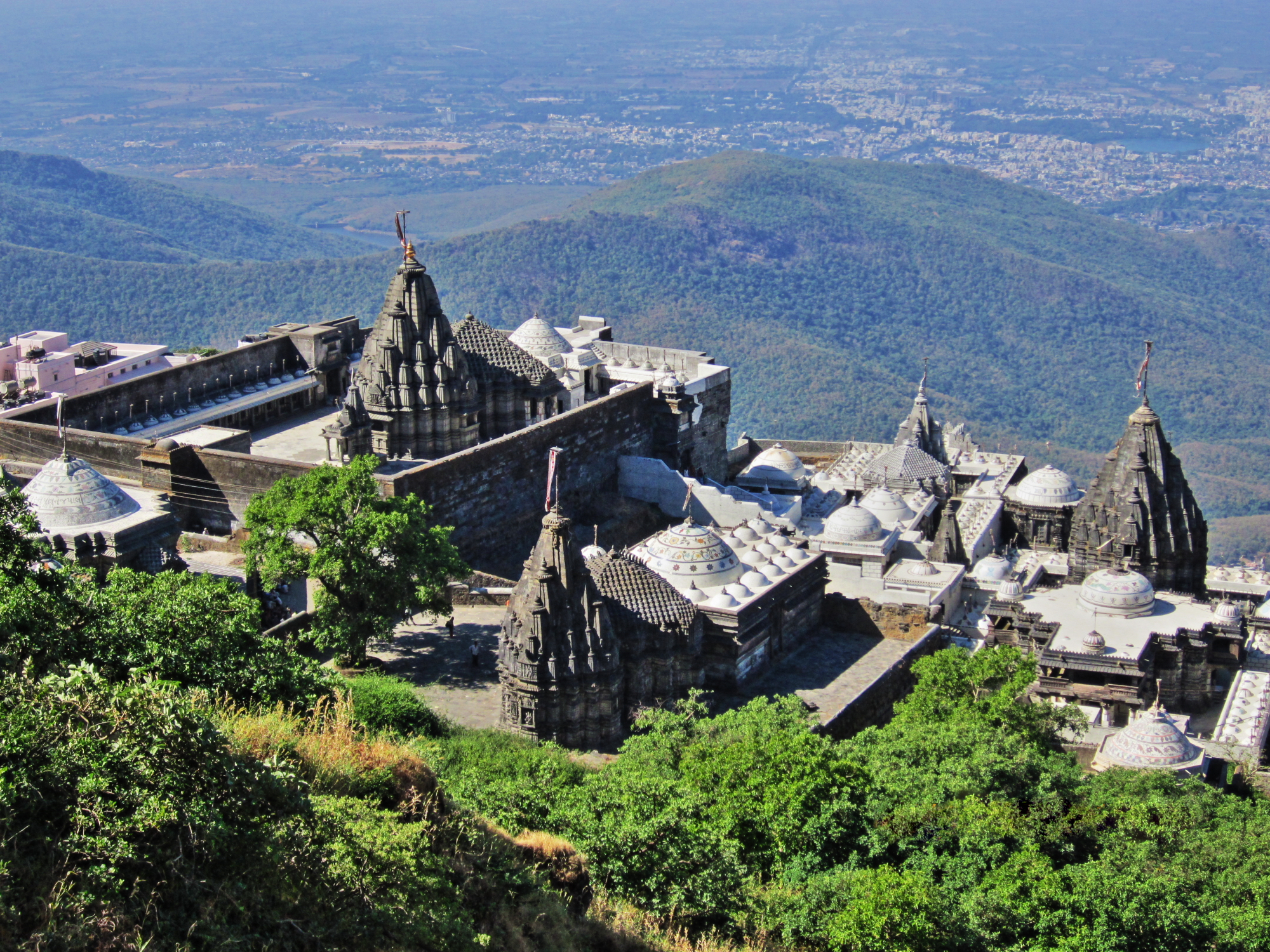
The Jain temples of Girnar sit atop the mountain in a series of peaks called Tunks. The first Tunk holds a black granite temple dedicated to Lord Neminath, constructed in 1128 CE, its pillars dense with intricate carvings and colored mosaics. The second Tunk houses a temple to the Jain deity Ambika, an attendant goddess of Neminath whose shrine dates to at least the 8th century - the Digambara Jain text Harivamsapurana, written in 783 CE, already mentions it. Sixteen temples in total crown the mountain, sacred to both the Shvetambara and Digambara sects of Jainism. In the 7th century, the Chinese traveler Hsuan-tsang visited and described Girnar as a place of "supernatural monks." The temples visible today were largely built in the 13th century, though they sit on foundations of far older devotion. Jain texts record that crores of monks have attained liberation from this mountain - a claim that speaks less to arithmetic than to the depth of Girnar's place in the Jain spiritual imagination.
The Long Climb and the Quick Ride
For centuries, pilgrims reached Girnar's temples the only way possible: on foot, ascending ten thousand stone steps from the base. The fifth Tunk, with its foot-idol of Bhagwan Neminath, requires the full climb. It is an act of devotion measured in sweat and altitude, each step a small surrender of the body's comfort. In 2020, an alternative arrived. Asia's longest ropeway, first proposed in 1983 but delayed for decades by government approvals and litigation, was inaugurated by Prime Minister Narendra Modi on October 24. The ropeway stretches 2,320 meters and lifts passengers 850 meters to the Ambika temple in about ten minutes - a journey that once took hours of climbing. The construction, managed by Usha Breco Limited, transformed access to the mountain. Whether this changes the pilgrimage's meaning is a question each visitor answers differently. The steps remain, worn smooth by centuries of bare feet.
Where Faiths Converge
Girnar is not exclusively Jain. Hindu temples share the mountain, and the broader landscape around Junagadh layers Hindu, Jain, and Buddhist histories atop one another. The Ashoka edicts at the base are Buddhist in origin. The Rudradaman inscription reflects the syncretic culture of the Western Satraps. The Jain temples above represent a tradition that considers this mountain eternal in its sanctity. And Hindu pilgrims have their own routes and shrines on the peaks. This convergence is not unusual in India, but Girnar concentrates it with unusual intensity - from a pre-common-era boulder at the roadside to medieval temples at the summit, from an emperor's proclamations to a Tirthankara's liberation. Standing at the base and looking up, what you see is a mountain. What you are looking at is a cross-section of Indian civilization, stacked vertically in stone.
From the Air
Located at 21.52°N, 70.53°E, about 5 km east of Junagadh in Gujarat's Saurashtra region. Girnar is a prominent cluster of rocky peaks rising sharply from the surrounding plains - easily identifiable from the air. The mountain reaches approximately 1,117 meters (3,665 feet), the highest point in Gujarat. Look for the ropeway line ascending the western face. Nearest airport is Rajkot Airport (RAJ/VARK), about 100 km to the northeast. Junagadh has a small airstrip. At low altitude, the temple complexes on the peaks may be visible as white structures. Recommended viewing altitude: 5,000-8,000 feet AGL.