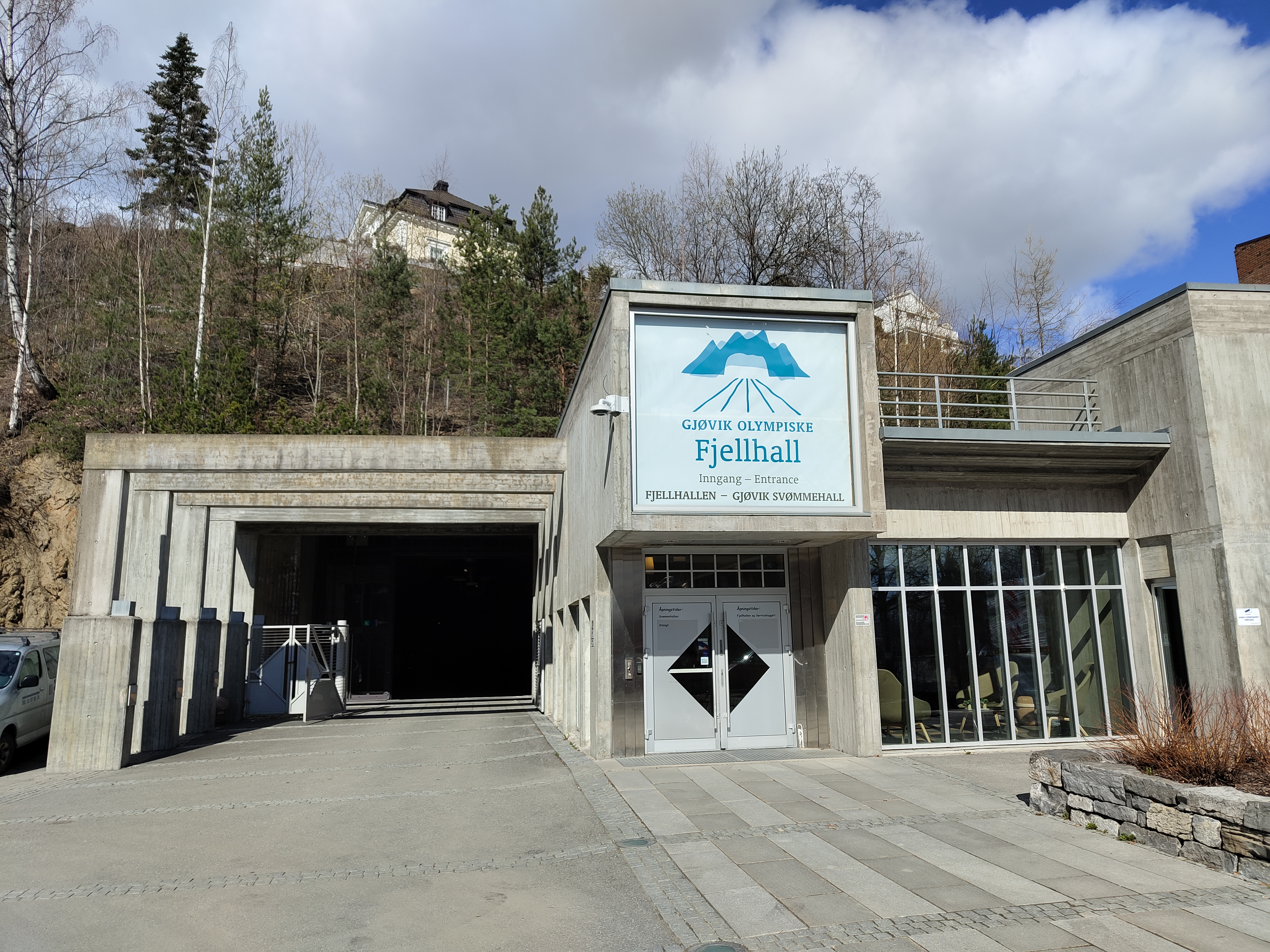
Gjøvik Olympic Cavern Hall
The idea was sketched on a napkin. In 1988, consulting engineer Jan A. Rygh sat at dinner with municipal engineer Helge Simenstad, who had just mentioned that Gjøvik had been awarded an ice rink for the upcoming Olympics. Rather than proposing another conventional arena, Rygh suggested something audacious: carve the rink directly into the mountain. That napkin sketch became the Gjøvik Olympic Cavern Hall, the world's largest cavern hall for public use, where 5,500 spectators watch ice hockey 120 meters inside solid bedrock.
A Nation That Builds Underground
Half of Norway's surface consists of exposed rock, and the country has long embraced that geology rather than fought it. Underground cavern halls serve as power plants, transport tunnels, storage facilities, and civil defense shelters across the nation. Gjøvik itself had opened Norway's first underground swimming pool back in 1974, so the leap from subterranean swimming to subterranean skating was less radical than it sounds. The advantages were practical and elegant: a cavern hall would not consume precious downtown property or mar the town's skyline, yet it would sit centrally enough to minimize travel costs. Most compellingly, the stable year-round temperature of the mountain's interior would slash the energy needed to maintain ice. Nature would do the cooling for free.
Blasting for the Olympics
The Norwegian Parliament approved funding in April 1990, and by January 1991 the municipal council had committed to the underground option. The main planning fell to Fortifikasjon, a firm with deep expertise in subterranean construction. Workers blasted and excavated their way into the hillside just west of Gjøvik's town center, creating a main hall covered by 25 to 55 meters of bedrock overhead. The project cost 134.6 million Norwegian krone, a figure that bought not just the arena but also a 25-meter swimming pool, a cafeteria, and a telecommunications installation later operated by Telenor. The cavern hall opened in 1993, just in time for the Lillehammer games, its ownership shared between the Olympic organizing committee and the municipality.
Olympic Ice and World Records
During the 1994 Winter Olympics, the cavern hosted 16 ice hockey matches between February 12 and 26, including two quarter-finals and a semi-final. The remaining games played at the larger Hakons Hall in nearby Lillehammer, but Gjøvik's underground rink drew attention for its sheer novelty. The following year brought an unexpected encore: the 1995 World Short Track Speed Skating Championships were relocated here from Hamar after scheduling conflicts with ice hockey playoffs. It remains the only time those world championships have been held in Norway, and the venue delivered spectacularly. Six world records fell during the competition, including Chae Ji-hoon's 4:56.29 in the men's 3,000 meters and Chun Lee-kyung's 5:02.18 in the women's equivalent.
Mountain Logic
After the Olympic flame moved on, the operators discovered that the mountain kept giving. In March 1995, they announced the ice would remain year-round, because the natural cooling of the surrounding rock made it economically absurd to melt it. The refrigeration system's waste heat was captured and recycled to warm the rest of the cavern, saving roughly 1,000 kilowatts in energy costs. The main hall, designed from the start as a multi-use venue, has hosted handball, basketball, volleyball, football, tennis, concerts, and trade events. The 1999 World Women's Handball Championship used it as one of seven group-stage venues, and the 2016 Winter Youth Olympics brought short track speed skating back to Gjøvik. Inside the mountain, the temperature stays constant, the acoustics stay crisp, and the rain stays outside. It is, in its quiet Norwegian way, a solution so logical it seems obvious in hindsight.
From the Air
Located at 60.79°N, 10.68°E on the western shore of Lake Mjøsa. The cavern hall entrance is just west of Gjøvik town center, but the facility itself is invisible from the air since it is entirely underground. Look for Gjøvik along the lake's western bank. Nearest airport is Oslo Gardermoen (ENGM), approximately 100 km southeast. Approach from above Lake Mjøsa at 3,000-5,000 feet for the best view of the town and its mountainous surroundings.