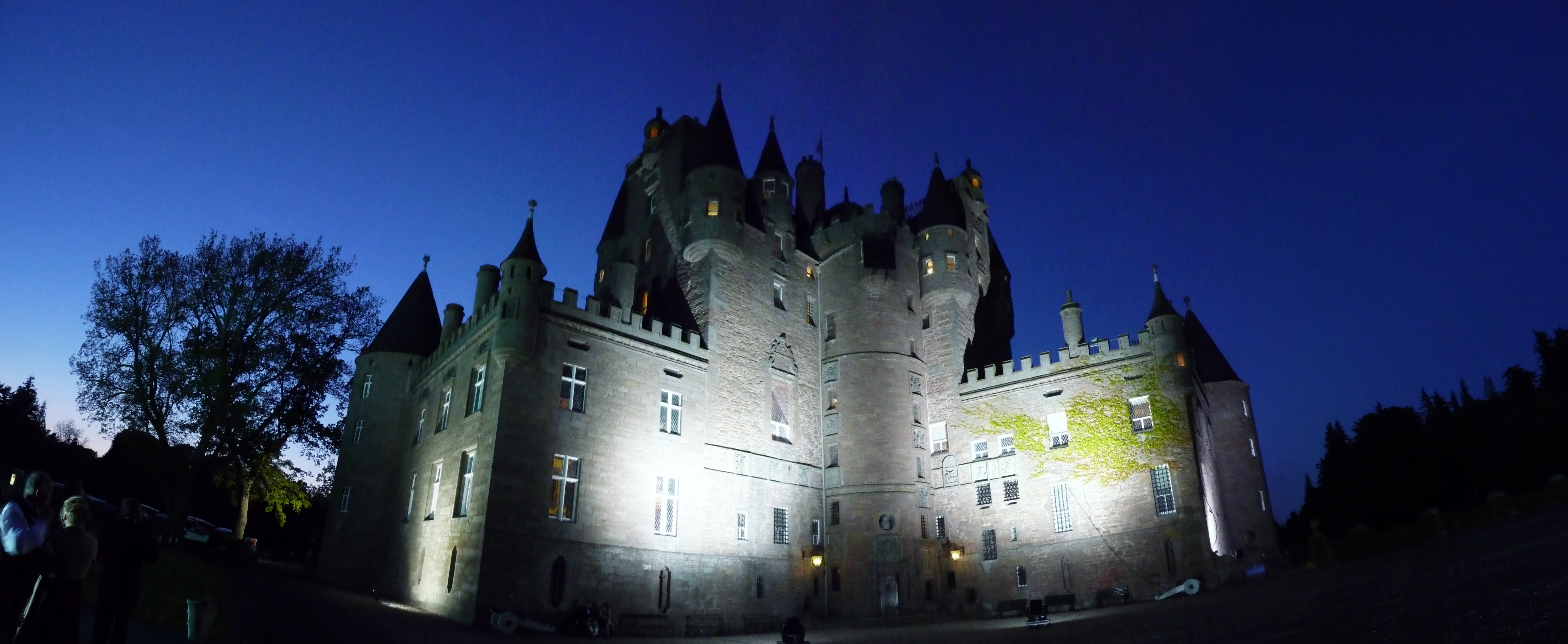
Glamis Castle
Every family has secrets. The Bowes-Lyons, Earls of Strathmore and Kinghorne, whose family seat is Glamis Castle in Angus, Scotland, have had theirs examined by outsiders for over a century and a half. The legend of the Monster of Glamis -- a hideously deformed child supposedly born to the family, kept hidden in a bricked-up room, and shown only to each successive Earl and his heir on the heir's twenty-first birthday -- has resisted every attempt at confirmation or debunking. Virginia Gabriel, the singer and composer who stayed at the castle in 1870, described strange sounds and an atmosphere of concealment. The family has never confirmed the story. They have never convincingly denied it either. The secret, if it was ever real, has been kept.
Murder and the Mists of Strathmore
Glamis Castle sits in the broad, fertile valley of Strathmore, between the Sidlaw Hills and the Grampian Mountains, about twenty kilometres inland from the North Sea. The estate covers more than fifty-seven square kilometres, and the castle itself -- its towers and turrets rising from well-kept grounds -- looks like the Platonic ideal of a Scottish castle, the image that springs to mind when the word is spoken. Shakespeare placed the murder of King Duncan here in Macbeth, though the historical Macbeth had no known connection to Glamis. The real murder at Glamis came earlier: in 1034, Malcolm II was mortally wounded in a nearby battle and brought to a royal hunting lodge on the site, where he died. The hunting lodge is long gone, but the association between Glamis and violent death was established a thousand years ago. The castle has been the home of the Lyon family since the fourteenth century, when Sir John Lyon, the Thane of Glamis, received the estate from Robert II. The title has been in the family ever since, evolving through the centuries into the Earldom of Strathmore and Kinghorne.
Ghosts, Gamblers, and the White Lady
No castle in Scotland carries more supernatural baggage than Glamis. The Monster is only the most famous of its legends. The tale of Earl Beardie -- a fifteenth-century lord who insisted on playing cards on the Sabbath, was warned to stop, declared he would play until doomsday or with the Devil himself, and was taken at his word by a stranger who appeared at the castle and condemned him to an eternity of card-playing -- is a fixture of Glamis lore. The White Lady, thought to be the ghost of Janet Douglas, Lady Glamis, who was burned at the stake on Edinburgh's Castle Hill in 1537 on charges of witchcraft brought by James V, is said to haunt the castle chapel. Tour guides point to a seat in the chapel that is kept permanently reserved for her, and no visitor is permitted to sit in it. Whether these stories are true in any factual sense is beside the point. They have accreted around the castle over centuries, becoming as much a part of its architecture as the stone walls and turret stairs. Glamis is a place that generates stories the way certain landscapes generate weather -- not because anything supernatural inhabits it, but because its age, its scale, and its deep family history create the conditions in which stories naturally form.
A Royal Childhood
Glamis Castle entered the modern consciousness primarily through its connection to the British royal family. Lady Elizabeth Bowes-Lyon grew up here, the ninth child of the fourteenth Earl of Strathmore and Kinghorne. She married Prince Albert, Duke of York, in 1923, and when he unexpectedly became King George VI in 1936 following his brother's abdication, she became Queen Consort -- known for the rest of her long life as the Queen Mother. Her second daughter, Princess Margaret, was born at Glamis Castle on August 21, 1930 -- the first royal birth in Scotland in over three hundred years. The castle's association with the Queen Mother, who died in 2002 at the age of 101, brought it sustained public attention and a steady stream of visitors. The building itself is largely seventeenth-century, though the architect Inigo Jones has traditionally been credited with aspects of its design -- Historic Scotland considers the King's Master Mason William Schaw a more likely candidate, given the traditionally Scottish character of the architecture.
Stones and Shadows
The approach to Glamis Castle is lined with four bronze statues placed in the seventeenth century: Charles I in boots, James VI in a stole, Charles II in Roman dress, and James VII as he appeared in his Whitehall portrait. The first two were sculpted by Arnold Quellin, and they stand as silent witnesses to the Stuart dynasty's long, complicated relationship with Scotland. Inside, the castle's small chapel seats forty-six people and remains in regular use for family functions, though the White Lady's seat stays empty. The clock tower houses the family archives, including a papal bull and the memoirs of Mary Eleanor Bowes, the eighteenth-century Countess whose life story inspired William Thackeray's Barry Lyndon. The estate surrounding the castle is a working landscape, producing lumber and beef alongside its gardens and arboretum. An arboretum overlooking the Glamis Burn contains trees from around the world, many of them rare and several hundred years old. Glamis Castle is currently the home of the nineteenth Earl of Strathmore and Kinghorne, who succeeded to the title in 2016. The Monster, if it ever existed, is long dead. The stories remain very much alive.
From the Air
Glamis Castle stands at 56.62°N, 3.00°W in the Strathmore valley in Angus, Scotland. The castle's distinctive towers and turrets are visible from the air, set in extensive grounds between the Sidlaw Hills and the Grampians. Forfar lies approximately 5 nm to the northeast, and Dundee approximately 12 nm to the south. Nearest airport: Dundee (EGPN) approximately 12 nm to the south.