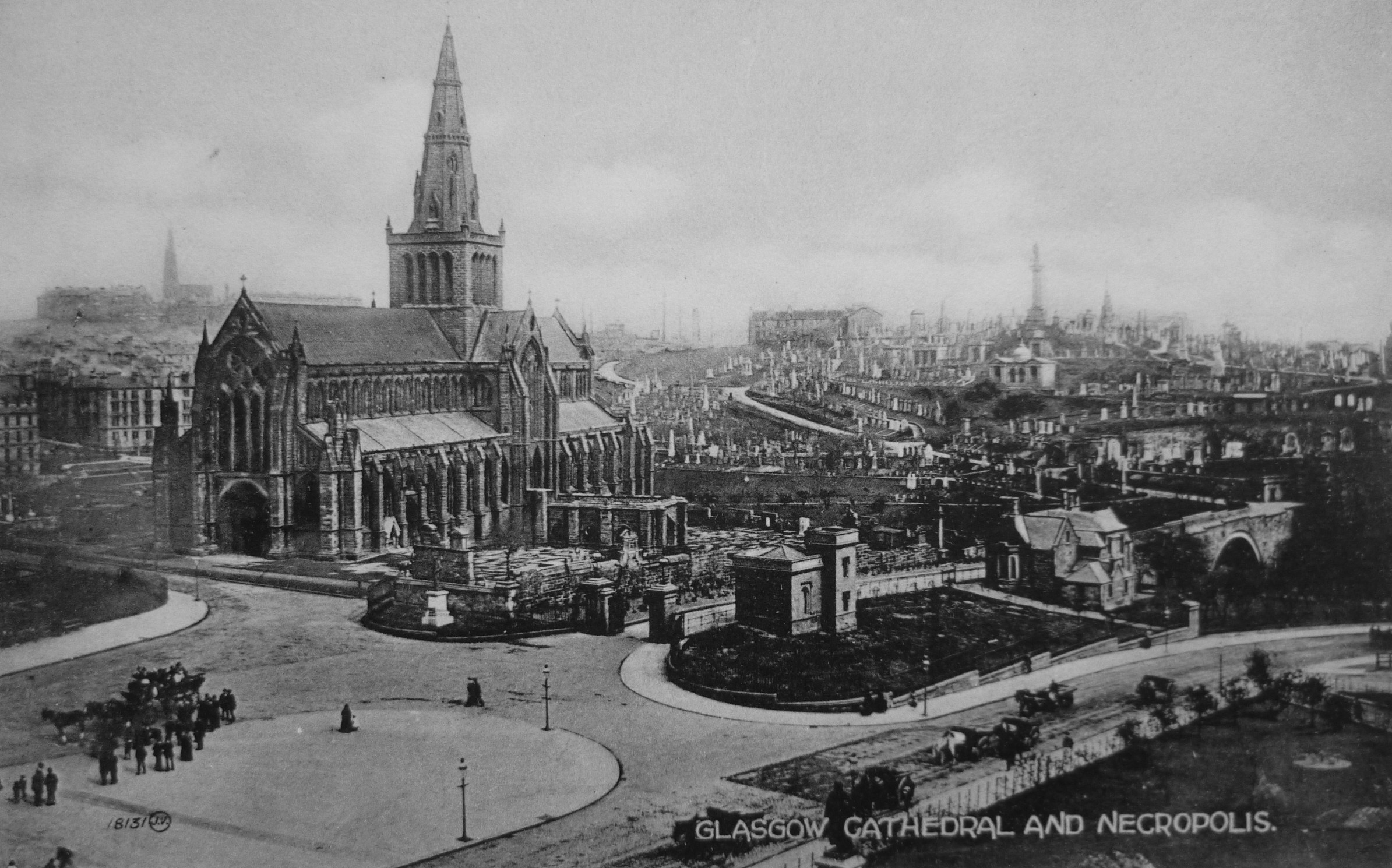
Glasgow Cathedral
In the 6th century, a man named Mungo carried the body of a holy man called Fergus to a burial ground on the western bank of the Molendinar Burn and built a monastic cell beside the grave. Fourteen centuries later, the cathedral that grew from that act of devotion still stands on the same hillside, making it the oldest building in Glasgow and one of only two medieval cathedrals in Scotland -- alongside St Magnus in Orkney -- to have survived the Reformation essentially intact.
The Hillside and the Saint
Glasgow Cathedral owes its unusual hillside location to the sanctity of the ground beneath it. The first stone cathedral was consecrated in 1136 in the presence of King David I, built directly over Mungo's burial place. The present building, dedicated in 1197 and substantially rebuilt in the 13th century, descends the steep western bank of the now-buried Molendinar Burn in two dramatic levels. The Lower Church, reached by descending into the hill, houses Mungo's tomb at its center. In the medieval period this shrine drew pilgrims from across Scotland, and in 1175 Pope Alexander III recognized Glasgow as 'a special daughter' of Rome, freeing the diocese from York's jurisdiction.
Warrior Bishops and a Stolen Crown
The cathedral's medieval history reads like a thriller. In 1164, after the defeat of the Norse-Gaelic warlord Somerled at the Battle of Renfrew, his severed head was brought to the cathedral. Edward I of England visited in 1301, making offerings at the high altar for four days during the Wars of Scottish Independence. When Robert the Bruce killed John Comyn at Greyfriars in Dumfries in 1306, he rushed to Glasgow Cathedral, where Bishop Robert Wishart granted him absolution, rallied the Scottish clergy, and then -- in a magnificent act of defiance -- used timber the English had provided for repairing the bell tower to construct siege engines instead. Wishart's defaced tomb effigy still lies in the Lower Church.
Surviving the Reformation
When the Scottish Reformation swept through in 1560, Archbishop James Beaton fled to France with the diocesan records, and the cathedral was stripped of its Catholic furnishings. Lead was torn from the roof. By 1574, the town council acknowledged the building was in such "greit dekaye and ruyne" that it might collapse entirely. But unlike most Scottish cathedrals, which were reduced to ruins, Glasgow's was saved -- partly because the town needed it for Protestant worship, and partly through sheer civic stubbornness. A £200 tax was raised for repairs, and the building limped through centuries of neglect until a 19th-century appreciation of its architectural significance brought proper restoration.
Tobacco Lords and Troubling Legacies
The 18th and 19th centuries brought Glasgow's mercantile wealth into the cathedral. Memorials to the city's Tobacco Lords were erected in the building, including those honoring Alexander Spiers of Elderslie and Sir James Stirling of Keir, both of whom owned enslaved people in the West Indies. Cecilia Douglas, another enslaver, commissioned a stained glass window to preserve her family's legacy; it has since been removed. The cathedral's entanglement with the profits of slavery is part of Glasgow's broader reckoning with a trade that brought enormous wealth to the city at an enormous human cost.
Where Glasgow Gathers
Glasgow Cathedral remains a place where the city marks its most significant moments. In 1971, a memorial service was held for the 66 who died in the Ibrox disaster. First Minister Donald Dewar's funeral took place here in 2000. Elizabeth II attended jubilee services in 1977 and 2012. The distinctive green copper roof, installed between 1909 and 1912 when the original medieval timber was found to be unsafe, makes the building instantly recognizable from the air. Beside it, the Victorian Necropolis climbs the adjacent hill in a forest of ornate monuments, the dead of industrial Glasgow looking down upon the living cathedral of their patron saint.
From the Air
Glasgow Cathedral sits at 55.86°N, 4.23°W on a hillside in the Townhead area of central Glasgow. The distinctive green copper roof is visible from the air, with the Glasgow Necropolis rising on the hill immediately to the east. Glasgow Royal Infirmary lies adjacent. Nearest airport: Glasgow International (EGPF, 7 nm west). The cathedral is approximately 1 nm northeast of George Square. The River Clyde runs 0.5 nm to the south.