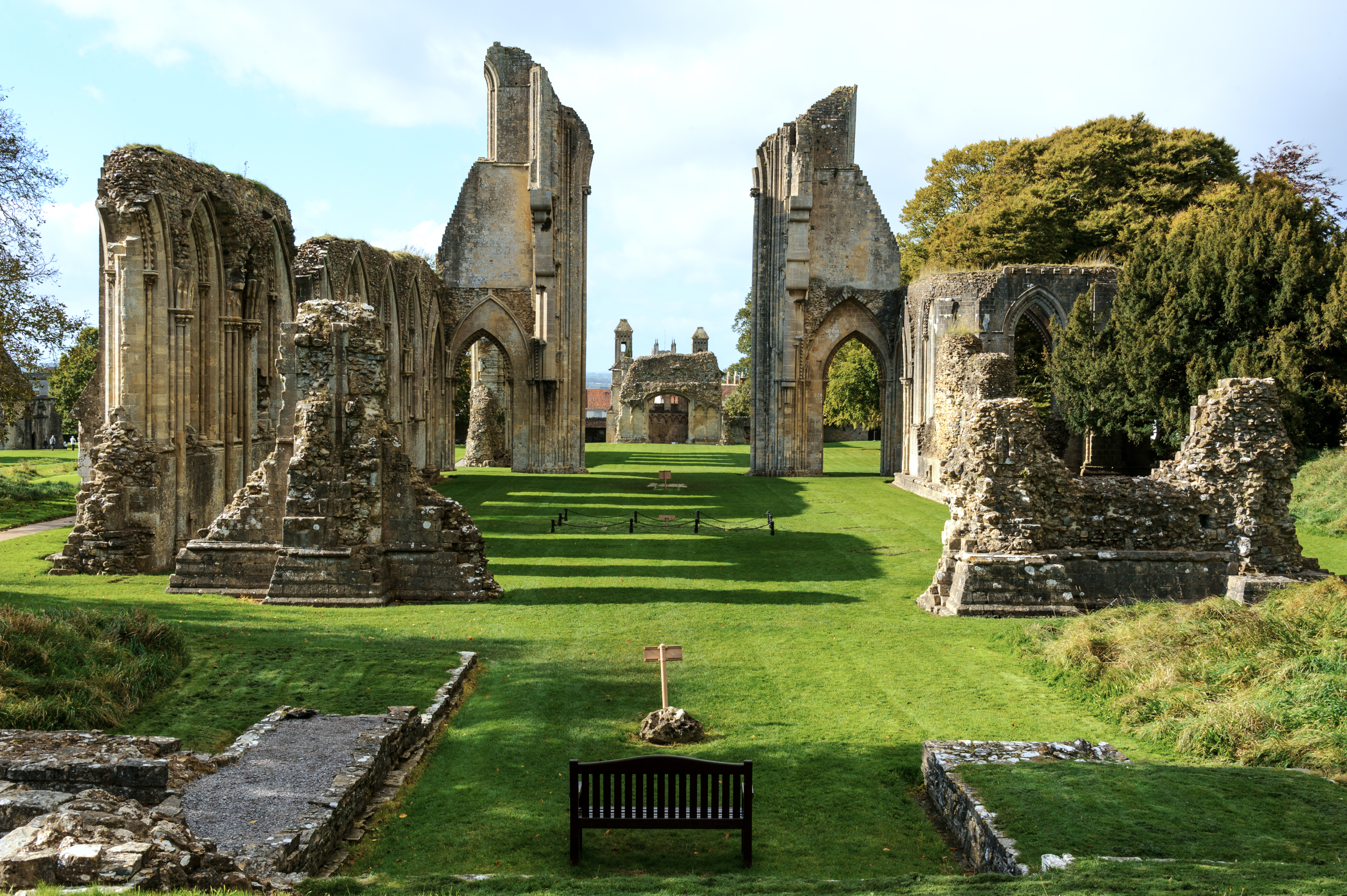
Glastonbury Abbey
In 1191, the monks of Glastonbury Abbey announced that they had found the tomb of King Arthur and Queen Guinevere. The timing was convenient. A catastrophic fire had destroyed much of the abbey in 1184, and the discovery of England's most legendary monarch -- buried on their own grounds -- generated the pilgrimage traffic and donations needed to rebuild. Whether the bones were genuine has been debated for eight centuries. What is certain is that the monks understood something about the power of story, and Glastonbury has been trading on legends ever since.
The Oldest Story
Christian legends claim that Joseph of Arimathea, the man who donated his tomb for Christ's burial, founded a church at Glastonbury in the first century AD. There is no archaeological evidence to support this, but the claim gave the abbey an origin story older than any other Christian foundation in Britain. The earliest reliable record of a church here dates to a charter of 766. The Saxon monastery grew steadily, and when the Diocese of Sherborne was divided in 909, Glastonbury's influence expanded across the Somerset Levels. By the tenth century, under the reforming abbot Dunstan, later Archbishop of Canterbury, the abbey had become one of the most important religious houses in England.
Wealth Beyond Measure
By the fourteenth century, Glastonbury was the richest monastery in England. The abbey controlled vast tracts of surrounding land and was instrumental in the drainage of the Somerset Levels, engineering the landscape to create productive farmland. The Great Church, rebuilt after the 1184 fire, stretched over 550 feet and was one of the longest in England. The Lady Chapel, the first section to be rebuilt, still stands in ruin and is considered a masterpiece of transitional Norman-Gothic architecture. The abbey's wealth attracted not only pilgrims but royal attention. Kings visited. Popes granted privileges. The community grew to include a significant scriptorium and library.
The Abbot on the Tor
Henry VIII's Dissolution of the Monasteries reached Glastonbury in 1539. The last abbot, Richard Whiting, was an elderly man who had governed the community quietly for more than two decades. When he resisted surrendering the abbey's treasures, he was arrested, subjected to a show trial at Wells, and dragged to the summit of Glastonbury Tor. There he was hanged, drawn, and quartered, his head fixed to the abbey gate and his body parts displayed across Somerset. He was in his late seventies. The abbey's lands and wealth were seized by the Crown, the buildings stripped of lead and valuables, and the great church left to decay. Whiting's execution was meant as a warning. It became, instead, a symbol of the brutality of the Dissolution.
Avalon Endures
The medieval monks' assertion that Glastonbury was Avalon, the mythical island where Arthur was taken after his final battle, proved more durable than any stone building. A marker in the abbey grounds identifies the spot where the supposed royal grave was found, and visitors still pause there. The ruins themselves possess a stark beauty: broken arches rising from manicured lawns, fragments of wall tracing the outline of what was once the longest church in England. The abbey is now a Grade I listed building and scheduled ancient monument, open as a visitor attraction. The legends have never stopped accumulating. New Age associations with ley lines and earth energies have layered onto the Arthurian and Christian traditions, making Glastonbury a palimpsest of belief stretching across two millennia.
From the Air
Located at 51.147N, 2.715W in the town of Glastonbury, Somerset. The abbey ruins are visible within a large walled precinct in the town centre. Glastonbury Tor, with its distinctive tower, rises prominently nearby and serves as an excellent visual reference. Nearest airports: Bristol (EGGD) approximately 20nm north, Exeter (EGTE) approximately 35nm southwest. Best viewed from 2,000-3,000ft.