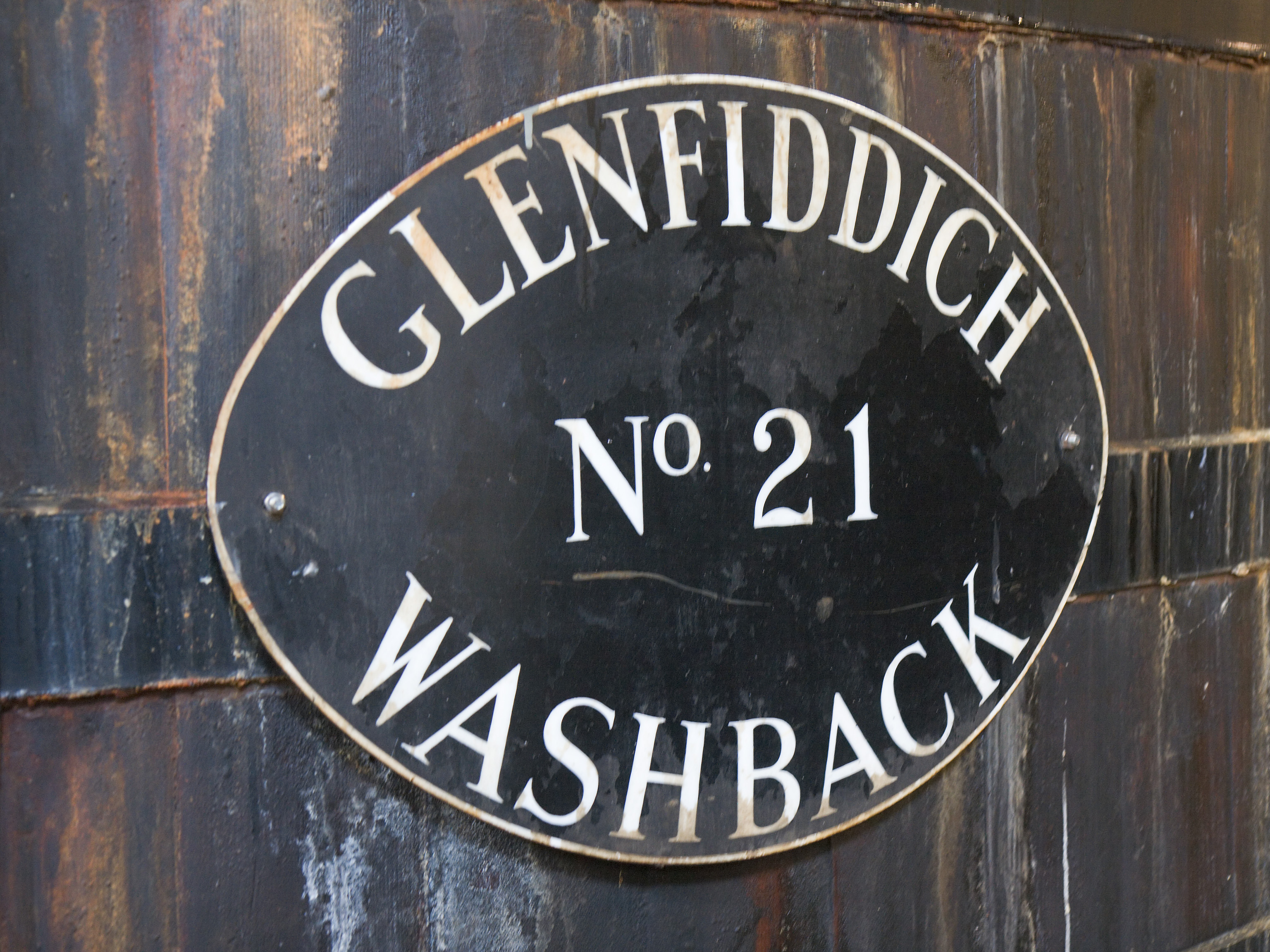
Glenfiddich
On Christmas Day 1887, spirit ran from the copper stills of a new distillery in the glen of the River Fiddich for the first time. William Grant had spent twenty years learning the whisky trade at other distilleries before building his own with his seven sons and two daughters, stone by stone, in the town of Dufftown. The name he chose, Glenfiddich, comes from the Scottish Gaelic Gleann Fhiodhaich -- "valley of the deer" -- and the stag that once roamed these Speyside hills still watches from the label of every bottle. What Grant started as a family enterprise remains one: five generations later, his descendants still run the operation, and Glenfiddich is now sold in 180 countries as the world's best-selling single malt.
A Contrarian's Bet
Grant's timing looked eccentric more than once. When American Prohibition shut down the whisky export market in the 1920s, most Scottish distillers scaled back. Glenfiddich did the opposite, ramping up production while barrels were cheap and warehouses plentiful. The gamble paid handsomely when Prohibition was repealed and a thirsty American market found Glenfiddich sitting on deep reserves of well-aged spirit. Decades later, in 1963, the family made another bold move: they began marketing Glenfiddich as a standalone single malt at a time when blended Scotch dominated the market. It was effectively the birth of the modern single malt category, and the triangular bottle -- designed by Hans Schleger in 1956 -- became its icon.
Forty-Three Swan Necks
Inside the distillery, 43 distinctively shaped copper pot stills stand in rows, their swan-neck curves smaller than those at most major competitors. The distillery insists on this specific shape because even a minor change in dimensions alters the character of the spirit. To keep the stills identical, Glenfiddich employs its own team of coppersmiths on-site -- a rarity in the modern industry. The water feeding the process flows from the nearby Robbie Dhu springs, and after years of maturation in casks sourced from Caribbean rum producers, American bourbon distillers, and Spanish sherry bodegas in Jerez de la Frontera, the whisky is cut with that same spring water before bottling. A cooperage on the grounds, one of the last remaining at a working distillery, maintains the oak casks that give each expression its colour and flavour.
Dufftown and the Whisky Trail
Dufftown bills itself as the Malt Whisky Capital of the World, and Glenfiddich is its flagship attraction. The distillery sits on Scotland's Malt Whisky Trail, a tourism route linking seven working Speyside distilleries, the Speyside Cooperage, and the historic Dallas Dhu distillery, now preserved as a museum. Visitors to Glenfiddich can see the old pagoda-roofed maltings, walk the still halls, and learn how the distillery has converted whisky waste into biogas that now powers its delivery trucks. Since 2002, an Artists in Residence programme has brought painters, sculptors, and other creatives to live and work among the warehouses, adding a cultural layer to a place that might otherwise be defined entirely by its liquid output.
The Dram That Travelled
Glenfiddich's reach extends well beyond Speyside. The 15-year Solera Reserve earned three double-gold medals at the San Francisco World Spirits Competition between 2007 and 2010. Inspector Morse, the fictional Oxford detective, drank it; Don Cheadle's character in Hotel Rwanda used bottles of it as bribes to survive genocide. It appears in the bars of the Yakuza video game series. In 2014, the family acquired Drambuie, the honey-and-herb whisky liqueur, for a sum rumoured near 100 million pounds. Through all these expansions, the Grant family has resisted selling the business. That stubbornness -- building when others retreated, keeping the stills small when others went large, staying independent when consolidation swept the industry -- is as much a part of Glenfiddich's character as the water from the Robbie Dhu springs.
From the Air
Located at 57.455N, 3.131W in the heart of Speyside, Moray. Best viewed at 3,000-5,000 ft AGL. The distillery complex and its pagoda roofs are visible along the River Fiddich valley near Dufftown. Nearest airport: RAF Lossiemouth (EGQS) approximately 15 nm north. Inverness Airport (EGPE) lies 40 nm to the west.