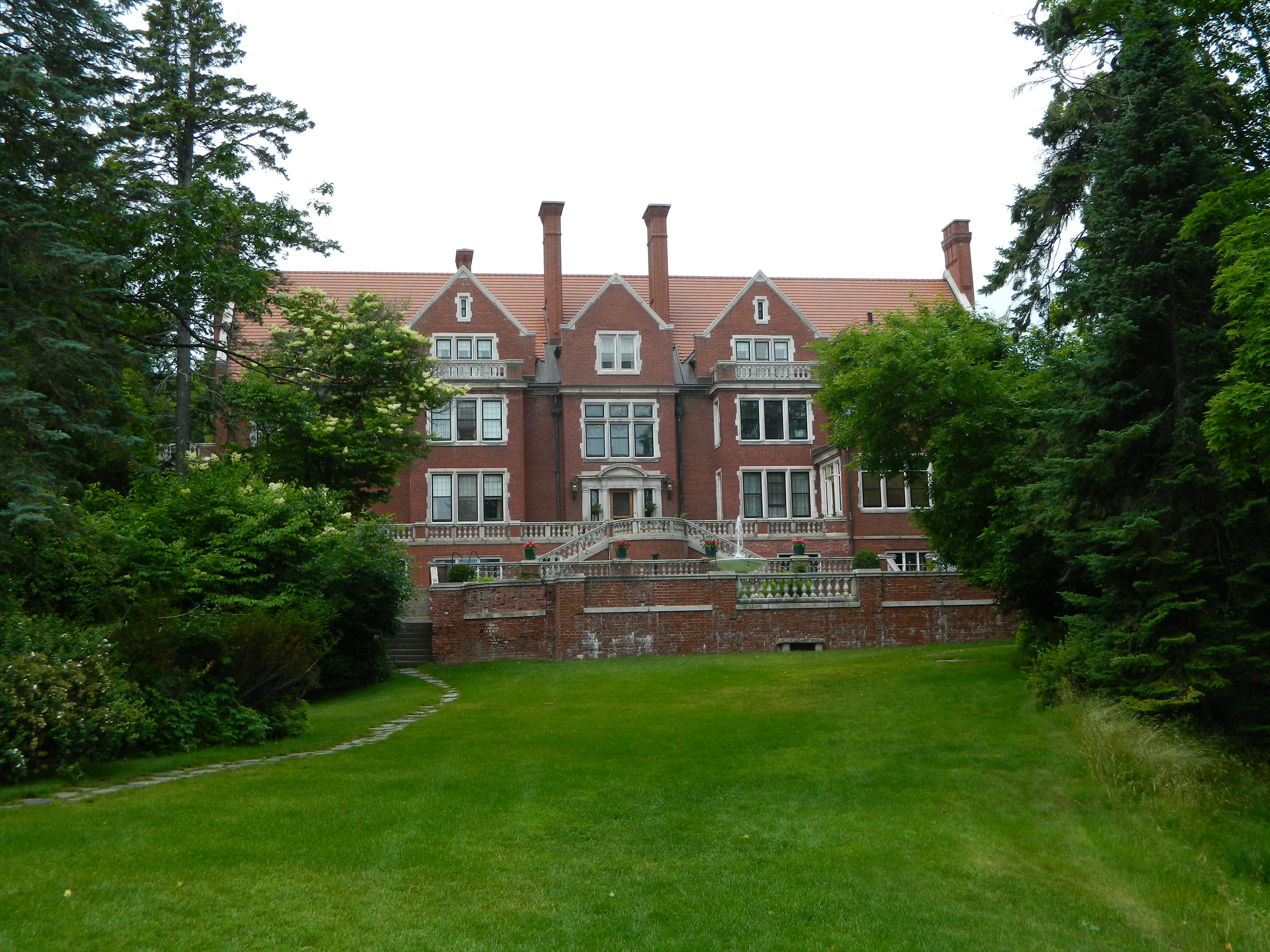
Glensheen Historic Estate
The satin pillow still haunts the imagination. On the night of June 27, 1977, someone crept through this 39-room lakeside mansion, bludgeoned a nurse to death with a brass candlestick on the grand staircase, then climbed to the second floor and smothered 83-year-old Elisabeth Congdon in her bed. The murders at Glensheen became Minnesota's most sensational crime -- and transformed a gilded Duluth estate into something far more complicated than its architect ever intended. Today, Glensheen sits on 12 acres of Lake Superior waterfront, its Jacobean gables and formal gardens immaculate, drawing visitors who come for the craftsmanship and stay for the story.
The Mansion That Mining Built
Chester Adgate Congdon arrived in Duluth as an attorney and made his fortune through iron ore. Working as a lawyer for the Oliver Mining Company, he purchased cheap mining land on the western Mesabi Range, then profited enormously by leasing it to U.S. Steel as demand for ore surged. In six years, the value of his stock rose 555 percent. By the early 1900s, Congdon was one of the wealthiest men in Minnesota. In 1905, he began building a home befitting that fortune on the shore of Lake Superior. Architect Clarence H. Johnston Sr. designed the 20,000-square-foot mansion in the Jacobean revival style, with battered Tuscan columns flanking the entrance, leaded art glass sidelights, and a south-facing winter garden stretching nearly the full length of the ground floor. William A. French Co. designed the interiors, while the Charles Wellford Leavitt firm of New York laid out the formal terraced gardens. When completed in 1908, the estate had cost $854,000 -- more than $22 million in today's dollars.
Thirty-Nine Rooms and a Boathouse
Glensheen is not simply a house but a self-contained world. Beyond the main mansion's 39 rooms -- 15 of them bedrooms -- the estate includes a Carriage House, a Gardener's Cottage, and a Boathouse perched directly on Lake Superior. The grounds were designed in the English landscape tradition, with terraced gardens stepping down toward the water. Chester Congdon also donated funds for Duluth to purchase the lakeshore land for what became Congdon Boulevard, a scenic road running along Lake Superior's north shore from the Lester River to Stony Point, on the condition that the shoreline would never be developed. He served as a Minnesota state representative from 1909 to 1913, but it is the estate and the family name that endured long after his death in 1916.
A Night in June
Elisabeth Congdon, Chester's youngest daughter, was given a life estate when the family transferred Glensheen to the University of Minnesota Duluth in 1968, allowing her to live there until her death. That death came violently. Roger Caldwell, the second husband of Elisabeth's adopted daughter Marjorie, was convicted of two counts of first-degree murder for killing Elisabeth and her night nurse Velma Pietila. Pietila was found bludgeoned on the grand staircase; Elisabeth was discovered smothered in her bedroom. Marjorie stood to inherit $8 million upon her mother's death. She was charged with conspiracy but acquitted. Caldwell's conviction was overturned in 1982 by the Minnesota Supreme Court, but rather than face retrial, he pleaded guilty and submitted a full confession. Released from prison, he took his own life in 1988. Marjorie was later twice convicted of arson and once wanted for bigamy in North Dakota.
From Crime Scene to Cultural Landmark
Two years after the murders, in 1979, the mansion opened to the public as a historic house museum. For years, the third floor and attic remained closed due to safety concerns over limited access, but both opened to small group tours in 1992. The estate is listed on the National Register of Historic Places and is now one of Minnesota's most visited historic homes. The murders have never fully separated from the architecture. A 2015 musical titled Glensheen, created by Jeffrey Hatcher and Chan Poling, dramatized the crime. Multiple television programs have featured the story. The 1972 film You'll Like My Mother, starring Patty Duke and Richard Thomas, was shot at Glensheen five years before the real violence occurred -- a coincidence that only deepened the mansion's gothic reputation. Today, the University of Minnesota Duluth operates the estate, and visitors walk the same staircase, through the same rooms, past the same leaded glass, where fortune and tragedy once collided.
From the Air
Located at 46.815N, 92.052W on the Lake Superior shoreline in east Duluth, Minnesota. The estate sits on a 12-acre waterfront parcel visible from low-altitude approaches along the lakeshore. Duluth International Airport (KDLH) is approximately 7 miles northwest. The mansion's formal gardens and boathouse are identifiable from 3,000-5,000 feet AGL when following the shoreline. Lake Superior's western tip provides a dramatic backdrop. Congdon Boulevard runs along the shore nearby. Range Regional Airport (KHIB) in Hibbing is 65 miles to the northwest. Best viewed on approaches from over Lake Superior heading west toward the Duluth hillside.