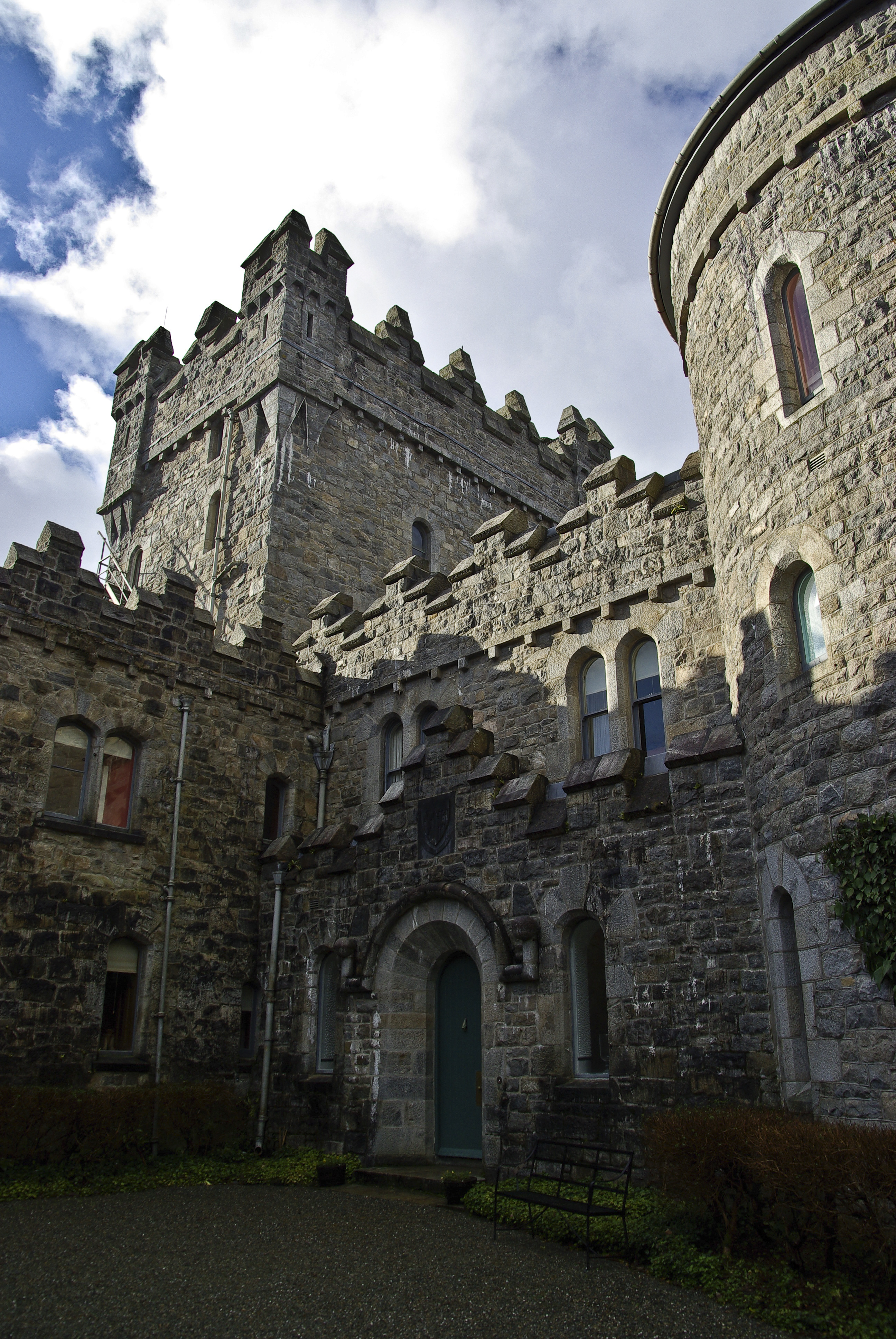
Glenveagh Castle
Local tradition holds that a curse was placed on Glenveagh Castle: that none of its owners would produce an heir. True or not, the curse has held. The castle has passed from hand to hand since the 1870s, each owner leaving it childless, each drawn by the same extraordinary setting -- a four-story Scottish baronial keep rising from the shores of a glacial lough, backed by 40,000 acres of mountains, birch glens, and red deer. The Irish name, Gleann Bheatha, means "Glen of the Birch Trees." It is one of the most beautiful and troubled estates in Ireland.
The Landlord Who Cleared the Glen
Captain John George Adair was a man of County Laois who made his fortune through speculative land deals in the American West. He purchased the Glenveagh and Gartan estates in 1859, assembling 28,000 acres of Donegal wilderness. His ambition was to build an estate that would surpass Balmoral, Queen Victoria's Scottish retreat. He married Cornelia Wadsworth Ritchie, the daughter of a Union general killed in the American Civil War, and together they began constructing the castle between 1867 and 1873. But Adair's name in Donegal carries no affection. In April 1861, following a dispute over shooting rights that had escalated into the murder of his Scottish steward, Adair made good on his threat to evict his tenants. A cortege of 200 police, magistrates, and the sub-sheriff set out from Letterkenny. Over three days they cleared 44 families -- 244 people -- from their homes, beginning with a widow and her seven children at Lough Barra. It was not done for financial necessity, but to improve the aesthetic view from the castle windows.
Exile and Memory
The evicted families scattered. Some went to the workhouse in Letterkenny. Others were helped by local clergy who raised funds. In Australia, the Donegal Relief Fund was revived, arranging passage for young people between the ages of sixteen and twenty-eight. Many settled in Sydney, where the strong oral tradition of Donegal ensured that their descendants would remember exactly why their families had crossed the world. These tenant clearances, known as the Derryveagh Evictions, entered ballad and folklore. Adair died in 1885, his legacy one of notoriety. His widow Cornelia proved to be his opposite -- popular, considerate of the townspeople, devoted to the beauty of the castle grounds. She entertained the Duke of Connaught and his wife in 1902. But the Adairs left no children.
The Professor Who Disappeared
In 1929, Harvard professor Arthur Kingsley Porter purchased Glenveagh from the Adair estate. A renowned art historian, Porter used the castle as a second home, filling it with his significant collection and entertaining guests amid the Donegal wilderness. He also built a fishing cottage on Inishbofin Island, off the Donegal coast. On 8 July 1933, Porter walked out to the island and was never seen again. His disappearance remains one of Ireland's enduring mysteries -- no body was recovered, and theories have ranged from accident to deliberate vanishing. His widow Lucy sold the estate to Henry Plumer McIlhenny of Philadelphia, a friend and former student of Porter's at Harvard. The curse, it seemed, had struck again.
The Gift to Ireland
McIlhenny, a Philadelphia art collector whose family fortune derived from the manufacture of gas meters and industrial appliances, purchased the estate in 1938 after renting it since 1933. He poured decades of love into the gardens and castle, making Glenveagh one of Ireland's great private estates. Then, in the 1970s, he did something remarkable: he gave the castle and its grounds to the Irish nation, enabling the creation of Glenveagh National Park. McIlhenny continued to use the castle as a part-time residence until 1982, but the land that Adair had cleared of its people now belonged to all of them. Today, visitors walk through the castle's rooms and its celebrated gardens, set against a backdrop of mountains and lough that has not changed since the birch trees gave the valley its name.
From the Air
Located at 55.03N, 7.97W in the heart of County Donegal, Ireland, within Glenveagh National Park. The castle sits on the shore of Lough Veagh, surrounded by mountainous terrain reaching over 2,000 feet. Best viewed at lower altitudes -- the castle and lough are distinctive from the air. Nearest airport is Donegal Airport (EIDL), approximately 25 km west. Letterkenny (EILN) lies about 20 km east. The surrounding park covers over 40,000 acres of protected wilderness.