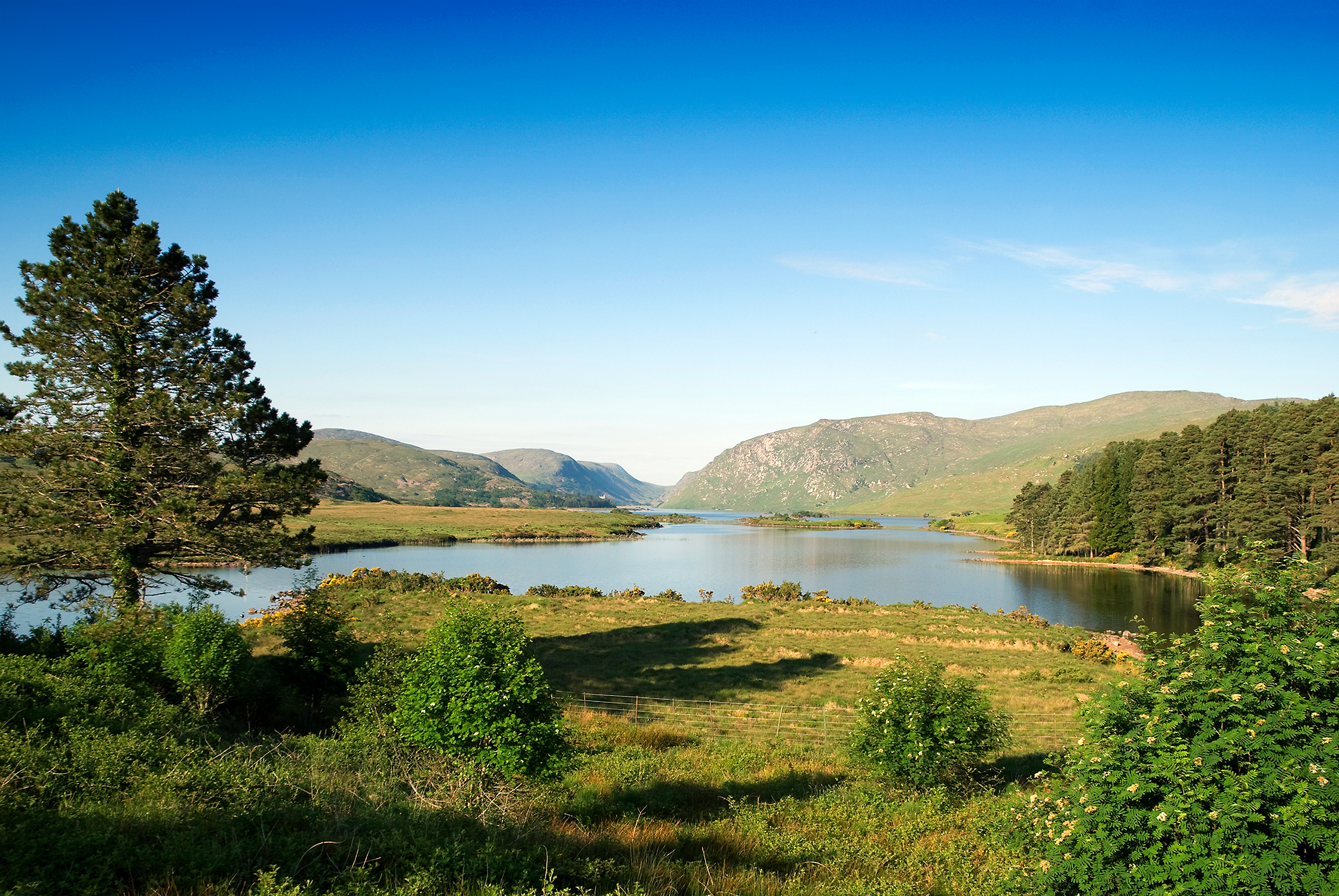
Glenveagh National Park
Over two bleak days in April 1861, a landlord named John George Adair evicted eighty-five tenants and their one hundred and fifty-nine children from their homes in this remote Donegal valley, then had the buildings destroyed. "Black Jack," as he became known, had bought several bankrupt estates after the Great Famine and combined them into Glenveagh. Now he wanted the people gone so he could build a castle to rival Balmoral and hunt deer across the empty mountains. The castle he built still stands, its gardens immaculate, its turrets reflected in the still waters of Lough Beagh. Glenveagh National Park is 170 square kilometres of beauty owed, in significant part, to cruelty.
Four Hundred Million Years in the Making
The valley itself is far older than any human drama. The Great Glen Fault cracked across Highland Scotland and Donegal four hundred million years ago when continents collided. The Donegal section, called the Leannan Fault, sliced through the granite Derryveagh Mountains, creating a line of weakness that glaciers would later exploit. During the last Ice Age, about 25,000 years ago, Donegal was among the last places in Ireland to shed its ice sheet, remaining frozen until roughly 14,000 years ago and inhospitable tundra for three thousand years after that. When the land finally warmed, forests of oak blanketed the valley -- oak, which in Irish is doire, the root of "Derry." The U-shaped glen that resulted, with Lough Beagh stretching 6.5 kilometres along its floor, is textbook glaciology: steep-sided, flat-bottomed, carved by ice into the shape that makes it beautiful.
Black Jack's Castle
Adair, from Laois, had made his fortune in North American land speculation. From 1857, he bought up distressed Donegal estates and consolidated them into Glenveagh. When his steward was murdered -- a consequence of his conflicts with tenants -- Adair retaliated with the mass eviction of 1861. Many of those displaced emigrated to Australia with charitable assistance; others ended up in the workhouse. How many died is not recorded. Glenveagh Castle was built between 1870 and 1873 in baronial style, a four-storey rectangular keep designed to look medieval without actually being so. Adair married the wealthy American widow Cornelia Wadsworth Ritchie and established the JA Ranch in the Texas panhandle, where he proved as inept a huntsman as he was ruthless a landlord -- he once shot his own horse instead of a buffalo. He died in 1885. Cornelia, remembered as kind and generous, continued developing the estate until her death in 1921.
The Archaeologist, the Collector, and the State
Glenveagh's next owner, from 1929, was Arthur Kingsley Porter of Harvard, a dashing archaeologist who disappeared from the nearby island of Inishbofin in 1933. Stormy seas were the likely explanation, but his reputation ensured the mystery was inflated. From 1937, the estate passed to Henry Plummer McIlhenny of Philadelphia, whose family had roots in Donegal. McIlhenny was a renowned art collector who lavished attention on the castle and its gardens, expanding them to over eleven hectares of themed plantings. He sold much of the estate to the Irish government in 1975 to enable creation of a National Park, and donated the castle and gardens in 1981. The park, established officially in 1984 as the third of Ireland's six national parks, has grown through subsequent purchases to its current 170 square kilometres.
Where Eagles Return
The golden eagle was hunted to extinction in Ireland by 1912. In 2001, a reintroduction programme released birds into Glenveagh, and by 2007, the first native-born eagle hatched and took flight. Progress has been slow: as of recent counts, approximately thirty golden eagles range across Ireland, far short of the sixty needed for a minimum viable population. They remain red-listed, but the trajectory is encouraging. The park also supports red deer herds that move between high ground and valley with the seasons, as well as meadow pipits, stonechats, grouse, ravens, peregrines, and merlins on the uplands. Woodland birds include siskins, treecreepers, and crossbills. The peat bogs to the west sustain curlew, dunlin, and migratory geese. Cars are not permitted beyond the visitor centre; a shuttle bus carries visitors the 3.5 kilometres to the castle, or you can walk in forty minutes through a landscape where the contrast between the manicured gardens and the wild crags beyond them is sudden and complete.
From the Air
Located at 55.01°N, 7.99°W in the Derryveagh Mountains of County Donegal, Republic of Ireland. The park's centrepiece, Lough Beagh, stretches 6.5 km through a distinctive U-shaped glacial valley visible from altitude. Errigal (751 m), Donegal's highest peak, rises to the southwest just beyond the park boundary. Donegal Airport (EIDL) is approximately 30 km to the northwest on the coast. Letterkenny, the nearest town, lies 24 km to the southeast. The park's remote mountain terrain and frequent low cloud require caution at lower altitudes.