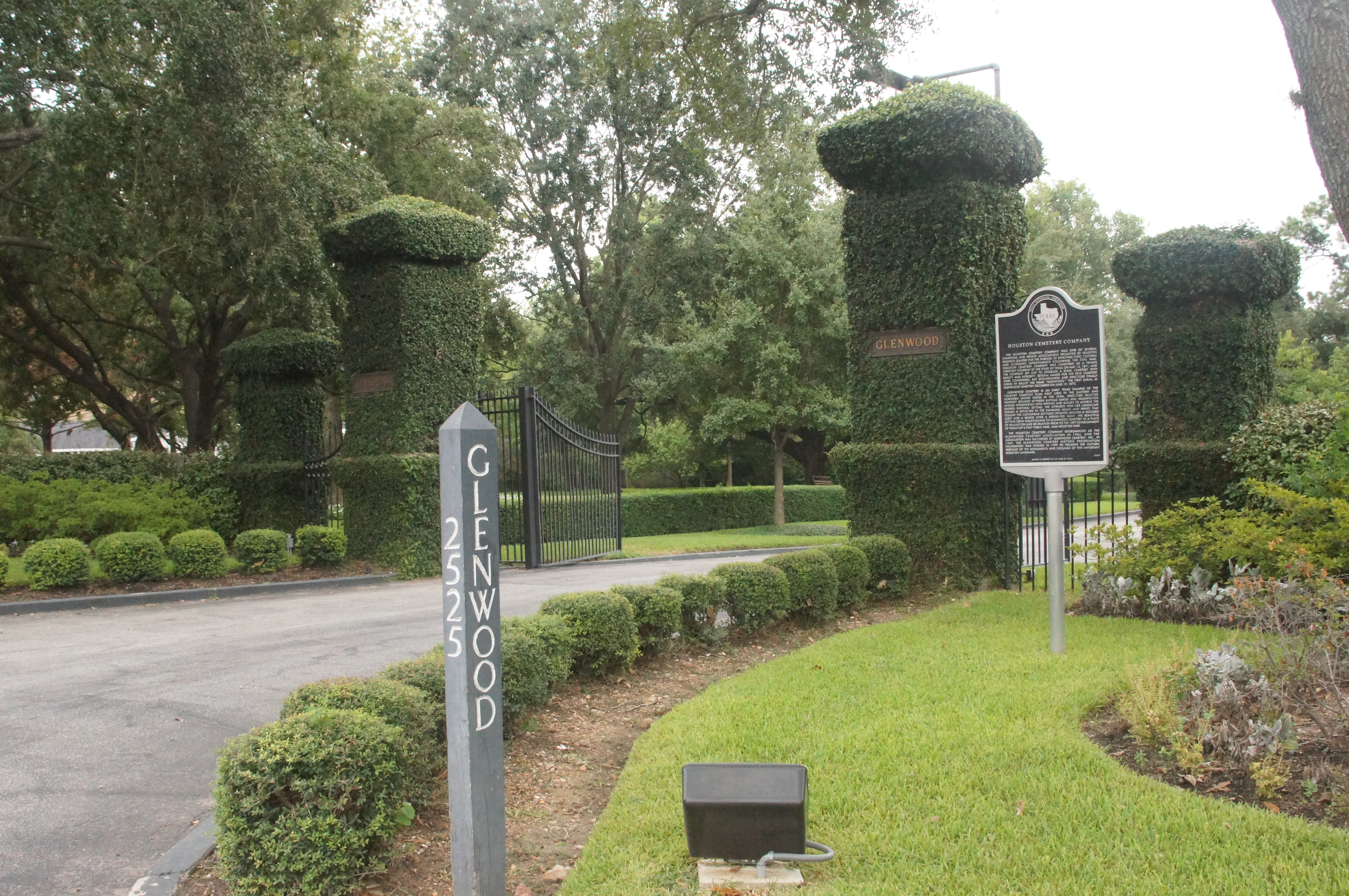
Glenwood Cemetery
They called it the River Oaks of the dead, and the comparison holds. In Houston, where oil money and political power shaped the twentieth century, Glenwood Cemetery became the one address that truly mattered - the place where the city's founders, governors, wildcatters, and visionaries ended up side by side, their monuments rising from the wooded bluffs above Buffalo Bayou. Opened in 1871 as Houston's first professionally designed cemetery, Glenwood broke from the rigid gridiron layouts that dominated the city's burial grounds, opting instead for the rolling, garden-style landscapes popular in the great Victorian cemeteries of the East Coast. The result was so appealing that by the 1880s, Houstonians were riding mule-drawn streetcars out to Washington Avenue not to mourn but to picnic among the headstones.
A Garden for the Eternal
Glenwood Cemetery took shape on two tracts of land on the north bank of Buffalo Bayou, west of downtown Houston. Part of this ground once belonged to Archibald Wynns, a lawyer and congressman for the Republic of Texas, and later served as a brickyard before William Harrison King - himself a mayor of Houston - held the property. In 1870, Alfred Whitaker secured a charter for the Houston Cemetery Company and used his own landscaping expertise to clear lots, grade rights of way, and coax beauty from the raw Texas terrain. The first burial took place on June 19, 1872. Unlike Houston's other cemeteries with their regimented rows, Glenwood embraced curving paths, deep ravines running to the bayou, formal plantings beneath towering hardwoods, and a diversity of statues and monuments that gave the grounds the character of a sculpture garden. Parts of the property still offer unobstructed views of the downtown Houston skyline, a juxtaposition of the living city and its most storied resting place.
Republic, Revolution, and Reconstruction
The graves at Glenwood read like a roll call of Texas history. Anson Jones, the last president of the Republic of Texas, lies here - a man whose political career ended so bitterly that he took his own life at the Capitol Hotel. His wife, Mary Smith Jones, the first lady of the Republic, survived him by decades. Charlotte Baldwin Allen, wife of Houston's co-founder Augustus Chapman Allen, rests beneath a large monument; her daughter Eliza was once celebrated as the first child born in Houston. William Robinson Baker, who arrived in 1837 to work for the Houston Town Company and later became mayor, is buried beside his wife. Two Reconstruction-era mayors, Joseph Robert Morris and Thomas Howe Scanlan, are interred here as well. Roy Hofheinz, the Harris County judge and mayor who built the Astrodome, also made Glenwood his final address. The Republic of Texas graves are marked with metal markers and frequently adorned with the Lone Star flag.
Oil, Steel, and the Tools That Built Spindletop
Houston's oil fortunes are well represented beneath Glenwood's canopy. Walter Benona Sharp, whose innovations in mud drilling helped unlock the legendary Spindletop field, has a family plot here. He co-founded Sharp-Hughes Tool Company with Howard R. Hughes Sr., who rests nearby. The younger Howard Hughes - aviator, filmmaker, and industrialist - joined the family plot in death. Ross S. Sterling, co-founder of Humble Oil and governor of Texas from 1931 to 1933, lies here alongside fellow Humble founders William Stamps Farish II and Harry C. Wiess. Joseph S. Cullinan, a founder of Texaco, and Glenn McCarthy, the flamboyant wildcatter who inspired the character Jett Rink in the film Giant, are also among Glenwood's permanent residents. George H. Hermann, the oil producer and philanthropist whose name graces Hermann Park and Hermann Hospital, rounds out a concentration of petroleum wealth that mirrors Houston's own rise.
Minds, Healers, and Hidden Legacies
Beyond politics and petroleum, Glenwood shelters the legacies of those who shaped Houston's intellectual and cultural life. Edgar Odell Lovett, the first president of Rice University, served from 1912 to 1946 and lies at rest here. William Ward Watkin, the architect who oversaw construction of Rice's original campus buildings, was also a trustee of the cemetery itself. Edward M. House, known as Colonel House, wielded enormous influence as an adviser to President Woodrow Wilson. William P. Hobby, the Texas governor whose name lives on at Hobby Airport, shares the grounds with his wife Oveta Culp Hobby, who served as the first Secretary of Health, Education and Welfare. Pioneering heart surgeon Denton Cooley, whose grandfather Daniel Denton Cooley developed the Houston Heights neighborhood, was buried at Glenwood when he died in 2016 at age ninety-six. Annette Finnigan, a suffragette and arts patron, and Margaret Kinkaid, who founded The Kinkaid School in 1906, represent the women whose contributions built Houston's civic fabric.
The Long View from the Bluffs
Glenwood has weathered its own turbulence. By the 1890s, the cemetery's condition had deteriorated enough that a group led by W. D. Cleveland demanded a court-appointed receivership. Reorganization came in 1904, and again in 1969, when Glenwood became a nonprofit. In 1999, the Glenwood Cemetery Historic Preservation Foundation was established to steward the property, and that same year the cemetery absorbed the adjacent Washington Cemetery, expanding its total footprint. Today the grounds remain a working cemetery, still accepting burials amid the live oaks and monuments. The Houston Press once named it the city's best cemetery - an unusual accolade, perhaps, but one that captures the peculiar pride Houstonians take in this place. Standing on the bluffs, looking past the statues and the ravines toward the downtown skyline shimmering in the Gulf Coast heat, it is easy to understand why the dead and the living alike have been drawn here for more than a century and a half.
From the Air
Located at 29.765N, 95.386W on the northern bank of Buffalo Bayou, west of downtown Houston. The cemetery's wooded grounds and mature hardwood canopy are visible as a distinctive green patch along the bayou corridor. Look for the contrast between the tree-covered cemetery and the surrounding urban development along Washington Avenue. Downtown Houston skyline is visible to the east-southeast. Nearby airports: William P. Hobby Airport (KHOU) approximately 11nm southeast; George Bush Intercontinental (KIAH) approximately 20nm north. Ellington Field (KEFD) approximately 18nm south-southeast. Best viewed at 2,000-3,000 feet AGL for the relationship between the cemetery, Buffalo Bayou, and the downtown skyline.