Gloucester Cathedral
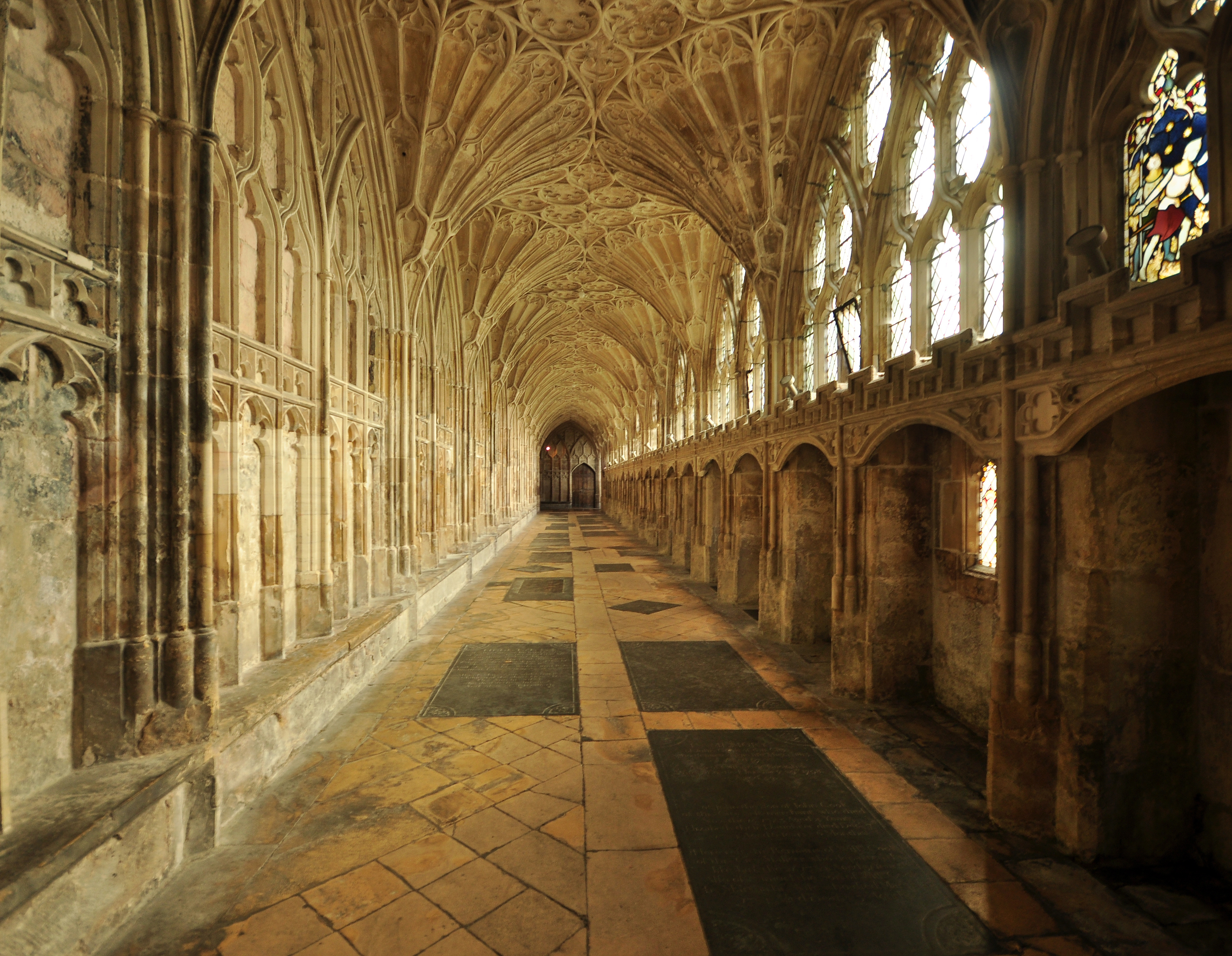
Millions of people have walked through Gloucester Cathedral's cloisters without setting foot in Gloucestershire. The earliest and perhaps finest fan vaulting in England lines these passages, stone ribs spreading from slender columns like frozen palm fronds. When the Harry Potter filmmakers needed corridors for Hogwarts, they came here. But Gloucester Cathedral was famous long before cinema discovered it. William the Conqueror held his Christmas Court in its chapter house in 1085 and ordered the compilation of the Domesday Book. Henry III was crowned here in 1216. The building's history is a concentrated distillation of English power, piety, and architectural ambition spanning nearly a thousand years.
From Saxon Minster to Norman Powerhouse
The cathedral traces its origins to a minster founded around 679 by Osric, King of the Hwicce, a sub-kingdom of Mercia. The Benedictine order took control at the beginning of the eleventh century, and around 1058 a new abbey was established nearby. By 1072, however, the community had dwindled to just two monks. Abbot Serlo, appointed after the Norman Conquest, transformed the abbey's fortunes. Beginning around 1089 after a major fire, he oversaw the construction of a substantial new church. Rising revenues and royal patronage funded an ambitious building programme whose massive Norman nave columns -- cylindrical drums of pale stone rising thirty feet to the arcade -- remain among the most powerful Romanesque interiors in England.
A King's Tomb, A Cathedral's Fortune
When Edward II was murdered at Berkeley Castle in 1327, several abbeys refused to accept his body, fearing the political consequences. Gloucester's abbot took the risk. The gamble paid magnificently. Pilgrims flocked to the murdered king's tomb, and their offerings funded a spectacular rebuilding programme that transformed the east end of the Norman church into one of the earliest and most complete examples of the Perpendicular Gothic style in England. The great east window, installed around 1350 and measuring roughly 72 feet by 38 feet, is one of the largest surviving medieval windows in Britain — the largest at the time of its installation, later surpassed by York Minster's Great East Window. It commemorates the English knights who fought at the Battle of Crecy and the Siege of Calais. Edward II's tomb itself, surmounted by an ornate canopy of Purbeck marble, became one of the most visited shrines in medieval England.
The Cloisters and the Crown
The cloisters, rebuilt in the fourteenth century, display the earliest fan vaulting anywhere in the world. Each bay is an exercise in geometric precision, the ribs radiating from their columns in perfect symmetry. The lavatorium -- the monks' communal washbasin recess -- survives with its original lead-lined trough. These spaces were designed for monastic life: study, procession, contemplation. That they have become one of the most recognisable film locations in the world is an accident of their beauty. Beyond Potter, the cathedral has appeared in productions from Doctor Who to Wolf Hall, its combination of Norman severity and Gothic elaboration providing a visual vocabulary that reads as unmistakably, profoundly English.
A Living Cathedral
Gloucester Cathedral survived the Dissolution of the Monasteries by being elevated to cathedral status in 1541, when Henry VIII created the new Diocese of Gloucester. The former abbey church became the seat of a bishop, and the monastic buildings found new uses. The great cloister garth, once enclosed for the monks' exclusive use, is now open to visitors. The cathedral's medieval stained glass collection is among the finest in Europe, and its combination of Norman, Early English, Decorated, and Perpendicular Gothic architecture makes it a textbook of English building styles spanning four centuries. Services continue daily beneath the same vaults where monks chanted nine hundred years ago, the organ notes reverberating off stonework that has outlasted every dynasty that patronised it.
From the Air
Located at 51.868N, 2.248W in the north of Gloucester city, near the River Severn. The cathedral's squat central tower is a prominent landmark. Nearest airports: Gloucestershire Airport (EGBJ) approximately 3nm east, Bristol (EGGD) approximately 25nm south. Best viewed from 2,000-3,000ft for context with the city and the Severn.