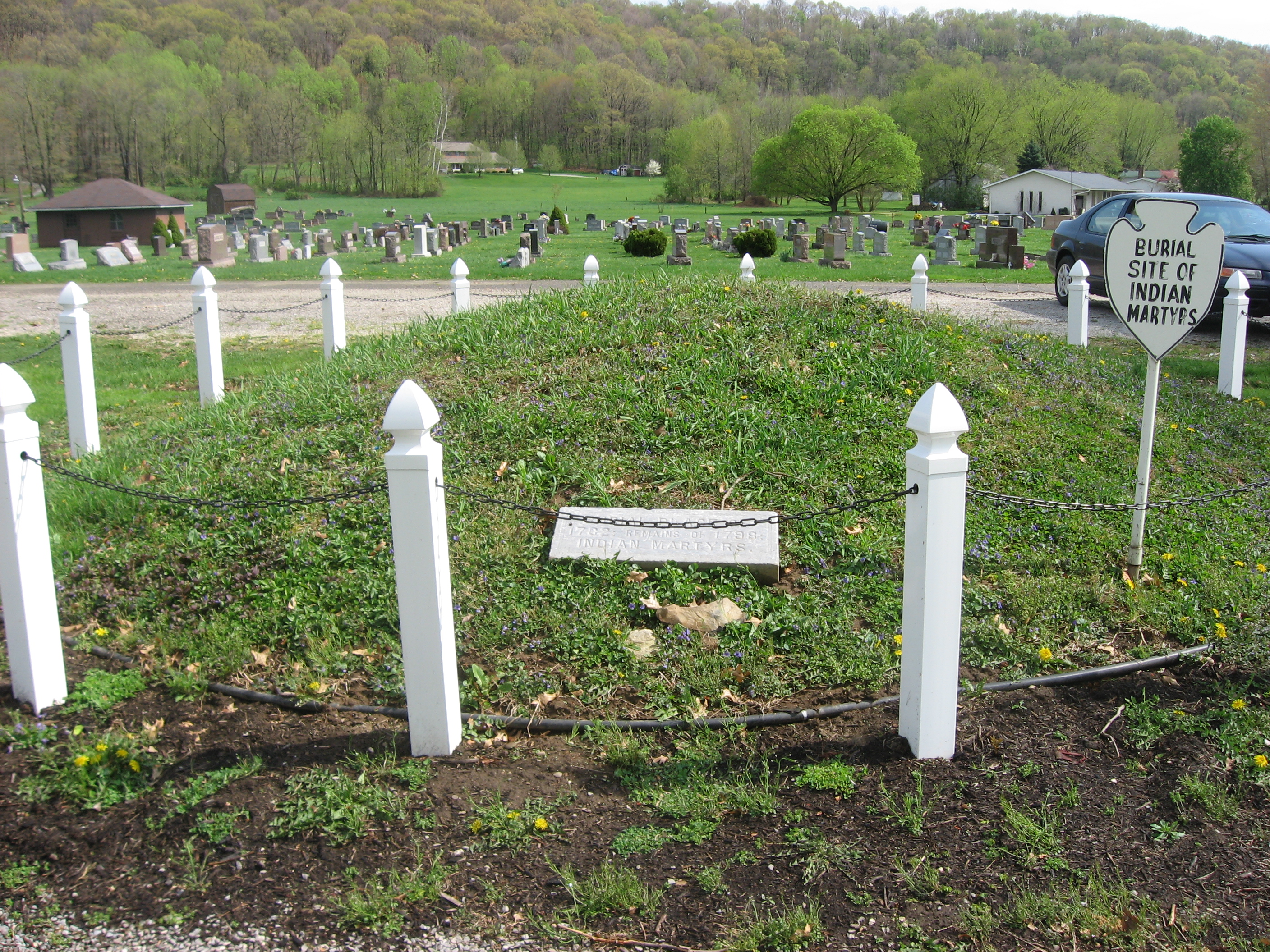
Gnadenhutten Massacre
"You recall the time when the Jesus Indians of the Delawares lived near the Americans, and had confidence in their promises of friendship, and thought they were secure, yet the Americans murdered all the men, women, and children, even as they prayed to Jesus?" Shawnee chief Tecumseh spoke those words to future President William Henry Harrison in 1810, nearly three decades after the event, and the accusation still carried the weight of undeniable truth. At a small Moravian mission village along the Tuscarawas River in eastern Ohio, 96 Christian Lenape -- 28 men, 29 women, and 39 children -- were systematically killed by Pennsylvania militia on March 8, 1782, during the American Revolutionary War. They died singing hymns.
Huts of Grace
The name Gnadenhutten translates from German as "huts of grace," and for the Lenape converts who settled there under Moravian missionary guidance, the village was exactly that. These were not warriors. They were Christian converts who had adopted European farming practices, lived in structured mission communities, and embraced pacifism. The Moravian missions along the Tuscarawas River -- Gnadenhutten, Schoenbrunn, and Salem -- represented a unique experiment in cultural coexistence during the turbulent years of the American Revolution. But their position between British-allied nations to the north and American settlers to the south made them targets from both directions. The British and their Lenape allies had already forced the Christian Lenape from their villages once before, relocating them to Upper Sandusky. By early 1782, some had returned to Gnadenhutten to harvest the corn they had left behind in their fields.
The Day the Singing Stopped
The militia arrived under the command of Lieutenant Colonel David Williamson with approximately 160 men from the Pennsylvania frontier. They told the Lenape they had come to escort them to safety. The Christian Lenape, trusting the Americans, surrendered their weapons. Once disarmed, the militia took a vote on whether to kill their captives or take them as prisoners. The vote was for death. The Lenape were confined in two buildings -- one for men, one for women and children -- and told they would die the next morning. They spent the night in prayer and hymn. At dawn on March 8, 1782, the militia entered the buildings with coopers' mallets and tomahawks and killed every person inside, scalping each one. Two boys survived, one of them scalped, and escaped to tell what happened. The militia then piled the bodies in the mission buildings and burned the village to the ground. They needed 80 horses to carry away the plunder: furs, pewter, tea sets, and clothing.
A Cycle of Retribution
The massacre unleashed a chain of revenge that consumed the frontier. The Lenape allies of the British vowed retaliation. When George Washington learned what had happened, he ordered American soldiers to avoid capture at all costs, knowing what enraged Lenape warriors would do to prisoners. His fears proved justified. Washington's close friend Colonel William Crawford was captured while leading an expedition against the Lenape at Upper Sandusky later that year. Crawford had not been at Gnadenhutten, but he was tortured and killed in retaliation. David Williamson, the officer who had led the massacre, survived the same Crawford expedition but lived out his remaining years in poverty, dying in 1814. Captain Charles Bilderback, another participant, was captured and killed by Lenape warriors in 1789. The violence the militia had unleashed came back for them, one by one.
A Stain Time Cannot Wash Away
No criminal charges were ever filed against the perpetrators. Many soldiers denied involvement, and their descendants refused to acknowledge what had happened. But the Moravian missionaries published detailed accounts, and as the facts became widely known, the massacre was recognized as what one historian called "a crime against humanity." The U.S. Congress, outraged, granted three town sites to the surviving Moravian Lenape in 1785. In 1799, missionaries John Heckewelder and David Peter returned to collect the remains and buried them in a mound on the village's southern side. Theodore Roosevelt, writing in 1889, called it "a stain on frontier character that the lapse of time cannot wash away." Today the descendants of survivors, including children of Israel Welapachtshechen who was killed at Gnadenhutten, make up the majority of the Christian Munsee tribe in Kansas.
What Remains
The village site is preserved and listed on the National Register of Historic Places. The state of Ohio reconstructed a typical mission house and cooper's shop on the grounds. Every year, descendants of the Lenape martyrs gather for a remembrance service. At the 2019 ceremony, Gerard F. Heath, a descendant and grandson of Christian Moses Stonefish, acknowledged the duality of the place: it is a site of mourning but also one of "honoring the Christian people who died on the site during the American Revolutionary War." The outdoor drama Trumpet in the Land, performed in nearby New Philadelphia, tells the story of the massacre and the events leading up to it. Writers from Zane Grey to Cormac McCarthy have referenced the atrocity. The ground at Gnadenhutten holds a story that refuses to be forgotten -- a reminder that the American frontier was built not only on courage and ambition, but also on acts of profound cruelty against those who chose peace.
From the Air
Gnadenhutten is located at 40.354N, 81.435W in Tuscarawas County, eastern Ohio, along the Tuscarawas River valley. The site sits at roughly 850 feet elevation in gently rolling terrain. The nearest airport is Harry Clever Field (KPHD) in New Philadelphia, approximately 8 nautical miles to the northwest. Tuscarawas County Airport (5G3) is also nearby. From the air, look for the small village of Gnadenhutten along the river; the memorial site is on the south side of the community. The area is characterized by low wooded hills and agricultural fields typical of the Ohio hill country. Best viewed at 2,000-3,000 feet AGL.