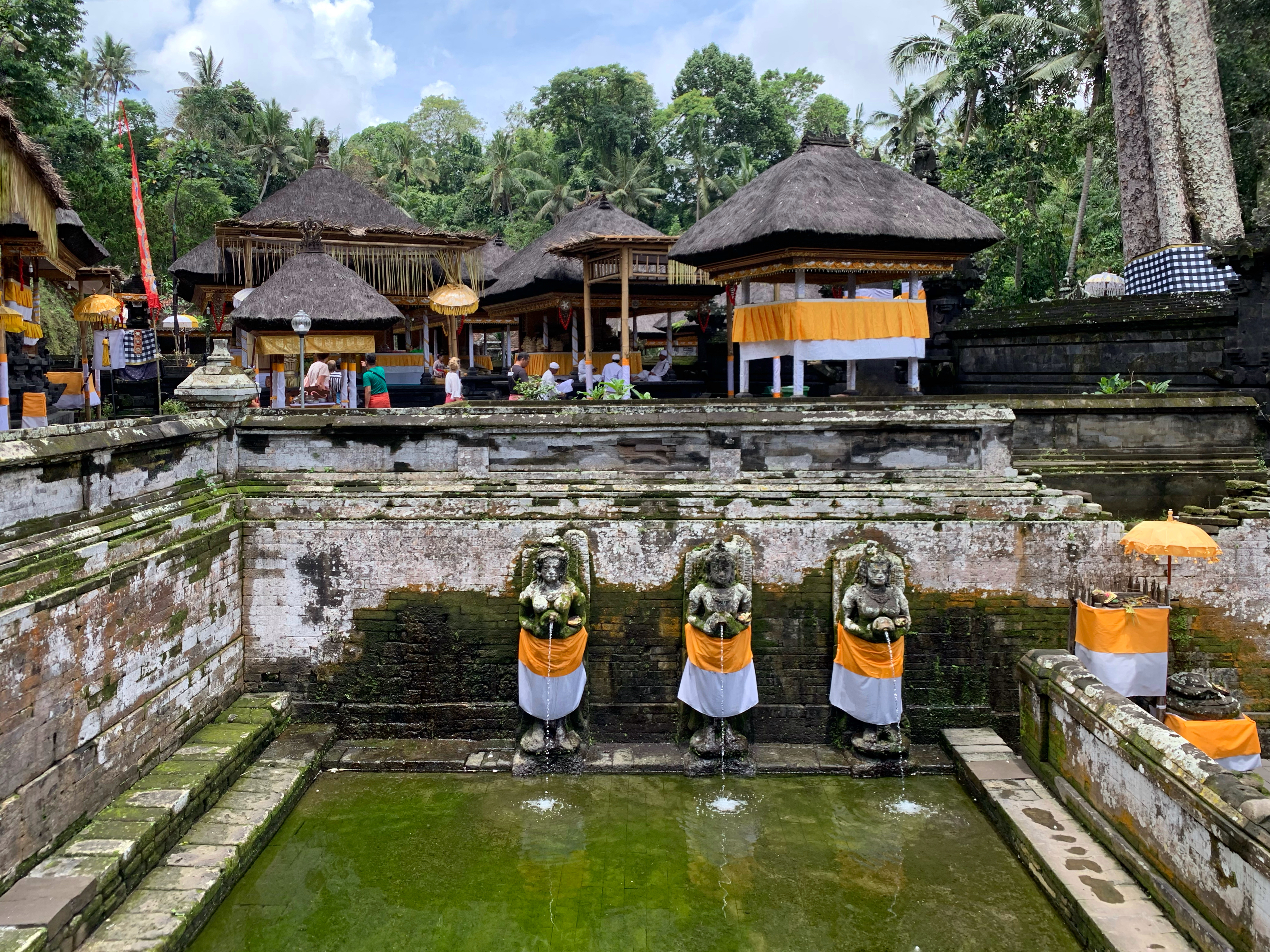
Goa Gajah: The Demon Mouth at the Bottom of the Stairs
The entrance is a mouth. Not metaphorically -- literally. A monstrous face carved into living rock opens its jaws wide, and visitors walk directly between its stone teeth into darkness. Whatever spiritual purpose the builders intended for Goa Gajah, they wanted the threshold to feel like being consumed. The cave sits at the bottom of a long stone staircase in Gianyar, on Bali's lush interior near Ubud, hidden in a ravine where the Petanu River cuts through jungle. For centuries after the Bali Kingdom declined, the forest swallowed this place whole. Dutch archaeologists rediscovered the cave in 1923 and found the demon mouth staring back at them from beneath centuries of vegetation. The bathing fountains below it would remain buried for another three decades.
A Giant's Fingernail and a Kingdom's Faith
Balinese folklore credits the cave's creation to Kebo Iwa, a legendary giant whose fingernail supposedly gouged the sanctuary from solid rock. Scholars offer a less dramatic origin: the cave most likely dates to the 11th century, during the height of the Bali Kingdom. What makes Goa Gajah unusual is its refusal to belong to a single faith. Inside the narrow cave, a lingam and yoni -- symbols of the Hindu god Shiva -- sit alongside a statue of elephant-headed Ganesha. Down by the river, carved stupas and chattras mark the space as Buddhist. The complex served both traditions simultaneously, a reminder that the boundaries between religions in medieval Bali were far more porous than modern categories suggest. Worshippers came here not to choose between faiths but to meditate in a space where both converged.
Seven Rivers in Stone
The bathing pool that Dutch archaeologists missed in 1923 finally emerged from the earth in 1954. What they uncovered was remarkable: six stone women standing in a row, each holding a water pitcher, each representing one of the seven holy rivers of India -- the Ganga, Sarasvati, Yamuna, Godavari, Sindhu, Kaveri, and Narmada. A seventh statue once completed the set, but an earthquake shattered it long ago. Water still pours from the surviving pitchers into a pool below, and visitors still come to receive its blessing. That Balinese artisans carved tributes to rivers flowing thousands of kilometers away on the Indian subcontinent speaks to the reach of the trade and spiritual networks that connected the archipelago to the wider Hindu world. These were not isolated islanders. They were cosmopolitans whose sacred geography spanned an ocean.
The Face That Guards the Threshold
Nobody agrees on exactly what the carved face at the entrance represents. Early European visitors called the site the Elephant Cave, assuming the figure was a pachyderm, and the name stuck -- Goa Gajah translates to exactly that. Others point to the Ganesha statue inside and argue the elephant association comes from the god, not the facade. But the face itself, with its bulging eyes and clawed hands pulling its own mouth open, looks less like any particular animal than like a bhoma -- a protective demon meant to swallow evil before it can enter sacred space. The Javanese poet Mpu Prapanca mentioned the site in the Desawarnana, a court poem written in 1365, confirming that the cave was already old and significant when Java's Majapahit Empire held sway over Bali. Incense still burns inside the small cave today, trailing white smoke through the narrow chamber, and visitors who arrive in shorts are handed sarongs before they may enter the courtyard.
Almost a World Heritage Site
In 1995, Indonesia nominated Goa Gajah for UNESCO World Heritage status. The site appeared on the Tentative List under the Cultural category, joining a dozen other Indonesian landmarks seeking international recognition. For twenty years it waited. Then in 2015, Indonesia withdrew the nomination along with eleven other sites. The reasons were bureaucratic rather than cultural -- the sites had not progressed through the evaluation pipeline, and Indonesia chose to reset its submission strategy rather than let aging nominations languish. Goa Gajah remains unprotected by UNESCO designation, though Balinese custom and Indonesian heritage law provide their own forms of guardianship. The cave does not need a plaque from Geneva to confirm what the carved demon face has announced for a millennium: this is sacred ground, and you enter on its terms.
From the Air
Goa Gajah (8.52S, 115.29E) sits in the Petanu River ravine near Ubud in Bali's Gianyar regency. Ngurah Rai International Airport (WADD/DPS) lies 28km to the south with runway 09/27 (3,000m). The site is nestled in dense tropical vegetation and not easily visible from altitude, but the Ubud area's distinctive rice terrace patterns are identifiable from above. Mount Agung (3,142m) rises to the northeast. Tropical climate with wet season November-March. Afternoon convective activity common year-round.