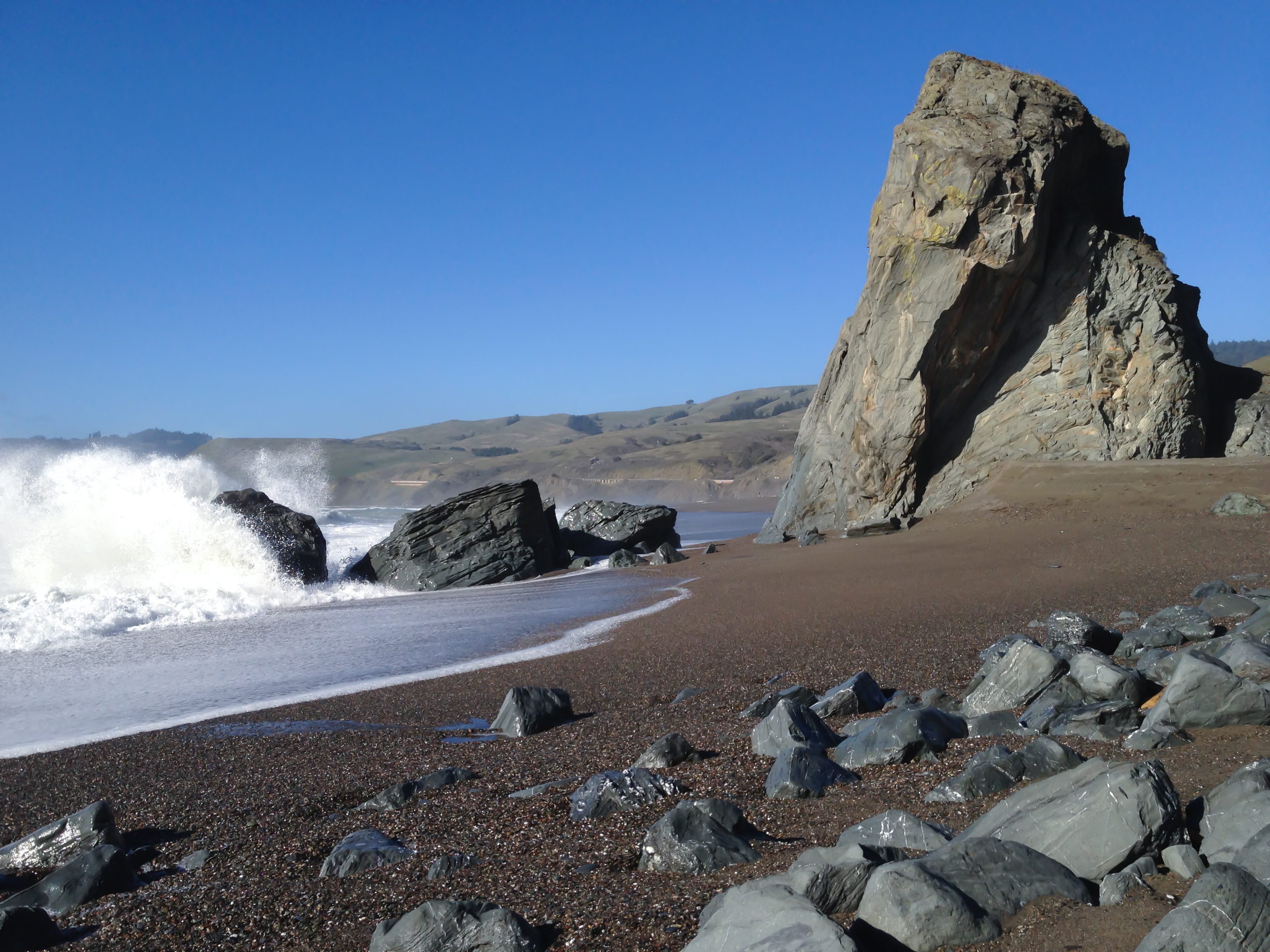
Goat Rock Beach
Goat Rock used to be part of the mainland. Around 1920, quarry operators blasted so much stone from its base that they accidentally severed the formation from the shore, turning a coastal headland into something closer to an island -- connected now by only a thin, low-lying isthmus that doubles as a parking lot. The rock itself is a flat-topped block of greywacke, resistant enough to outlast the softer melange that once surrounded it, and its near-vertical cliffs are posted with signs prohibiting climbing. Early in the twentieth century, goatherds reportedly grazed their animals on the grassy summit, since goats were among the few creatures nimble enough to scale the slopes. The name stuck.
Where the River Surrenders
The Russian River -- Sonoma County's largest watercourse -- empties into the Pacific at the northern end of Goat Rock Beach, and the meeting of fresh and salt water defines this place. During summer, a sandbar builds across the river mouth, damming the flow and separating river from ocean. When water levels rise high enough at the Jenner visitor center, the bar breaches, splitting the beach into two sections. The northern half, sheltered by the river's outflow, becomes a nursery: harbor seals haul out onto the sand to pup in a protected cove that the annual cycle of sand and current creates and destroys. Beyond the river mouth sits the town of Jenner, and north of that, Jenner Beach. To the south, Blind Beach hides on the far side of Goat Rock itself, the two stretches of sand separated by the monolith.
Sculpture Garden of the San Andreas
The San Andreas Fault runs roughly parallel to Goat Rock Beach, and the geology here tells the story of that proximity. The coastline is built from Franciscan Complex rock -- pillow basalt, chert, marine sandstone -- crushed and faulted during ancient plate collisions into a chaotic mixture geologists call melange. Waves erode the soft matrix, leaving the harder blocks standing as sea stacks that rise from the surf like abstract sculptures. Some appear on the marine terrace above the beach, evidence that they formed on the ocean floor and were lifted skyward by tectonic forces over millennia. Goat Rock Beach loses land every year to marine and wind erosion, and heavy storm winters accelerate the loss. The beach reinvents itself annually -- sand redistributed, pebble patches shifting, the dark gray smooth stones that line the stretch north of Goat Rock rearranged by currents that never repeat exactly.
Mammoth Trails and Miwok Middens
A third of a mile south of the beach, uplifted sea stack formations bear rubbing marks too high to have been made by cattle. Mammoths are believed to have roamed this coast as recently as 40,000 years ago, polishing the rock at shoulder height; fossil remains found at Bodega Head to the south support this. The Coast Miwok and Pomo peoples were the earliest known human inhabitants, and archaeological finds dating to at least 1849 include kitchen middens and habitation sites scattered along the shore. The land was part of Rancho Bodega, a Mexican land grant, and the Russians logged the old-growth forests above the coastal prairie in the early nineteenth century. At least 17 vessels may have been lost in these waters, though no wrecks have been confirmed. To the south, iron pins embedded in the sandstone bluffs at Duncans Landing testify to a once-active shipping industry.
Seals, Hawks, and Sneaker Waves
Three habitats converge at Goat Rock Beach: marine, littoral, and coastal prairie. Gray whales pass offshore. Harbor seals, elephant seals, and California sea lions haul out on the sand -- the state recommends a 50-yard buffer during pupping season. Anadromous fish enter the Russian River estuary, migrating up the Laguna de Santa Rosa and other tributaries. Above the beach, the coastal prairie supports lupine, thistle, and wild oats, while California mule deer graze among the grasses. The beach itself is governed by danger: strong rip currents generated by a steep underwater trench run parallel to shore, and sneaker waves arrive without warning. Swimming is strictly prohibited. Hang-gliding, however, is permitted from a 150-foot launch point on the marine terrace above the southern beach, provided pilots carry the proper credentials.
One-Eyed Willy's Last Horizon
In 1985, a film crew pointed cameras toward Arched Rock from Goat Rock Beach and called the spot Cauldron Point. It was the final scene of The Goonies: the pirate ship Inferno, belonging to the legendary One-Eyed Willy, sailing into the Pacific and out of frame. The beach's cinematic afterlife has made it a minor pilgrimage site for fans of the cult film, though most visitors come for less nostalgic reasons -- beachcombing, birdwatching, or simply standing at the edge of a continent where the geology is visibly in motion. The Sunset Boulders near the entrance road draw rock climbers, with routes ranging from beginner-friendly 5.2 to formidable V10 bouldering problems. Metroactive readers once voted Goat Rock the second most popular beach in Sonoma County, a ranking that seems about right: popular enough to be known, wild enough to feel uncrowded.
From the Air
Coordinates: 38.447N, 123.126W. Goat Rock Beach is visible where the Russian River meets the Pacific -- look for the massive sea stack (Goat Rock) at the southern end of a crescent beach, connected to the mainland by a narrow isthmus. Arched Rock and other sea stacks are visible offshore. Bodega Head lies approximately 10 nm to the south. Nearest airport: Charles M. Schulz-Sonoma County Airport (KSTS), about 30 nm southeast. Recommended altitude: 1,500-3,000 ft for full coastal panorama. Marine fog is frequent, especially summer mornings.