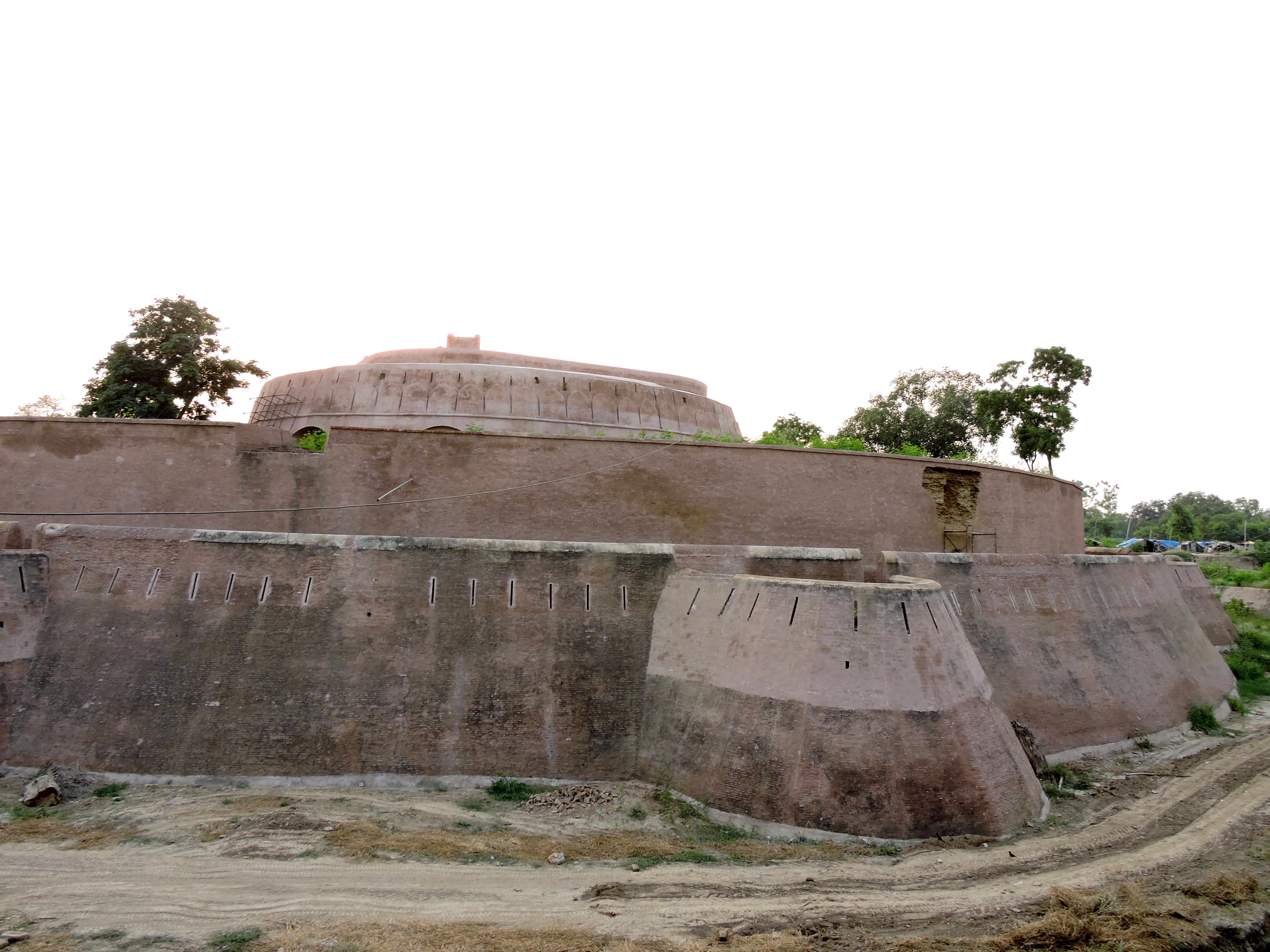
Gobindgarh Fort
The Koh-i-Noor diamond slept here. Before it passed through the hands of the East India Company and into the Tower of London, the world's most contested gemstone sat in the Toshakhana -- the treasury vault -- of a square brick fort in the middle of Amritsar. Gobindgarh Fort has outlived every power that claimed it: the Bhangi warlords who built it, the Sikh emperor who renamed it, the British who remodeled it, and the Indian Army that sealed it from the public for seven decades. When the gates reopened in 2017, Amritsar's residents walked into a place most had never been allowed to enter, discovering that their city's most prominent military structure had been hiding in plain sight.
The Bhangis and the Lion of Punjab
In the 18th century, Gujjar Singh Banghi of the Bhangi Misl -- one of the twelve sovereign Sikh confederacies that governed Punjab -- erected a square brick-and-lime fortress on Amritsar's southwestern fringe. A thousand meters around its perimeter, it bristled with 25 cannons on its ramparts. The Bhangis held it until 1805, when Maharaja Ranjit Singh took the fort and renamed it after the tenth Sikh Guru, Gobind Singh. Ranjit Singh deepened the moat, reinforced the gates, and hired French military engineers to redesign the defenses along European fortress principles. Ravelins -- angled earthworks designed to absorb cannon fire -- rose around the curtain walls. The mud core of those walls, ten to twelve meters thick, could swallow cannonballs whole. Ranjit Singh filled the Toshakhana with treasure and garrisoned 2,000 soldiers inside, turning Gobindgarh into a shield for the Golden Temple and the Grand Trunk Road beyond.
A Cannon Named Zamzama
Among the fort's most storied possessions was a gun too large to ignore. The Zamzama -- "Taker of Strongholds" -- was an 80-pound cannon, fourteen feet four inches long with a nine-inch bore, cast in Lahore in 1757 under orders from Afghan king Ahmad Shah Durrani. A Persian inscription along its barrel declares it "a destroyer even of the strongholds of the heaven." In 1762, Bhangi chief Hari Singh seized the cannon from Lahore, and it became known as the Bhangian di Top -- the Bhangis' gun. When Ranjit Singh took Amritsar in 1802, Zamzama passed to him. He dragged it across Punjab in a specially built carriage, deploying it at Daska, Kasur, Sujanpur, Wazirabad, and Multan. At the Multan siege in 1810, the great gun finally failed to discharge. Rudyard Kipling immortalized a twin of this cannon in the opening line of Kim: "He sat, in defiance of municipal orders, astride the gun Zam-Zammah." That twin stands outside the Lahore Museum. The original belonged to Gobindgarh.
Bricks That Tell Two Stories
Walk through Gobindgarh and you read Punjab's colonial transition in the masonry. Sikh-era structures use Nanakshahi bricks in lime mortar -- dense, durable, built to absorb siege artillery. The circular plinth at the fort's geometric center, all that survives of a Sikh-era tower, features ornate buttresses with three-banded cornices. The Toshakhana is a square building divided into two chambers, roofed with a double-vault system and walls a meter and a half thick. Then the British arrived in 1849 and layered their own vocabulary on top. The Durbar Hall, built in 1850, introduced colonnaded verandahs, wooden louvers against tropical heat, and a grand staircase. Four fireplaces line a huge upstairs hall that seems too celebratory for its official designation as a six-bed hospital. The barracks rose atop Sikh foundations -- thick Nanakshahi brick walls in lime mortar below, thinner British-era walls in mud mortar above. Even the roofing changed: masonry vaults gave way to wooden trusses. Two empires, readable in a single wall.
Behind Closed Gates
After Indian independence in 1947, the army took possession and the public disappeared from the equation. For seventy years, Gobindgarh Fort sat in the center of Amritsar, visible but inaccessible. The fifty-meter watchtower, completed in 1874, was demolished. The fort's bastions, its multi-level defense system, its gates designed with sharp turns to trap advancing enemies -- all of it existed behind walls that ordinary citizens could not cross. The Nalwa Gate, named after Ranjit Singh's general Hari Singh Nalwa, the Keller Gate at the rear, even the tunnel said to run toward Lahore -- these became rumors rather than places. In 2017, the Punjab government opened the fort as a heritage site. Mayanagri One Private Limited developed it into a living museum, while two galleries remained under public control. Today visitors watch a 7D show on Ranjit Singh's life, browse a coin museum in the Toshakhana that once stored the Koh-i-Noor, and eat Amritsari street food in the courtyards.
Fortress as Mirror
Gobindgarh's four bastions once pointed outward, each positioned at a cardinal direction to guard against threats from any quarter. Roads between gates wound through sharp turns, forcing attackers into kill zones where defenders at multiple elevations could fire simultaneously. Now those paths carry tourists past stalls selling phulkari embroidery and copper handicrafts from the Thatheras of Jandiala Guru. Evening brings the Whispering Walls show, projection-mapped light playing across ramparts that once absorbed cannon fire. Bhangra dancers perform on stages inside the compound. The transformation is striking but not total -- Nanakshahi bricks remain, the moat's outline persists, and the bastions still anchor the corners. Gobindgarh has become a place where Punjabis come not to defend their history but to encounter it, walking ground where the most famous diamond in the world once sat locked behind walls thick enough to stop a cannonball.
From the Air
Located at 31.63N, 74.86E in the center of Amritsar, Punjab, India. The fort's square layout with corner bastions and surrounding moat outline are distinctive from the air. Sri Guru Ram Dass Jee International Airport (ICAO: VIAR) is approximately 11 km northwest. Best viewed at 2,000-3,000 feet AGL, where the square perimeter and internal structures contrast with the dense urban fabric of Amritsar. The Golden Temple complex is visible roughly 1 km to the northeast.