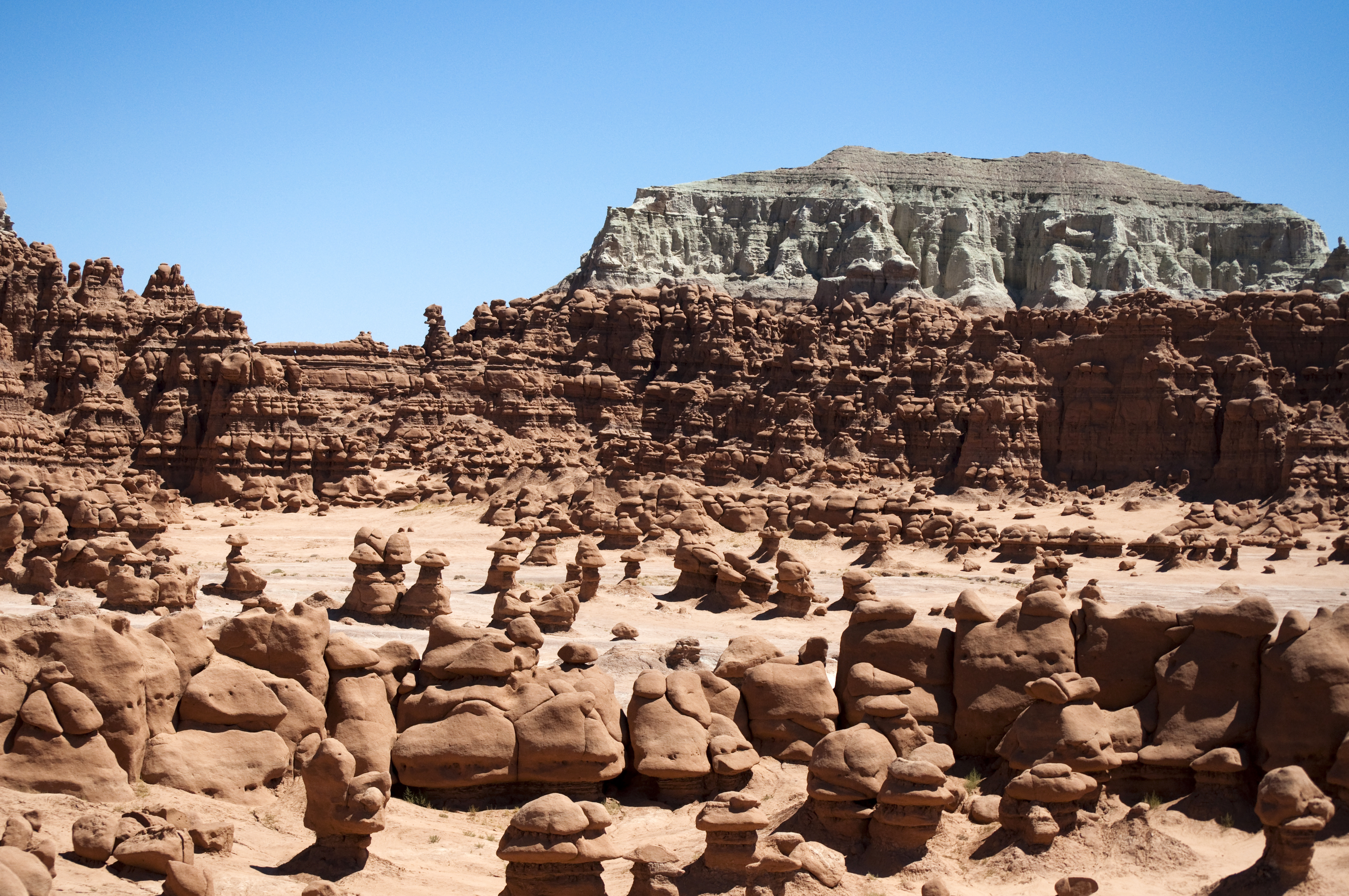
Goblin Valley State Park
Arthur Chaffin called it the Valley of the Mushrooms. In the late 1920s, while searching for a route between Green River and Caineville in central Utah, Chaffin and two companions reached a vantage point and stopped cold. Below them spread a valley of strange, goblin-shaped rock formations -- thousands of sandstone hoodoos standing like a frozen army, surrounded by walls of eroded cliffs and five flat-topped buttes. Chaffin did not return for twenty years. When he finally came back in 1949, he spent days photographing the scores of intricately carved rocks. The valley had waited patiently. It had been waiting, in fact, for millions of years.
An Army of Stone
The goblins of Goblin Valley are hoodoos -- pillars of soft rock capped by harder stone that erodes more slowly, creating the mushroom shapes, leaning towers, and twisted figures that give the valley its name. Wind, water, and the freeze-thaw cycle have sculpted the Entrada Sandstone into formations that range from waist-high stumps to towering pillars, each one unique. From above, the valley floor looks like a crowded amphitheater of stone figures caught mid-conversation. The average rate of erosion for a hoodoo is roughly two to four feet per century, which means the shapes visitors see today are slightly different from those Chaffin photographed in 1949 -- and the formations that will greet visitors a century from now will be different again. The goblins are always changing, always temporary.
Before the Cowboys
Long before Chaffin's discovery, the San Rafael Swell region bore the marks of Native American cultures. The Fremont, Paiute, and Ute peoples left pictograph and petroglyph panels throughout the area, and Goblin Valley itself contains several notable rock art panels alongside its geological formations. Cowboys searching for stray cattle found the secluded valley at some point before Chaffin's arrival, but it was his photographs and the publicity they generated that brought wider attention. Despite its remoteness, visitors began trickling in. Concerns about vandalism led to a 1954 proposal to protect the valley, and the state of Utah eventually acquired the property, establishing Goblin Valley State Reserve. It was officially designated a state park on August 24, 1964.
The Hoodoo That Fell
In October 2013, Goblin Valley made national news for the worst possible reason. A Boy Scout leader intentionally toppled a delicately balanced hoodoo while two companions watched, one of them recording video that was uploaded to the internet. The men claimed the formation looked ready to fall and posed a danger to visitors -- but the footage showed them cheering and high-fiving after pushing the rock. Given that hoodoos erode only two to four feet per hundred years, the formation they destroyed had stood for an immense span of time. The Utah National Parks Council dismissed the two leaders, and the national Boy Scouts organization removed them entirely. In January 2014, two of the men were arraigned on felony charges of criminal mischief. They eventually pleaded guilty to lesser charges, receiving one year of probation plus fines. The incident became a cautionary tale about the fragility of geological features and the responsibility visitors bear in public lands.
An Alien World in Utah
Hollywood recognized what Chaffin saw. In 1999, the makers of Galaxy Quest chose Goblin Valley as the filming location for an alien planet, and the valley's eroded sandstone dunes inspired the design of the fictional world's rock monsters. It is easy to see why: the landscape genuinely looks extraterrestrial, especially at dusk when the hoodoos cast long shadows and the red rock glows against a darkening sky. The park's sparse vegetation -- Mormon tea, Russian thistle, Indian ricegrass, and scattered cacti -- reinforces the sense of standing on another world. Jackrabbits, kangaroo rats, kit foxes, pronghorns, and midget faded rattlesnakes inhabit this harsh environment, along with scorpions and coyotes. Summer days are hot and dry, and the intermittent monsoon season can bring intense, localized thunderstorms that turn the terrain into a flash-flood zone within minutes.
From the Air
Goblin Valley State Park is located at 38.567N, 110.710W in the San Rafael Swell region of central Utah. From cruising altitude, the valley appears as a lighter-colored depression surrounded by eroded cliff walls and buttes. The hoodoo field is distinctive but small -- best appreciated at lower altitudes (2,000-3,000 ft AGL). Nearest airport: Green River Municipal Airport (U34), approximately 35 nm to the north. The park lies west of the Henry Mountains and north of Capitol Reef National Park. Summer thunderstorms can develop rapidly in the area.