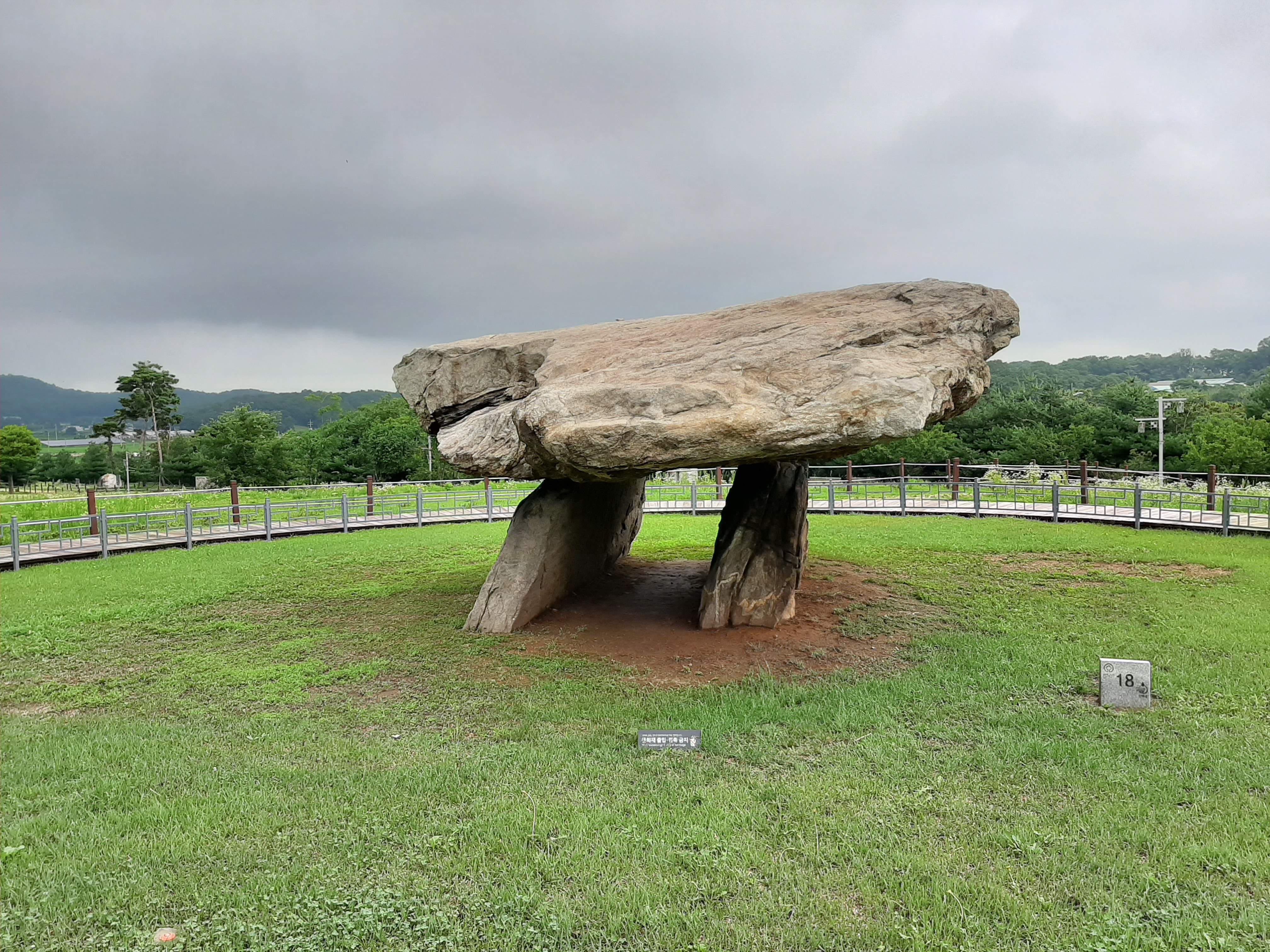
Gochang, Hwasun and Ganghwa Dolmen Sites
Forty percent of all the dolmens on Earth stand on the Korean Peninsula. Not in Europe, where Stonehenge draws millions. Not in the Middle East or along the Mediterranean. Korea. The sheer concentration defies easy explanation, and the three sites at Gochang, Hwasun, and Ganghwa, designated a UNESCO World Heritage Site in 2000, contain over a thousand of these stone monuments built during the first millennium BCE. Some are modest capstones resting on buried supports. Others are table-like structures weighing up to 280 tons, engineered and moved by communities whose names are lost but whose ambition is written in granite.
Stone Tables of the Dead
A dolmen, at its simplest, is a large flat stone balanced on smaller supporting stones, creating a chamber beneath. In East Asia, two main types evolved. The northern or table-type dolmen uses four upright stones to form a box, capped by a massive slab. The southern or go-board type buries its dead underground, with stones supporting the capstone above the surface. Both types appear across the Korean Peninsula, but their purposes were not limited to burial. When complete human bones were discovered at the Hwangseok-ri dolmen in Jecheon in 1967, the tomb function was confirmed. Yet some scholars argue that the largest and most prominently placed dolmens, positioned on high ground visible from a distance, served as altars or symbols of authority for the ruling groups that built them. One skeleton recovered from a dolmen stood 176 centimeters tall, and its skull shape differed from that of modern Koreans, a tantalizing hint at the people behind these monuments.
The Valley of 442 Stones
At Gochang, in the southwestern province of North Jeolla, 442 dolmens line the foot of a series of hills from east to west, built at altitudes of roughly 15 to 50 meters. Capstones here range from about one meter in length to massive slabs weighing 225 tons. The site contains the largest and most varied group of dolmens among the three UNESCO locations, and researchers believe most were constructed around the seventh century BCE. What makes Gochang remarkable is not just the quantity but the range: table-type and go-board-type dolmens sit near one another, suggesting either a long period of construction as styles evolved, or a community that practiced both traditions simultaneously. Walking among them today, along paths that wind through low hills and farmland, you encounter these ancient structures with startling frequency, some half-buried in earth, others standing clear against the sky.
Hwasun's Hidden Giants
The Hwasun dolmens occupy the valleys around the Jiseokgang River, where 596 dolmens cluster in a remarkably small area. Here the scale escalates. The largest dolmen in Daesin-ri measures 7.3 meters long, 5.0 meters wide, and 4.0 meters thick, weighing an estimated 280 tons. Moving a stone of that mass with Bronze Age technology required coordinated labor on a scale that implies significant social organization and engineering knowledge. Nearby, researchers have found quarry sites where capstones were cut, providing a rare glimpse into the construction process. The proximity of quarry and dolmen suggests these were not randomly placed but carefully planned, with builders selecting stone sources close to their intended sites. Hwasun's concentration of dolmens in such a confined area makes it one of the densest megalithic landscapes anywhere in the world.
The Island Sentinels of Ganghwa
On Ganghwa Island, off the west coast near Incheon, dolmens sit higher on mountain slopes than their southern counterparts, giving them a commanding presence over the surrounding landscape. These may be the oldest of the three groups, though conclusive dating remains elusive. The most notable is a northern table-type dolmen at Bugeun-ri, believed to have served as a site for ancestral rites. Its capstone measures 7.1 meters long and 5.5 meters wide, resting on only two supporting stones, with a combined weight between 150 and 225 tons. About 150 dolmens survive on the island, their distribution closely tracking what were once coastal areas, suggesting a connection to fishing communities in the Bronze Age. Ganghwa today is separated from the mainland by only a narrow channel, but three thousand years ago, the relationship between these stone builders and the sea may have been the defining feature of their existence.
From the Air
Located at 34.97°N, 126.93°E, the Gochang Dolmen Site is in North Jeolla Province, South Korea. The Hwasun site is approximately 50 km to the southeast, and the Ganghwa site is roughly 300 km to the north near Incheon. Nearest airports to Gochang include Gwangju Airport (RKJJ) about 60 km southeast and Gunsan Airport (RKJK) roughly 50 km north. The dolmen fields are spread across agricultural and hilly terrain, not individually visible from altitude but located near identifiable river valleys.