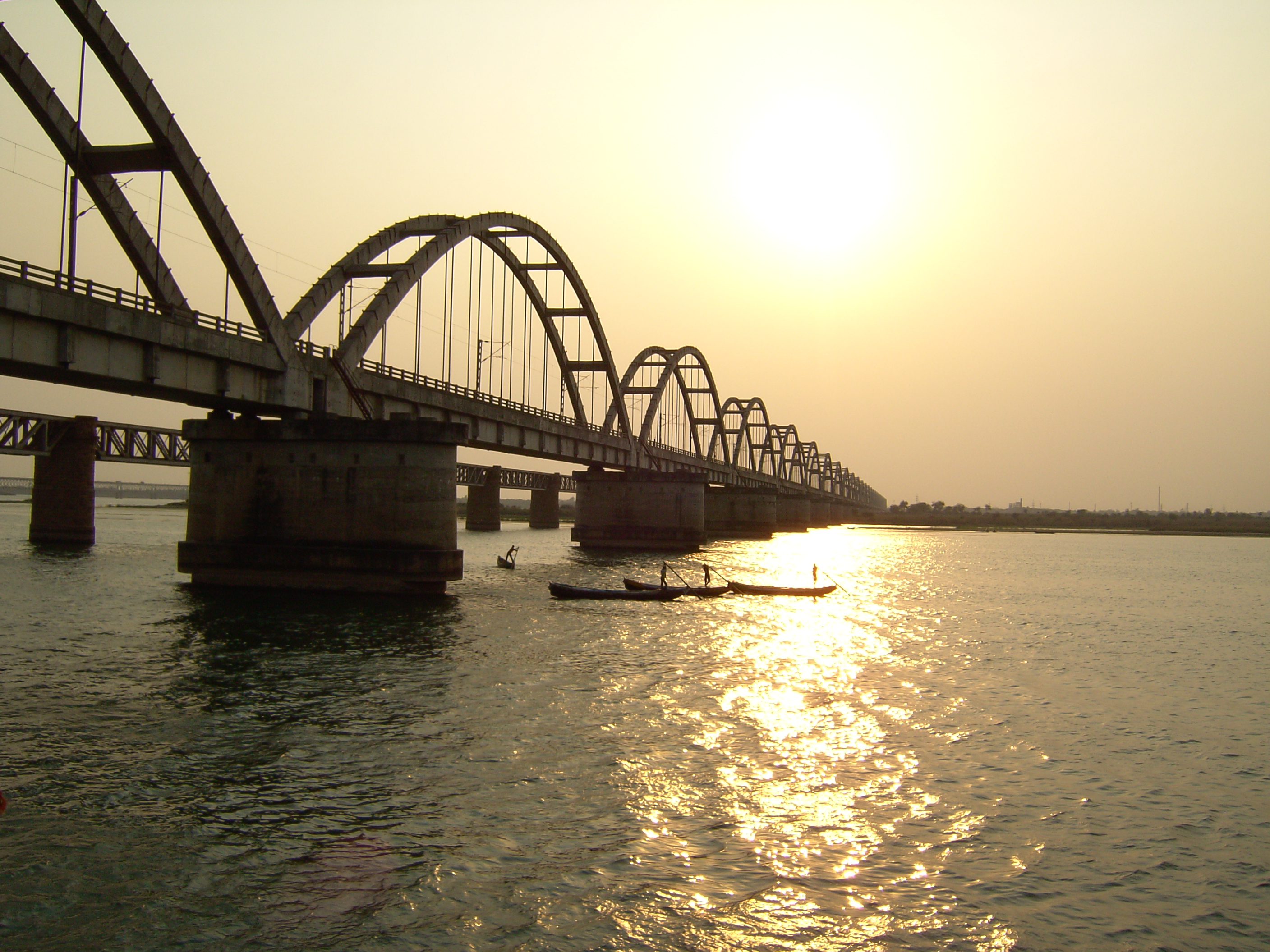
Godavari Arch Bridge
Three bridges cross the Godavari River at Rajahmundry, and together they tell the story of a century of Indian engineering. The oldest, the Havelock Bridge, opened in 1900 when British engineers first dared to span the broad Godavari delta. A century later, that Victorian ironwork was retired, replaced by something far more ambitious: a bowstring-girder arch bridge made of prestressed concrete, one of the longest of its kind in Asia. The Godavari Arch Bridge did not merely replace its predecessor. It announced a new era.
A Century of Crossings
Rajahmundry sits where the Godavari River begins to widen toward the Bay of Bengal, spreading across a floodplain that makes bridge-building both essential and treacherous. The Havelock Bridge served faithfully for a hundred years before its decommissioning in 1997. The second bridge, a truss design known simply as the Godavari Bridge, carries both road and rail traffic and ranks as India's third longest road-cum-rail bridge over water. But it was the third crossing that pushed boundaries. Construction began in 1991, and for six years engineers worked over the unpredictable Godavari, a river that swells dramatically during monsoons and sits in a region battered by Bay of Bengal cyclones. When the arch bridge opened for passenger trains in March 1997, it brought with it a new confidence: Indian infrastructure could match the scale of the landscape it served.
Built for the Storm
The Godavari Arch Bridge was designed with the worst in mind. Engineers calculated wind loads for cyclonic storms up to 200 kilometers per hour without live load, a concession to the ferocious weather systems that spin off the Bay of Bengal and rake Andhra Pradesh's coast. Train speeds were projected at 160 kilometers per hour, ambitious for Indian railways at the time. Each of the bridge's box girders was cast from M42 grade concrete and prestressed with 16 longitudinal cables, each cable tensioned to a force of 2,950 kilonewtons. The casting process alone required seven careful stages per girder, with engineers monitoring forces in the arch sections at every step to ensure no cracks formed. Three sets of pot bearings were imported from Switzerland, engineered to handle 1,050 tonnes of capacity each, while the remainder were manufactured domestically by BBR India.
The Trouble with Pier 27
No bridge of this scale escapes the complications of geology. After construction, railway authorities measured settlement across all 28 piers and found that pier 27, standing in the Kovvur Channel, had settled 211 millimeters, far beyond the 75 millimeters considered acceptable. The differential settlement threatened to warp the bearings, and BBR's consultants warned that the top plate would likely contact the bottom plate, causing damage. The fix required surgical precision: in May 2003, engineers lifted the bearings by 200 millimeters using eight hydraulic jacks rated at 400 tonnes each, then filled the gap with Conbextra HES, a quick-setting cementation material. Train operations had to be halted, but only briefly, in two short breaks carefully choreographed around the railway schedule. It was the kind of unglamorous, methodical work that keeps ambitious bridges standing.
River, Bridge, and City
The Godavari is India's second longest river, flowing over 1,400 kilometers from its source near Nashik in Maharashtra to its delta on Andhra Pradesh's coast. At Rajahmundry, the river is already vast, a wide expanse of water that dominates the city's identity. The three bridges are not just transportation links but landmarks, each representing a different chapter of the city's relationship with the river. Locals navigate their daily lives by reference to them: the old bridge, the road bridge, the new arch bridge. For a city built on the banks of one of India's sacred rivers, these crossings are as much cultural markers as they are feats of engineering. The Pushkaram festival, held every 12 years at the Godavari, draws millions of pilgrims to Rajahmundry, and the bridges become arteries through which devotion flows.
From the Air
The Godavari Arch Bridge is located at 17.012N, 81.753E, spanning the Godavari River at Rajahmundry in Andhra Pradesh. From the air, the three parallel bridges crossing the wide Godavari are unmistakable landmarks. Best viewed below 5,000 feet for detail on the arch structure. The nearest airport is Rajahmundry Airport (VORY), approximately 25 km to the east. The river and bridges are visible from much higher altitudes due to the width of the Godavari at this point.