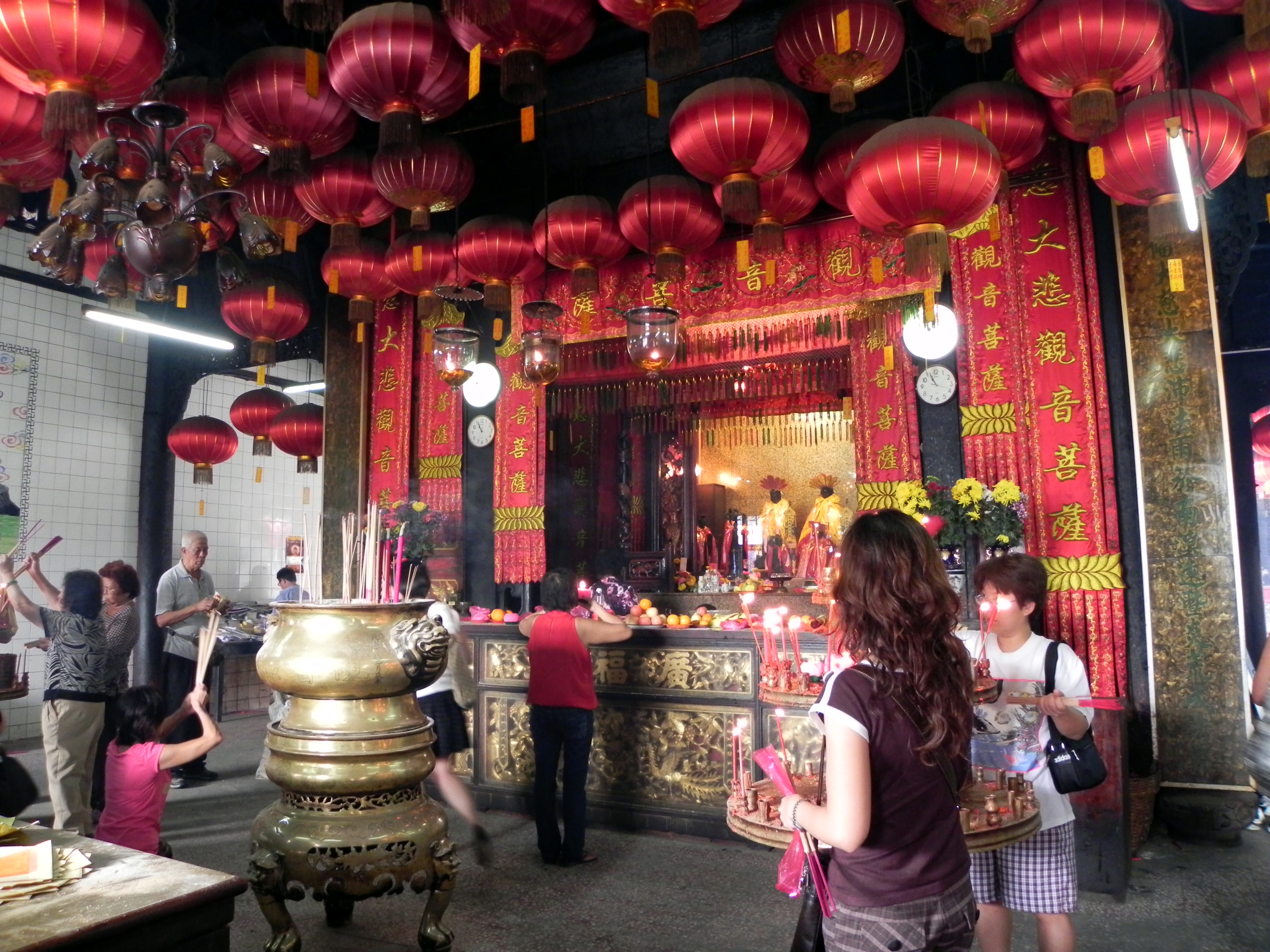
Goddess of Mercy Temple
Three wells hide inside the Goddess of Mercy Temple on Pitt Street in George Town. One sits in the front courtyard, open to anyone. A second stands beside the main shrine, reserved for monks. The third is concealed beneath the main altar of Guan Yin, the Bodhisattva of Mercy, and local legend holds that its water has medicinal properties. The wells were part of the temple's original feng shui design when it was built in 1800, making it the oldest Chinese temple in Penang. But the wells are not the strangest thing about this place. The strangest thing is that it was not originally built for Guan Yin at all.
A Sea Goddess Gives Way
When Chinese immigrants first erected the temple, they dedicated it to Mazu, the sea goddess who protects sailors and fishermen. This made practical sense. The early Chinese community in George Town had crossed the South China Sea to reach Penang, and Mazu worship was their spiritual anchor to the perilous voyage behind them. But George Town was growing fast. After Francis Light founded the settlement in 1786, waves of Chinese migrants poured into the city, and the community's needs shifted from maritime survival to daily life on shore. By 1824, the temple had been rededicated to Guan Yin. The transition tells the story of a diaspora settling in: the goddess of the crossing gave way to the goddess of mercy, because mercy is what you need once the journey is over and the hard work of living somewhere new begins.
Bombs, Fire, and Stubborn Survival
The temple has a reputation for being indestructible, and the record lends it some credibility. In December 1941, the Imperial Japanese Army bombed and invaded Penang. Buildings across George Town were reduced to rubble. The Goddess of Mercy Temple emerged unscathed. It survived further attacks in the years before and during the 1960s -- a turbulent period that included the aftermath of Malayan independence and ethnic tensions in Penang. Whether divine protection or fortunate geography explains the temple's survival, devotees have drawn their own conclusions. The temple's perceived invulnerability has only deepened the reverence surrounding it, attracting pilgrims who believe the site carries a special charge. The most recent renovation, completed between 2012 and 2017, restored the building while preserving the architectural features that have stood since 1800.
Dragons on the Roof, Guardians at the Door
The temple is a showcase of southern Chinese architectural tradition. Sweeping roofs curve upward at their edges in the style typical of Chinese temples, their ridges crowned with ceramic dragon figurines and floral motifs. Dragon-entwined pillars support the high roof inside, and gigantic doors at the entrance bear paintings of Taoist and Buddhist door guardians -- the Menshen tradition, meant to ward off evil spirits. The courtyard faces east toward Pitt Street, a deliberate feng shui orientation. Inside, the main altar enshrines Guan Yin, surrounded by red lanterns, offering tables, and the thick haze of incense smoke. Devotees practice kau cim, shaking bamboo sticks from a container until one falls out, then matching its number to a printed poem that offers guidance. The ritual is ancient, practical, and democratic -- no appointment necessary, no intermediary required.
The Living Center of Chinese Penang
The temple once served both religious and civic functions for Penang's Chinese community, acting as a gathering place where disputes were settled and community affairs organized. Those secular roles have since passed to the Penang Chinese Town Hall, but the temple's spiritual gravity has only intensified. It remains the focal point for major Chinese festivals, particularly the annual feast days of Guan Yin and the celebration of the Jade Emperor's Birthday, which draw devotees from across Southeast Asia. During Chinese New Year, red lanterns fill the courtyard and incense smoke rises in thick columns. Roadside stalls along Pitt Street sell prayer paraphernalia -- joss paper, incense bundles, offerings. The temple sits within the UNESCO World Heritage core zone of George Town, surrounded by the shophouses, clan jetties, and street art that define modern Penang's tourist landscape. But step through those guarded doors and the century falls away. The wells still hold water. The incense still burns. Guan Yin still listens.
From the Air
Located at 5.4184N, 100.3388E in the heart of George Town's historic district, on Pitt Street (now Jalan Masjid Kapitan Keling). The temple is not individually visible from altitude but sits within the dense heritage zone of George Town, identifiable by its tightly packed shophouse grid near the coast. Penang International Airport (WMKP) is approximately 16 km south. The George Town UNESCO core zone is best appreciated at 1,500-2,000 feet, with the Esplanade and Fort Cornwallis visible nearby to the northeast.