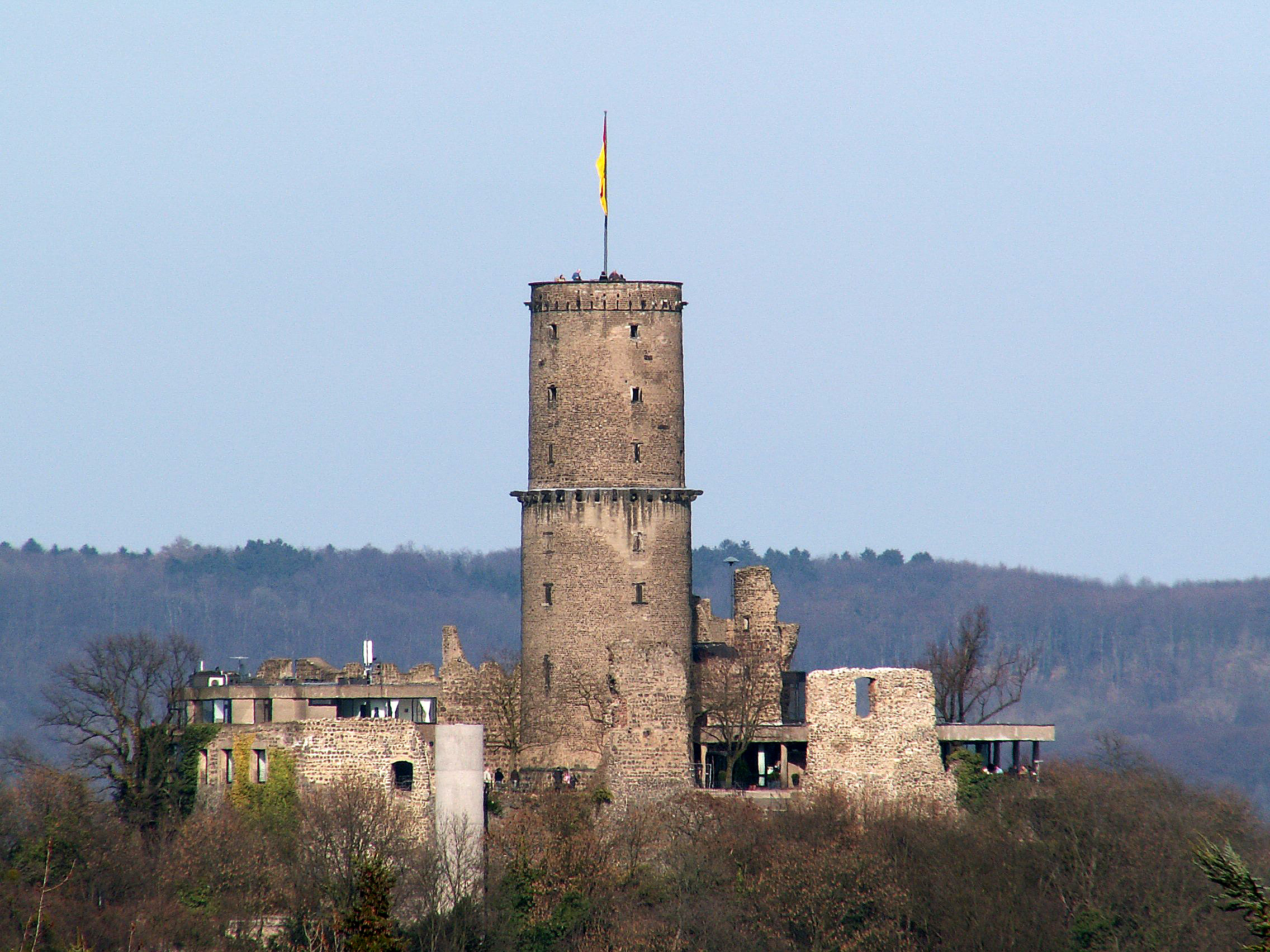
Godesburg
The cone announces itself from the river. You see it before you see Bonn, a single sharp peak rising four hundred feet above the Rhine's west bank, too clean and too symmetrical to be anything but a volcano with the body sanded off by time. The Godesberg has been a sacred height, a contested fortress, a national ruin, a Kaiser's gift to a city, and a hotel restaurant. The same hill, reused. The keep at the summit is cylindrical because Cologne archbishops in the 13th century thought cylinders held up better than squares, and they were right - it's the only piece of the old castle that survived a 1583 powder mine that took down half the rest of the structure. The keep is still there. So is the cone. Everything in between has changed at least four times.
Before the Castle
Documents from the early eighth century mention something on this hill. Documents from the reigns of Otto I in 927 and Otto II in 974 hint at a religious community on the peak, which is why the place was sometimes called Gottesberg, God's mountain. Nineteenth-century historians, working in the German Heimat movement, took those hints further and speculated about a pre-Christian shrine to Wotan, the Germanic god of war and the hunt, on the basis of the older variants Wotansberg and Woudensberg. The shrine is speculation; the documents do not confirm it. What is confirmed is that the hill had a name and a religious association centuries before anyone laid a fortress stone on it. Whatever happened on the peak in the early medieval centuries left no walls but left a name that stuck. Locals still call the place by it.
The Archbishop's Strongbox
The foundation stones of the castle were laid around 1210 on the order of Archbishop Dietrich I of Cologne, who was himself fighting to keep his elected post. Dietrich died in 1224, deposed by his rivals; his successors finished the fortress. For the next three and a half centuries, the Godesburg featured in Cologne archdiocesan chronicles as both a symbol and an instrument of archiepiscopal power. The archbishops were locked in century-long struggles with the patrician burghers of Cologne, who controlled the imperial free city but not the surrounding territory. The Godesburg, sitting between Cologne and Bonn, could be reinforced from the elector's loyal lands and threatened the city's southern road. By the late 14th century the castle was holding the elector's archives and valuables. By the mid-16th century chroniclers were calling it the Lieblingssitz, the favorite seat. Successive archbishops added a keep, dungeons, a chapel, a curtain wall, and the switchbacked entry road that made foot assault a nightmare.
The Day It Ended
On 17 December 1583, after a month of futile cannonade, Bavarian sappers detonated 1,500 pounds of powder under the southeastern wall. The explosion cracked open half the castle in a single instant. Many people died inside, including soldiers, peasants, servants, women, children, and prisoners held in the dungeons. The Bavarian commander Ferdinand of Bavaria, brother of the Catholic archbishop-elector Ernest, had been ordered to take the place during the Cologne War, a dynastic-religious conflict that began with the previous elector's conversion to Calvinism. The Godesburg was a casualty of that war. It was also the practical end of the war on the lower Rhine. Bonn fell six weeks later. The Cologne electorate stayed Catholic for the next two centuries. The hill kept its keep but lost its purpose. For the next three hundred years the ruin stood empty, used occasionally as a watchtower during the Thirty Years' War, picked over for stone, painted by visiting Romantics, photographed for postcards.
A Kaiser's Gift, A Hotel's Floor
In 1891 the German emperor Wilhelm II donated the ruin to the city of Bad Godesberg, which had grown up around the hill's southern slopes and become a fashionable spa town for Berliners and Rhinelanders. The gift was symbolic rather than practical - the city had no obvious use for a 13th-century medieval ruin, but it had a tourist economy that could absorb one. For most of the next seventy years the keep was a viewpoint and the lower ruins were a picnic ground. Then in 1959 came the most unusual chapter. The architect Gottfried Bohm, son of the better-known church architect Dominikus Bohm and himself a future Pritzker laureate, drew up plans to rebuild parts of the ruin as a hotel and restaurant. Modern concrete and glass were inserted into the surviving medieval walls without pretending to be medieval. The restaurant opened to views over the Rhine. The hotel rooms, fitted into the old curtain wall, were later converted to apartments. Bohm's work on the Godesburg is now itself a study object for architecture students interested in how new buildings can inhabit ruins without erasing them.
The View from the Keep
Climb the keep today and you look north toward Bonn and south up the Rhine toward the Siebengebirge, where the Drachenfels and Petersberg make their own volcanic statements on the eastern bank. The Rhine swings in a wide curve at your feet. On a clear day you can see the spires of Cologne Cathedral 25 kilometers downstream, which is the same view the archbishop's wardens watched in the 14th century and the same view the Bavarian gunners surveyed in November 1583 while they decided where to place their batteries. The cylindrical keep is the oldest continuously visible structure on the river bend. It survived the explosion that killed everything around it. It outlasted the archbishops who built it, the emperors who fought over it, the Kaiser who gave it away, and the spa-town economy that polished it into a destination. The cone is still volcanic. The view is still spectacular. The latrine drains are sealed.
From the Air
Coordinates: 50.6851, 7.1507. The Godesberg is a sharp volcanic plug rising about 400 feet from the Rhine's west bank, 7 km south of Bonn center. Visually distinctive: a single isolated cone topped by a cylindrical stone keep. Recommended viewing altitude 2,500-3,500 feet on a Rhine valley transit. Nearest major airport: Cologne Bonn (EDDK), 14 nm north. The cone is paired across the river with the Siebengebirge's Drachenfels (5 km southeast). Watch for Rhine valley haze and EDDK Class C/D airspace.