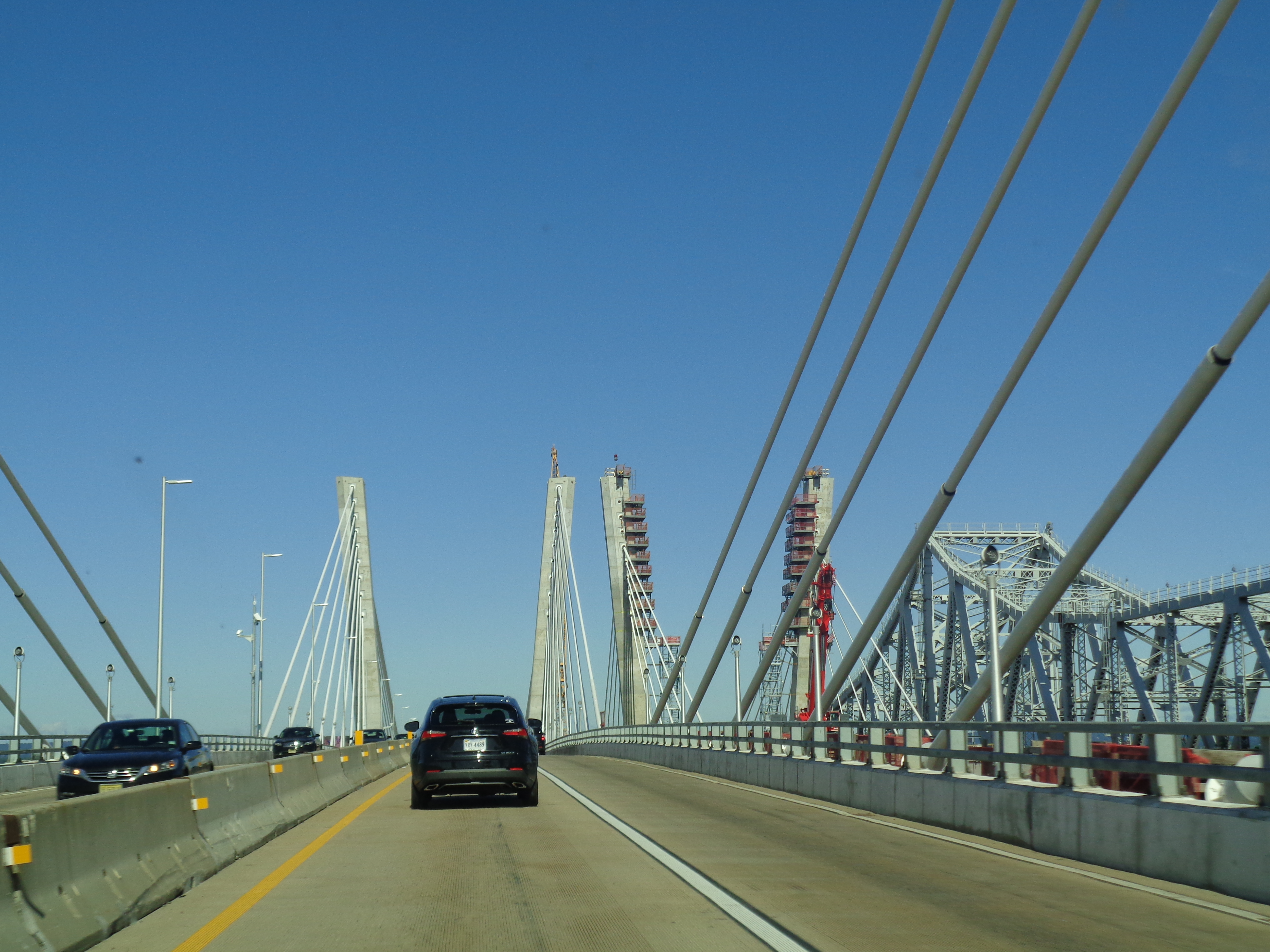
Goethals Bridge
The bridge carries the name of George Washington Goethals, the Army Corps of Engineers general who supervised construction of the Panama Canal and later became the first consulting engineer of the Port Authority of New York and New Jersey. It's a fitting legacy: Goethals spent his career connecting places that geography had separated, and the bridge bearing his name has been doing exactly that across the Arthur Kill strait since 1928 — first as a steel cantilever, and since 2017 as a pair of cable-stayed spans that replaced it.
The Original Structure
The first Goethals Bridge was a four-lane steel truss cantilever design by engineer John Alexander Low Waddell, who also designed the nearby Outerbridge Crossing. It stretched 7,109 feet, stood 62 feet wide, and provided 135 feet of vertical clearance over the Arthur Kill — the brackish tidal strait that separates Staten Island from New Jersey. The bridge opened in 1928 as one of several crossings built in the region during the postwar expansion of automobile infrastructure. For nearly nine decades it served as a critical link for commuters and freight moving between New Jersey and the New York metropolitan area. By the early 2000s, however, the Port Authority had concluded that the structure was aging and insufficient for modern traffic demands.
Decades of Planning
The process of replacing the Goethals Bridge was almost comically long. The Port Authority began studying alternatives in 1985. By 1990, executives had decided a new parallel span was the best solution. A final environmental impact statement was issued in 1997. Staten Island officials objected, citing potential traffic increases. A 2001 study recommended a fully new structure. Public hearings on the draft environmental impact statement were held in 2009. The Port Authority approved the $1.5-billion replacement project in April 2013 — nearly thirty years after the first studies began. Part of the complexity was aeronautical: the FAA required bridge towers to stay below 272 feet because of flight paths at Newark Liberty International Airport, just 2.5 miles north on the New Jersey side. The towers also had to slant outward to prevent ice accumulation from falling onto the roadway.
The New Bridge
The replacement Goethals Bridge is actually two structures — a pair of cable-stayed spans built sequentially so traffic could keep moving during construction. The eastbound span opened on June 10, 2017, at which point the old cantilever bridge was closed. The original was dismantled in January 2018. The westbound span opened on May 21, 2018. Space was deliberately left between the two bridges to accommodate potential future transit service, though no rail or dedicated bus lane was included in the initial design. A shared pedestrian and bicycle path, restored with the new westbound span, finally opened on March 4, 2020. The project won ENR New York's Project of the Year for 2018. Tolls are collected eastbound only, a practice dating to August 1970 when westbound tolls were abolished and eastbound tolls were doubled — a policy applied simultaneously to eleven other crossings in the region.
A Name That Earns Its Place
George Washington Goethals led the construction of the Panama Canal from 1907 to 1914, solving engineering and logistical problems that had defeated a French attempt for two decades. The Canal connected the Atlantic and Pacific oceans; the bridge connecting New Jersey and Staten Island is a more modest crossing, but the principle is the same. The Arthur Kill is a strait that commerce and commuters have always needed to cross. The bridge that bears Goethals' name has been their means of crossing it for nearly a century — first in steel cantilever, now in cable-stayed twin spans that will carry the traffic of the New York region well into this one.
From the Air
Located at 40.636°N, 74.197°W, crossing the Arthur Kill strait between Elizabeth, New Jersey, and Staten Island, New York. The bridge is approximately 2.5 miles south of Newark Liberty International Airport (EWR) — pilots approaching or departing EWR will cross directly over or near it. The cable-stayed towers are constrained to 272 feet by FAA height restrictions. Excellent landmark for navigation: the twin spans are easily visible from pattern altitude and distinguish the Goethals from the nearby Outerbridge Crossing to the south. Viewing altitude of 1,500 to 2,500 feet MSL provides a clear look at the bridge structure and the industrial waterfront on both shores.