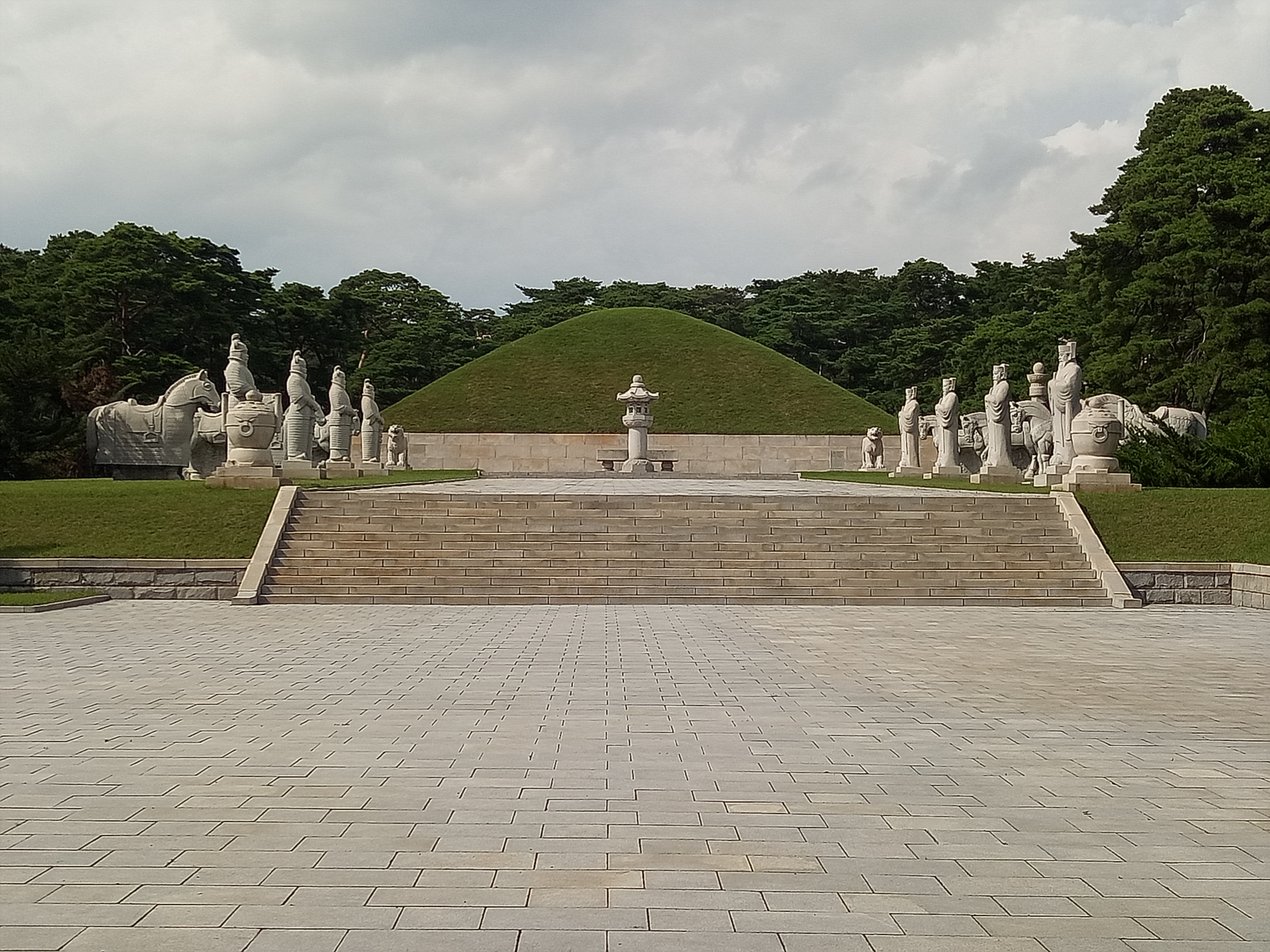
Goguryeo Tombs
Almost everything the Goguryeo kingdom built is gone. The fortresses that once guarded the passes between Manchuria and the Korean Peninsula have crumbled. The palaces of its capitals survive only as foundations. But underground, sealed inside stone burial chambers for more than fifteen hundred years, the murals remain. Thirty tombs near Pyongyang and Nampo, collectively designated the Complex of Koguryo Tombs, became North Korea's first UNESCO World Heritage site in July 2004 -- a recognition that these painted burial chambers hold nearly all that survives of a kingdom that dominated northeast Asia for seven centuries.
A Kingdom Preserved in Paint
Goguryeo was founded around 37 BCE in what is now northern Korea and southern Manchuria, and it grew into one of the most powerful states in East Asia. At its height, it controlled territory from central Korea to deep into modern China's Jilin province, and it fought the Sui and Tang dynasties to a standstill. When the kingdom fell in 668 CE, its architectural legacy was largely destroyed or absorbed by successor states. The tombs are the exception. Of more than 10,000 Goguryeo burial sites identified across China and Korea, only about 90 contain wall paintings. The UNESCO-inscribed complex near Pyongyang holds the majority of these painted tombs, making it the single most important repository of Goguryeo visual culture in existence.
Daily Life in Vivid Color
The murals are not subtle. Painted in strong, saturated colors that have barely faded, they depict scenes of daily life, mythology, hunting, warfare, and celestial imagery. Anak Tomb No. 3, one of the most famous in the complex, contains a portrait of the official Dong Shou, a former Yan dynasty figure who crossed into Goguryeo service -- a reminder that this was a cosmopolitan kingdom with roots in both Korean and Chinese traditions. Other tombs show mounted archers at full gallop, wrestlers locked in combat, musicians playing stringed instruments, and elaborate processions of officials in flowing robes. By 2005, seventy murals had been documented, most found along the Taedong River basin near Pyongyang, in the Anak area of South Hwanghae Province, and across the border in Ji'an, China's Jilin Province.
Engineering Underground
UNESCO recognized the tombs not only for their artistic value but for their engineering. The burial chambers demonstrate sophisticated construction techniques -- carefully cut stone slabs, corbelled ceilings, and drainage systems designed to protect the interiors from groundwater. The tombs were built to last, and they have. The complex includes the Tomb of King Tongmyong, the semi-legendary founder of Goguryeo, whose burial site became a focus of royal veneration for centuries. The scale of the wider Goguryeo burial tradition became clearer in May 2006, when construction work on China's Yunfeng Reservoir uncovered 2,360 additional tombs along with the ruins of an ancient walled city -- complete with a 1.5-meter wall, a four-meter-wide foundation, and evidence of a moat.
Contested Heritage
The Goguryeo tombs sit at the center of a modern dispute as charged as any ancient border war. Both North Korea and China claim Goguryeo as part of their national heritage, since the kingdom's territory straddled what is now the border between the two countries. China inscribed its own Goguryeo sites -- the Capital Cities and Tombs of the Ancient Koguryo Kingdom, located in Jilin Province -- as a UNESCO World Heritage site in the same year, 2004. South Korea, which traces its national lineage through Goguryeo to the later Goryeo and Joseon dynasties, views the Chinese claim as historical revisionism. The painted tombs near Pyongyang, regardless of which modern state claims them, preserve something that belongs to none of them exclusively: a window into a vanished civilization's understanding of life, death, and the worlds that come after both.
From the Air
The tombs are located at approximately 38.86N, 125.42E, in the Pyongyang and Nampo areas of North Korea. The sites are distributed along the Taedong River basin. Pyongyang Sunan International Airport (ZKPY) is the nearest major airport, roughly 15 km to the northeast. From altitude, the individual tomb sites are difficult to distinguish from the surrounding landscape, but the Taedong River valley and Pyongyang's distinctive urban grid provide orientation. The Anak tomb cluster is located in South Hwanghae Province, approximately 60 km southwest of Pyongyang.