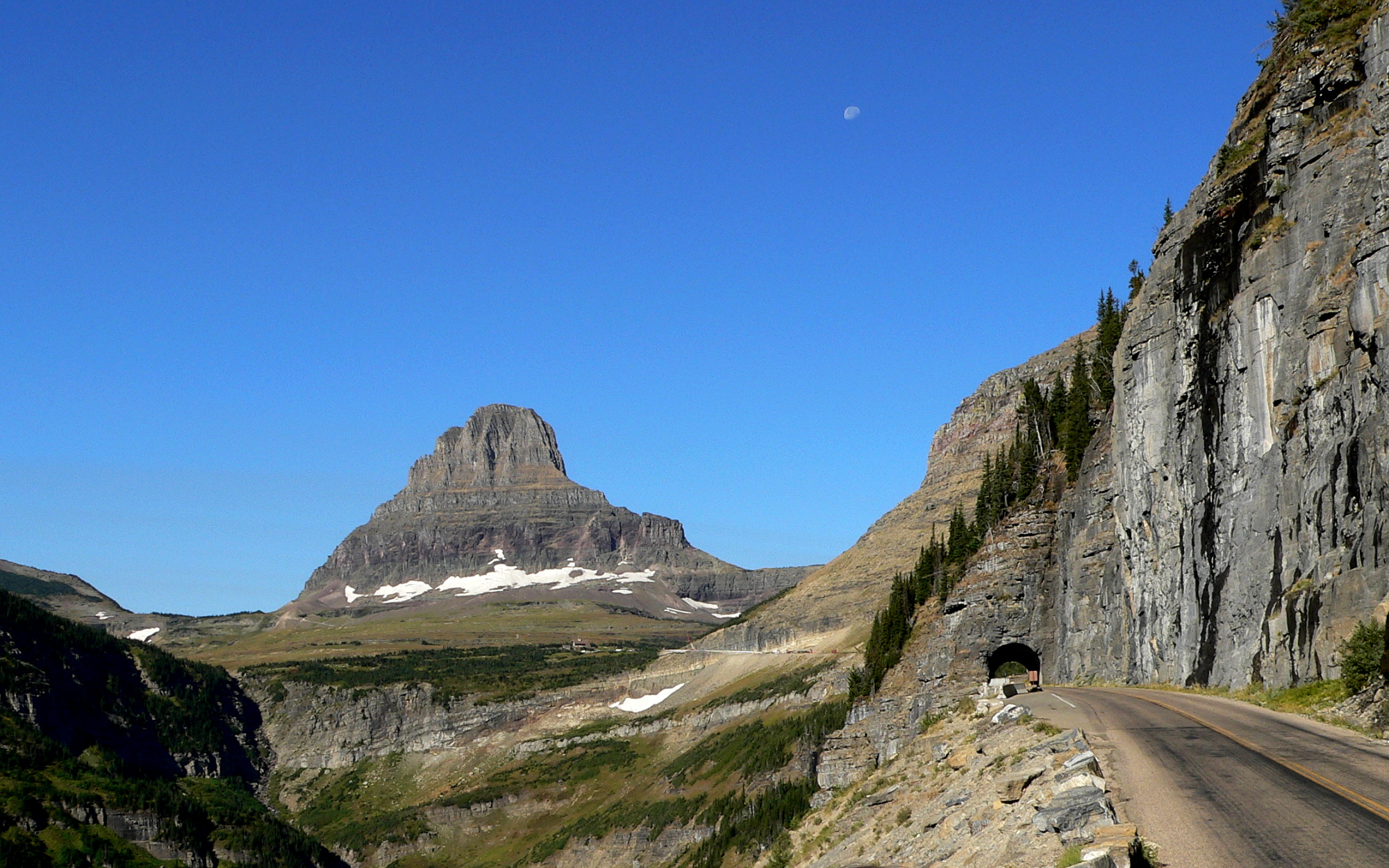
Going-to-the-Sun Road
The road clings to the mountainside like it has no business being there - and it almost wasn't built at all. For twelve years, from 1921 to 1933, workers blasted and carved a passage through some of the most challenging terrain in North America, creating a 50-mile route that climbs from valley floor to Logan Pass at 6,646 feet, crossing the Continental Divide through the heart of Glacier National Park. What they left behind is widely considered America's most scenic mountain road, a National Historic Landmark where every turn reveals peaks, glaciers, waterfalls, and drops that make passengers reach for the armrest.
Building the Impossible
When superintendent George Goodwin first conceived of a road crossing Glacier in 1917, critics called it impossible. The terrain was simply too steep, too rugged, too avalanche-prone. But Goodwin became the Park Service's chief engineer and made the road his life's work. Construction began in 1921 with workers dangling from ropes to drill blast holes into sheer cliffs.
As the project advanced, landscape architect Thomas Chalmers Vint proposed routing the upper portion along the Garden Wall escarpment - a knife-edge ridge that would require even more daring construction but would reduce switchbacks and minimize the road's visual impact on the landscape. Vint's alignment prevailed, at significantly increased cost. When the road finally opened end-to-end in 1933, it had cost $2.5 million - extraordinary for the era. The result was worth every penny.
The Garden Wall
West of Logan Pass, the road traverses the Garden Wall, a knife-edge arête carved by glaciers on either side. Here the engineering reaches its most audacious: the pavement is carved directly into the cliff face, with nothing between your wheels and a thousand-foot drop but a low stone wall. The Weeping Wall, where snowmelt cascades directly onto the road, soaks passing cars in early summer.
The road is narrow - too narrow for modern sensibilities. Vehicles longer than 21 feet or wider than 8 feet are prohibited between Avalanche Creek and Rising Sun, which covers the most dramatic sections. Rock overhangs west of Logan Pass limit height to 10 feet in places. These restrictions aren't bureaucratic inconveniences; they're the reality of a road carved into living rock nearly a century ago.
Red Jammers
Since the 1930s, distinctive red buses have carried visitors along the Sun Road, their canvas tops rolling back to reveal the enormity of the peaks. The original drivers earned the nickname "Gear Jammers" - they had to jam the manual gearbox into low gear to safely negotiate the steepest grades. The name stuck even after the fleet was modernized in 2001.
Today's Red Jammers continue a tradition nearly as old as the road itself. The guided tours offer history, geology, and wildlife spotting, but mostly they offer the chance to watch the scenery instead of the road. Modern shuttle buses also operate for shorter trips, and Blackfeet tour buses run on the east side, where the road descends toward the high plains of the reservation.
The Mountain Lake
The road has appeared in film far more than most realize. In Stanley Kubrick's The Shining, the opening credits show Jack Torrance's car winding along Saint Mary Lake's north shore, through the East Side tunnel - a location standing in for the fictional Overlook Hotel's approach. The scene reappeared in the 2019 sequel, Doctor Sleep.
In Forrest Gump, as Forrest reminisces about running across America, he remembers a mountain lake "so clear, Jenny, it looked like there were two skies, one on top of the other." That lake was Saint Mary, the Going-to-the-Sun Road visible behind him. Fleet Foxes wrote a song named after the road for their 2020 album Shore. Something about this place - its drama, its impossible beauty - captures the imagination of anyone who sees it.
Points of Wonder
From west to east, the road strings together landmarks like pearls on a necklace. Lake McDonald stretches ten miles in the cedar forest. The Trail of the Cedars winds through ancient giants. Bird Woman Falls drops 492 feet from a hanging valley. The Garden Wall rises like a castle wall. Logan Pass sits atop the Continental Divide, where mountain goats graze in alpine meadows.
East of the pass, the character changes. The land opens up, drier and more exposed. Going-to-the-Sun Mountain gave the road its name - a peak sacred to the Blackfeet people, named for their story of Sour Spirit, who traveled there to teach the tribe essential skills. Saint Mary Lake reflects the peaks, and the Rising Sun Auto Camp preserves the spirit of 1930s road-trip tourism. Each stop rewards attention, but the road itself is the destination.
From the Air
Located at 48.70N, 113.82W, crossing Glacier National Park from West Glacier to St. Mary, Montana. The road is visible from altitude as a thin ribbon carved into the mountainside, particularly spectacular along the Garden Wall section west of Logan Pass. Logan Pass (6,646 ft) is the high point, visible as a saddle on the Continental Divide. Lake McDonald is the large lake on the west side; Saint Mary Lake on the east. The road typically opens late June/early July and closes by mid-October due to snow. Nearest airports: Glacier Park International (KGPI) in Kalispell; Cut Bank Municipal (KCTB) on the east side. Mountain weather unpredictable; afternoon thunderstorms common in summer. The Garden Wall creates significant turbulence when winds are from the west.