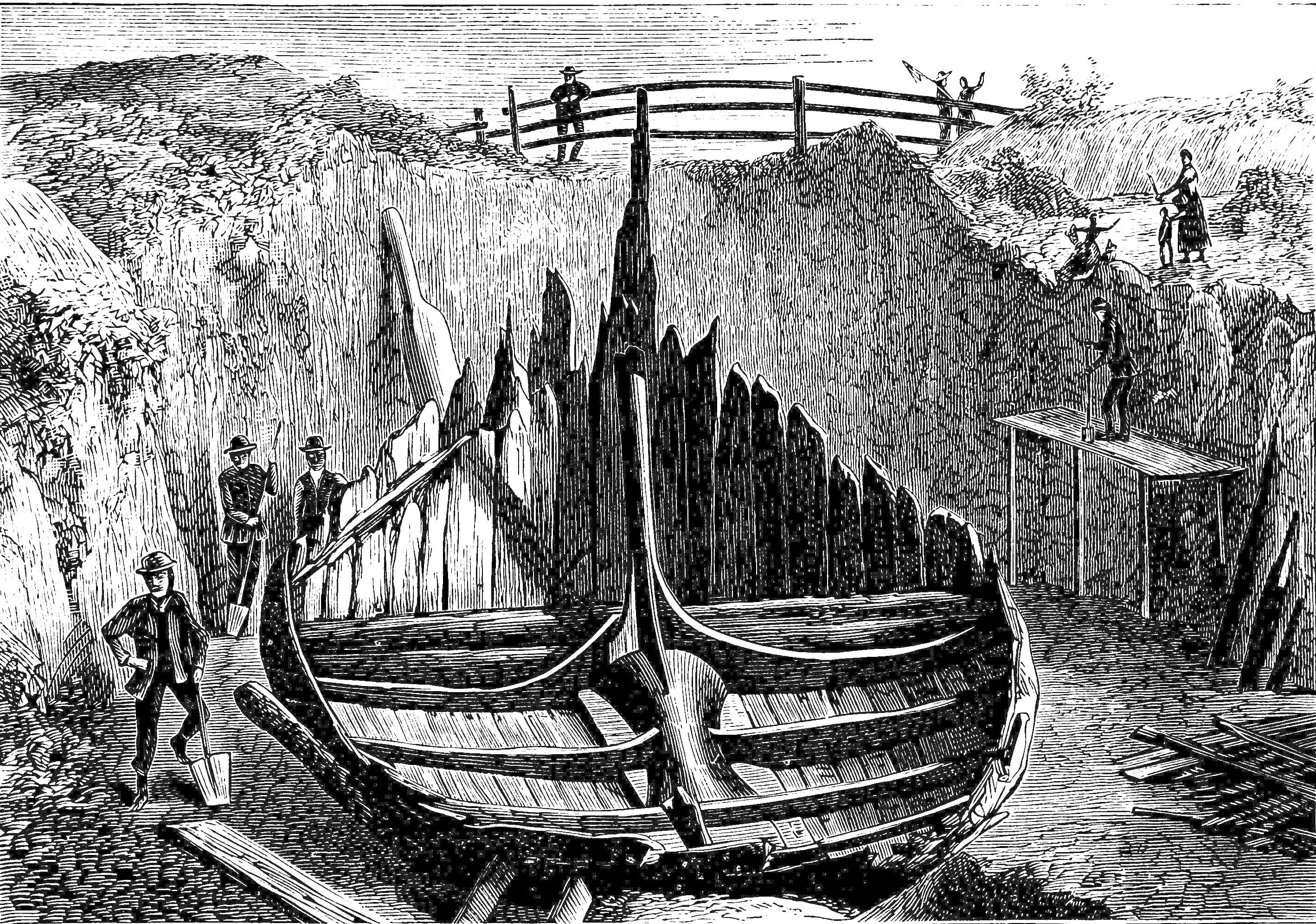
Gokstad Mound
In 1879, a farmer at Gokstad Farm in Sandefjord noticed something unusual in a large earthen mound on his property. What he had found would take another year to fully uncover -- and more than a century to fully understand. Beneath fifty meters of compacted earth lay a 23.8-meter ship built of oak, buried around the year 900 with a chieftain, his weapons, his horses, and enough grave goods to suggest he expected the afterlife to be comfortable. The Gokstad Mound, also called the King's Mound, has been called one of Norway's finest archaeological discoveries.
A Ship for the Next World
The Gokstad Ship was constructed around 890 AD and placed in its burial mound roughly a decade later. Built primarily of oak, it measured 23.8 meters in length and 5.2 meters in width, with 16 pairs of oars and an estimated top speed of twelve knots under sail. This was not a ceremonial replica but a seaworthy vessel, capable of ocean crossings. The chieftain buried within it was tall for his era -- between 181 and 183 centimeters -- and analysis of his remains suggests he died in battle around the age of 40. For a long time, scholars believed he was Olaf Geirstad-Alf, the half-brother of Halfdan the Black, but more recent research has cast doubt on that identification. His name remains unknown.
What the Grave Contained
The inventory of the Gokstad burial reads like a catalog of Viking life and death. Alongside the ship, excavators found 64 shields, a gaming board with horn counters, fishing hooks, kitchen utensils, six beds, a sleigh, and three smaller boats. Harness fittings of lead, iron, and gilded bronze spoke to the chieftain's status. But it was the animal remains that gave the burial its eerie grandeur: twelve horses, eight dogs, two goshawks, and two peacocks accompanied the dead man into the mound. The peacocks, exotic birds far from their native habitat, hinted at trade networks stretching south and east, connecting Viking Vestfold to a wider world. Archaeologist Nicolay Nicolaysen excavated the site between April and June of 1880, and the ship now resides at the Museum of the Viking Age in Oslo (the former Viking Ship Museum collection, in a new building).
Buried Near the Sea
When measured in 1880, the mound was 50 meters in diameter and 5 meters high. But the landscape around it has changed in ways the burial's creators could not have predicted. During the Viking Age, ocean water levels stood nearly 4 meters higher than today, which means the ship was originally buried close to the shoreline. The chieftain's final resting place was chosen to face the sea -- the element that had defined his life and power. Over the centuries, the land rose and the water retreated, leaving the mound stranded in what is now a quiet agricultural landscape. The connection to the fjord that once made this spot meaningful has been erased by geology, but not from the archaeological record.
The Mound Restored
After two years of restoration, the mound was formally rededicated on July 20, 1929, with between 2,000 and 3,000 spectators in attendance. King Haakon VII gave a speech at the ceremony, and a stone fence was erected around the site with birch trees planted along it. The chieftain's knuckle bones, returned to the grave in a sarcophagus on June 16, 1928, were brought back out by archaeologists in 2007 and are now held at the University of Oslo. The Gokstad Ship itself was relocated from the Viking Ship Museum (which closed for redevelopment) and is awaiting display in the new Museum of the Viking Age, expected to open in Oslo in 2027. The mound itself remains, a grassy dome in the Vestfold countryside -- unremarkable to anyone who does not know what it once held. That gap between appearance and significance is part of what makes Gokstad so compelling. A field, a hill, and beneath it, one of the great ships of the Viking world.
From the Air
Located at 59.14N, 10.25E at Gokstad Farm in Sandefjord, Vestfold county, Norway. The mound is a circular, grassy feature approximately 50 meters in diameter, visible from low altitude but easily missed from higher up. Nearest airport is Torp Sandefjord Airport (ENTO), approximately 8 km to the southwest. Oslo Gardermoen (ENGM) is about 130 km to the north. The site is on the western shore of the Oslofjord, and the surrounding landscape is flat agricultural land. Best viewed at 1,500-3,000 feet AGL to distinguish the mound from the surrounding fields.