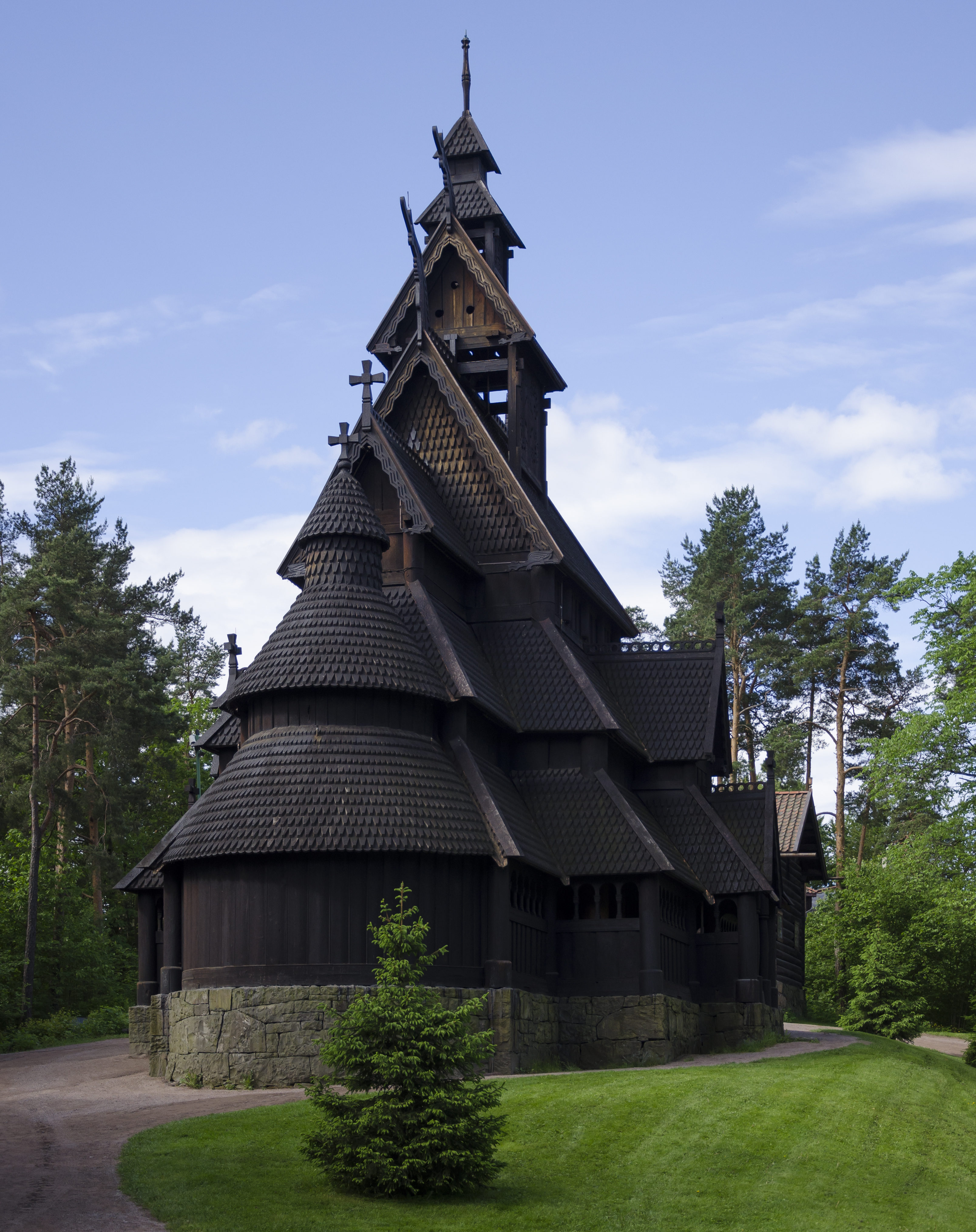
Gol Stave Church
For 200 kroner -- roughly the price of a few meals in 1880s Norway -- the Society for the Preservation of Ancient Norwegian Monuments bought the original timbers of a medieval church that its own congregation wanted to demolish. That transaction saved one of the finest surviving examples of Scandinavian stave architecture, a building whose pine posts and carved portals date back as far as 1157. Today Gol Stave Church stands not in Hallingdal, the mountain valley where it was built, but on the Bygdoy peninsula in Oslo, where it has anchored the Norwegian Museum of Cultural History for more than a century.
Raised on Living Trees
Stave churches take their name from their construction: vertical timber posts, or staves, that bear the weight of the building. Dendrochronological analysis places Gol's timbers between 1157 and 1216, making the church roughly contemporary with the great stone cathedrals rising across Europe. But where those cathedrals relied on quarried limestone, Gol's builders worked in pine -- a material that demanded constant vigilance against rot. The church they created featured a raised central space supported by freestanding posts, with a narrower choir ending in a rounded apse. Its west portal, largely original, is carved with interlocking leaf vines, animal jaws, and crowned male heads -- a visual language that blurs the line between Viking-age ornamentation and Christian devotion. For roughly five centuries the church stood in its original form on a mountainside above the Hallingdal valley, serving a growing congregation that would eventually outgrow it.
Centuries of Change, Then a Close Call
By the 17th century, the church had already been modified. A ceiling was installed, windows were cut into the south wall, and in 1652 a painter decorated the choir and apse with murals depicting the Last Supper and the four evangelists. The same itinerant artist left his mark on at least six other stave churches across Buskerud, working his way through the region over a decade. Around 1730, a gallery was added to the north side, and eventually the choir and apse were demolished and rebuilt in half-timber. Through all of this, the murals survived -- the old ceiling materials were reused, preserving the painted surfaces behind new construction. When the congregation expanded the building again in 1802, they demolished the original surrounding aisles and erected new outer walls, fundamentally altering the church's silhouette. By the 1870s, the people of Gol wanted something modern. The stave church was slated for demolition.
A King's Intervention
Preservationists from the Society for the Preservation of Ancient Norwegian Monuments (Fortidsminneforeningen) tried to save the church in place, but the congregation insisted on clearing the site. The society managed to purchase the medieval components for 200 kroner, with the condition that everything be removed once a new church was finished. There was one problem: the society had no land, and its fundraising produced only 387 kroner against estimated costs of at least 6,500. King Oscar II stepped in. In 1881, he had established what is recognized as the world's first open-air museum on his Bygdoy royal estate, and he offered both land and funding to make the church its centerpiece. The timbers were dismantled in January 1884, and when winter finally brought enough snow, they were loaded onto sledges, hauled to Kroderen station, and shipped by rail to what was then called Kristiania. By the summer of 1885, the church stood reassembled on Bygdoy, restored to what architects believed was its original medieval form, with Borgund Stave Church serving as the primary model for reconstructed elements like the surrounding arcade and roof rider.
Medieval Bones, Modern Skin
The reconstruction was both preservation and interpretation. Architect Waldemar Hansteen and builder Torsten Torstensen retained the original foundations, sleeper beams, structural posts, and most of the raised central framework. But centuries of modification meant the church could not simply be put back the way it had stood in Gol. Instead, the architects relied on 17th-century church account books, which described details like the roof rider with its two bells and saddle roof. Where Gol's own records fell silent, they borrowed from better-preserved churches -- wind vanes patterned after Hopperstad, the arcade after Borgund. The 1652 murals were carefully restored and reinstalled in the choir. All post-Reformation furniture was removed to maintain the medieval character. King Oscar even contributed a carved bench from Heddal Stave Church. When the king's collections merged with the Norwegian Museum of Cultural History in 1907, the church came under the museum's management, though it remains nominally the property of the Norwegian monarch to this day.
Echoes Across Continents
Gol Stave Church has inspired replicas that span the globe. In 1995, a faithful copy was built in the town of Gol itself as part of the Gordarike Family Park, though it stands at the valley floor rather than on the mountainside where the original once rose. Another replica anchors the Scandinavian Heritage Park in Minot, North Dakota, serving as a touchstone for the region's large Norwegian-American community. Perhaps the most recognizable copy stands in Epcot at Walt Disney World in Florida, where it represents Norway in the park's World Showcase. A smaller-scale version, Stavkirka on Savjord, was privately funded and completed in 2008 in Beiarn, Nordland. Each copy testifies to the same impulse that drove King Oscar II to save the original: the conviction that this timber building, with its dragon-headed gables and intertwined carvings, embodies something essential about Norwegian identity -- a construction tradition so distinctive that it has become the country's architectural signature.
From the Air
Located at 59.908N, 10.683E on the Bygdoy peninsula in western Oslo. The church sits within the Norwegian Museum of Cultural History grounds, visible as a dark wooden structure amid the museum's open-air collection. Nearest airport is Oslo Gardermoen (ENGM), approximately 50 km northeast. Oslo Fornebu (former ENFO, now closed) was the closer field. Approach from the Oslofjord to the south for best views of the Bygdoy museum peninsula. Recommended viewing altitude: 1,500-2,000 feet AGL.