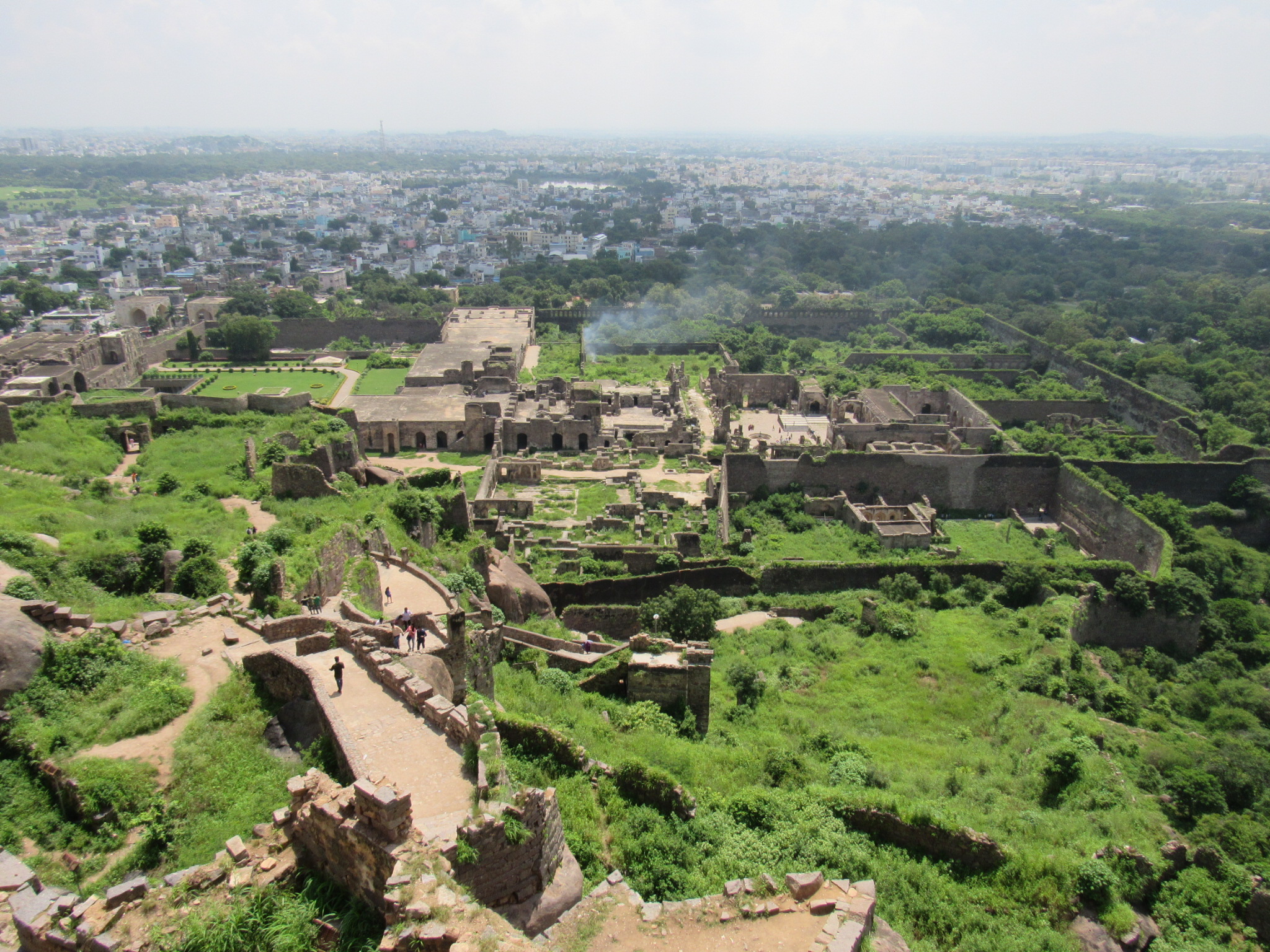
Golconda
Clap your hands at the entrance dome of Golconda Fort and the sound carries nearly a kilometer, reaching the Bala Hisar pavilion at the summit with startling clarity. This acoustic trick was not entertainment -- it was a siege warning system, built into the granite by engineers who understood that a fortress guarding the world's diamond trade needed every advantage it could get. For centuries, Golconda was where the earth's most famous gems changed hands. The Koh-i-Noor, the Hope Diamond, the Regent Diamond -- all passed through this citadel on the western outskirts of what is now Hyderabad. The name itself became a word in the English language: by the 1880s, "Golconda" meant any source of extraordinary wealth. John Keats opened a poem asking, "Hast thou from the caves of Golconda, a gem pure as the ice-drop that froze on the mountain?"
From Mud to Granite
The fort began modestly in the eleventh century as a mud-walled outpost built by the Kakatiya dynasty's Prataparudra to defend the western frontier. When Sultan Quli of the Qutb Shahi dynasty seized power in 1518, he recognized the strategic value of the hilltop and declared it his capital. Over the next 62 years, the first three Qutb Shahi sultans transformed the mud fort into a massive granite fortification stretching five kilometers in circumference. A seven-kilometer outer wall eventually enclosed the entire city. The fort would serve as the Qutb Shahi capital until 1590, when the dynasty shifted its seat to the new city of Hyderabad below. But Golconda remained the stronghold -- the place you retreated to when the world turned hostile.
The Diamond Capital
India held the world's only known diamond mines during the Kakatiya reign, and Golconda sat at the center of the trade. Gems from the Kollur Mine and others across the region were cut and sold within the fortress city's walls. The diamonds that passed through here read like a catalog of legend: the Daria-i-Noor, the Noor-ul-Ain, the Koh-i-Noor, the Hope Diamond, the Princie Diamond, the Regent Diamond, the Wittelsbach-Graff Diamond. Gemologists still use "Golconda" to classify the extremely rare Type IIa diamond -- crystals lacking nitrogen impurities, producing stones of extraordinary colorlessness and brilliance. Anthony Doerr placed the fictional "Sea of Flames" diamond in these mines in his Pulitzer Prize-winning novel All the Light We Cannot See. Rene Magritte named a painting after the city. The real Golconda hardly needed fiction to enhance its reputation.
Walls That Held and Walls That Fell
Golconda's defenses were formidable. Four distinct forts nested within a 10-kilometer outer wall punctuated by 87 semicircular bastions, eight gateways, and four drawbridges. The Fateh Darwaza -- Victory Gate -- earned its name only after Mughal emperor Aurangzeb's army finally marched through it in 1687, following an eight-month siege that only succeeded through treachery. Giant iron spikes studded the gate to prevent war elephants from battering it down. The Bala Hisar gate on the eastern side preserves carved peacocks and lions in the Hindu architectural style of the fort's Kakatiya origins -- a reminder that this was a Hindu fortress long before it became an Islamic sultanate. Cannons from the Mughal siege remain mounted on the bastions, including the Azhdaha-Paikar, a bimetallic cannon cast in 1647.
Sacred Ground and Living History
Hindu temples and Islamic mosques coexist within the fort's walls, reflecting centuries of layered rule. The Jagadamba temple, roughly 900 to 1,000 years old, draws hundreds of thousands of devotees during the annual Bonalu festival. A Mahankali temple stands nearby. The mosque of Ibrahim sits adjacent to the king's palace. This was never a monolithic culture -- it was a palimpsest, each dynasty adding its own layer without entirely erasing what came before. A kilometer north of the outer wall, the Qutb Shahi tombs stand among landscaped gardens, their Indo-Islamic architecture displaying the beautifully carved stonework of a dynasty that ruled for over 170 years. The Naya Qila extension, built after a failed Mughal siege in 1656, now houses the Hyderabad Golf Club -- a fate the fort's builders could not have imagined. An ancient baobab tree of enormous girth, known locally as Hatiyan ka Jhad (Elephant-sized tree), grows among the ramparts.
From the Air
Golconda Fort sits at 17.38N, 78.40E on a prominent hill on the western outskirts of Hyderabad. The fort complex is visible from altitude as a large fortified hilltop structure with extensive walls radiating outward. The Qutb Shahi tombs are visible 1 km to the north. Nearest airport is Rajiv Gandhi International (VOHS/HYD), approximately 25 km to the southeast. Elevation roughly 480 meters on the Deccan Plateau. The 10 km outer wall and 87 bastions create a distinctive footprint from the air.