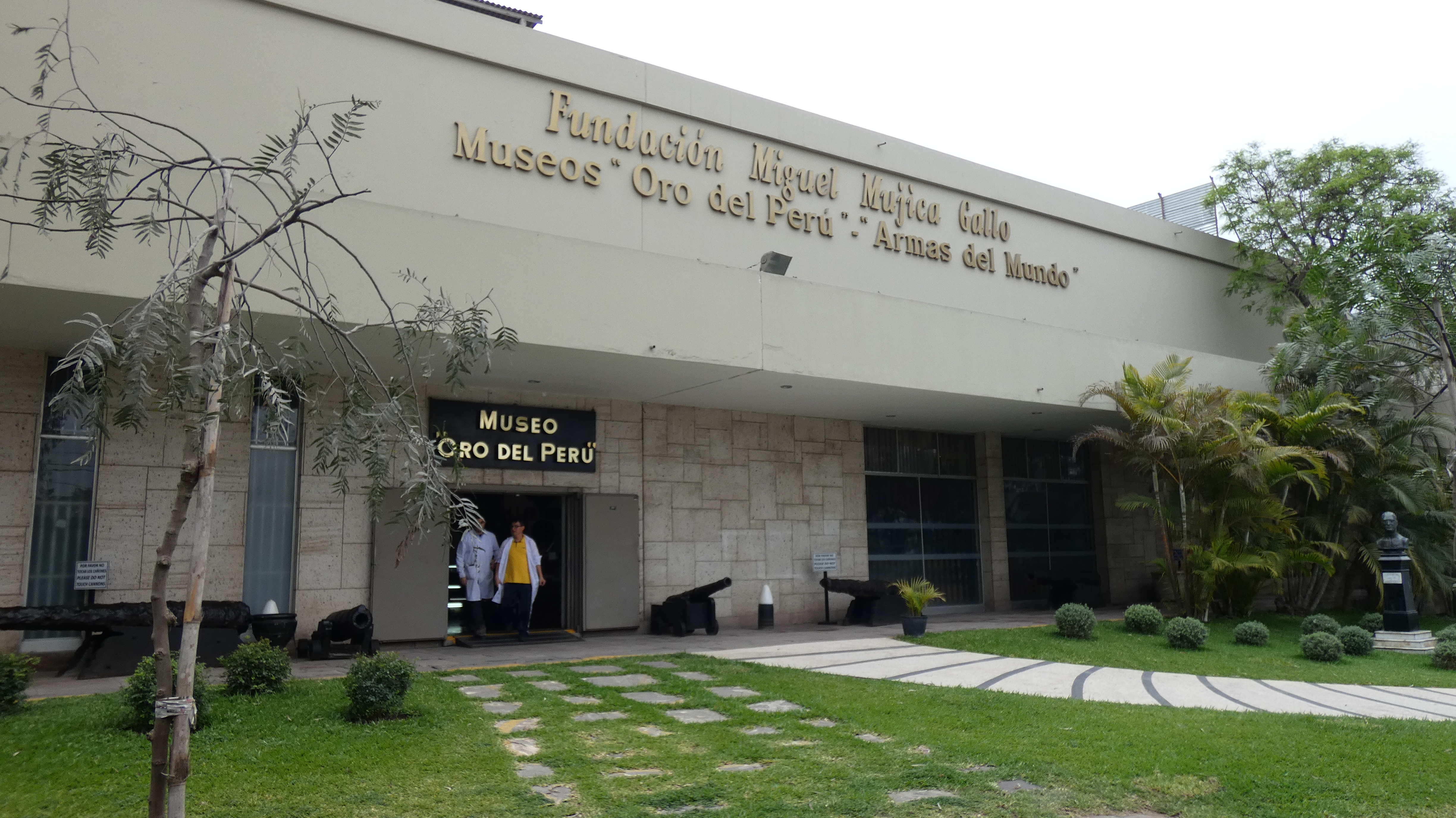
Gold Museum of Peru and Arms of the World
You enter through a vault door. The building is reinforced concrete, two stories, designed less like a museum and more like a bank. Inside, golden masks stare from behind glass: Sican faces with almond eyes, Moche nose rings, Inca wall plates thick enough to clad a temple. Upstairs, 20,000 weapons spanning seven centuries line the walls. This is the Gold Museum of Peru and Arms of the World, built in the 1960s by a diplomat named Miguel Mujica Gallo in the quiet Lima suburb of Monterrico. It was his private obsession made public -- and then, decades later, his private embarrassment made headlines when investigators reported that 85 percent of the gold pieces were likely forgeries.
The Collector and His Vault
Miguel Mujica Gallo was a Peruvian diplomat, an avid hunter, and a collector with a seemingly bottomless appetite for pre-Columbian artifacts and military weaponry. Beginning in the 1960s, he assembled over 7,000 gold pieces attributed to cultures that preceded the Inca: the Vicus, Moche, Sican, and Chimu civilizations, along with Inca-era objects. The collection included textiles, ceramics, and mummies in addition to the gold, silver, and platinum metalwork. He valued it at over $10 million. Alongside the archaeology, Mujica amassed more than 20,000 weapons from around the world, the oldest dating to the 13th century, along with military uniforms, saddles, armor, and spurs. He owned the museum until 1993, when he donated it to the Peruvian state. Today it is administered by the Miguel Mujica Gallo Foundation, directed by his daughter Victoria Mujica Diez Canseco.
Glitter and Doubt
Doubts about the collection's authenticity surfaced as early as the 1980s. Then, in a 2001 report, investigators concluded that roughly 85 percent of the gold pieces were of illegitimate authenticity -- a polite way of saying most of the museum's star attractions were forgeries. The revelation was devastating but perhaps not surprising: Peru's black market in pre-Columbian artifacts has long been one of the most active in the world, and the line between genuine and counterfeit has always been difficult to draw without laboratory analysis. Whether Mujica was a knowing participant or an enthusiastic victim of the forgery trade remains a matter of debate. The museum remains open, and the surviving authentic pieces -- golden gloves from the Sican culture, ceremonial bags from the Frias culture, masks that have passed scientific scrutiny -- are still worth seeing. The forgery scandal, oddly enough, has become part of the museum's story, a cautionary tale about the hunger for pre-Columbian gold that has driven collectors and looters alike for five centuries.
Swords Beside the Sarcophagi
The weapons collection occupies the upper floor and represents a different kind of obsession entirely. Mujica was a hunter, and his eye for armament extended well beyond the Andean world. The collection spans from 13th-century blades to modern military equipment, including swords that once belonged to Alexander I of Russia and Ferdinand VII of Spain. Military uniforms from multiple continents hang in cases near cavalry saddles and ornate spurs. The juxtaposition is deliberate and slightly unnerving: upstairs, the tools of global warfare; downstairs, the ceremonial objects of civilizations that those kinds of tools helped destroy. The museum's original grounds also included a restaurant called the Pabellon de Caza, designed by architect Luis Risso Arguedas and restaurateur Arturo Rubio, which became one of Lima's most fashionable dining spots in the early 1980s. Its original gate was reinforced after a terrorist attack destroyed it -- a reminder that the violence the museum curates is not always safely in the past.
The Weight of Gold
What endures about the Gold Museum is the question it raises about authenticity and desire. The pre-Columbian cultures of Peru's coast -- Vicus, Moche, Sican, Chimu -- were genuine masters of metalwork, producing objects of extraordinary refinement from gold, silver, and platinum. The real pieces in the collection demonstrate this clearly: the craftsmanship in a Sican golden mask or a Moche nose ring is unmistakable, the result of techniques developed over centuries. That someone would forge these objects in quantity says something about the power they still exert. The museum sits in Monterrico, a residential neighborhood of Santiago de Surco, next to Mujica's former residence. It is small enough to visit in an afternoon, large enough to make you wonder about the nature of collecting -- about the difference between preserving a civilization's heritage and possessing it, and about what it means when the desire to own the past outstrips the supply of genuine artifacts.
From the Air
The Gold Museum is located at 12.11S, 76.96W in the Monterrico neighborhood of Santiago de Surco, Lima. The site is not visible as a distinct landmark from altitude -- it is a two-story building in a residential area. Jorge Chavez International Airport (SPJC) is approximately 15 km to the northwest. The museum lies roughly 8 km south-southeast of Lima's historic center. Best oriented by the coastline to the west and the sprawl of Lima's southern suburbs.