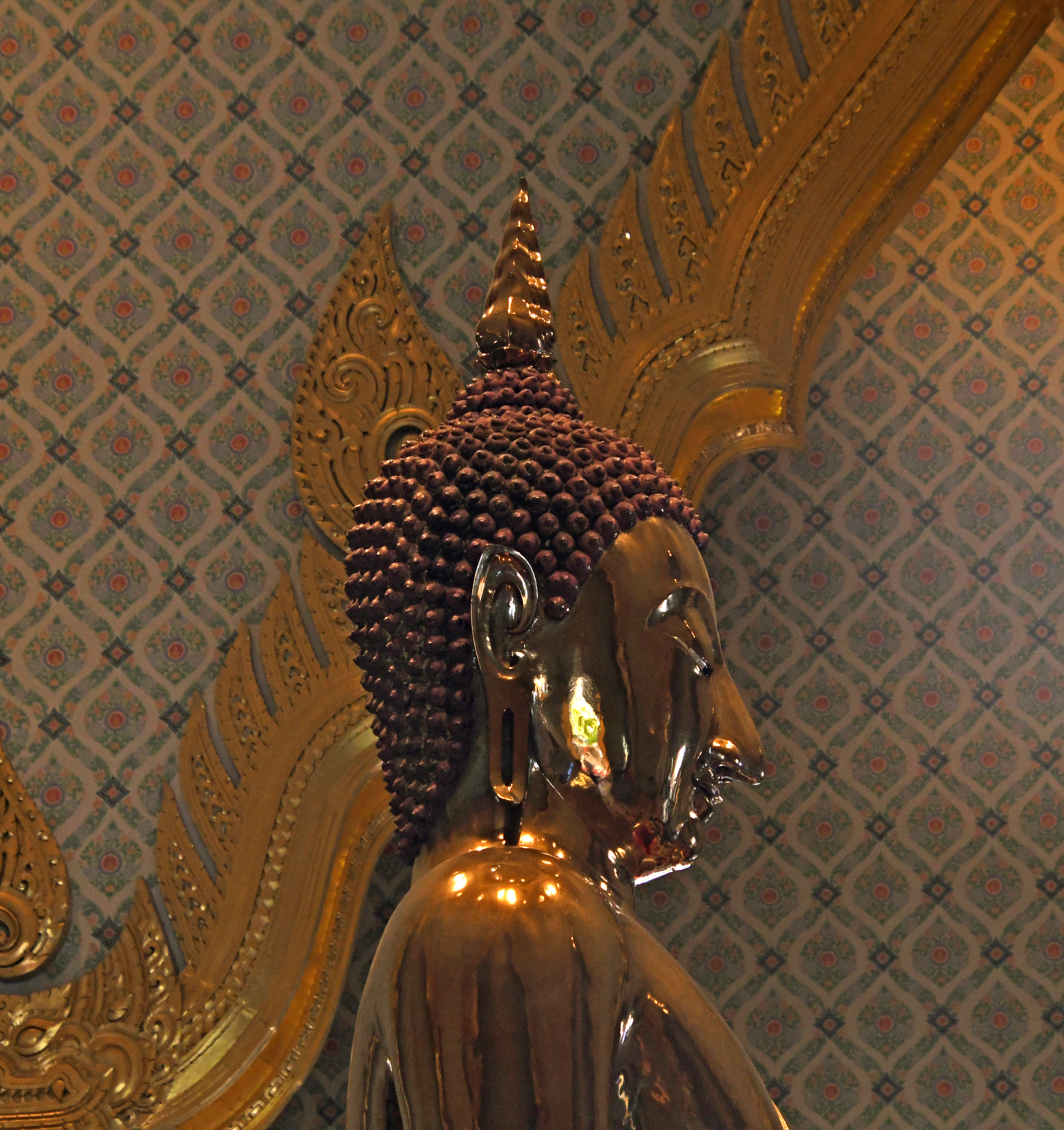
Golden Buddha (statue)
The ropes snapped on 25 May 1955, and the statue fell hard onto the ground. Workers at Wat Traimit had been attempting to move what they believed was a large but unremarkable plaster Buddha into a newly built viharn. When the figure struck the earth, chunks of plaster chipped away from the surface, and underneath, something caught the light. Gold. Not gilding, not leaf -- solid gold, gleaming beneath almost two centuries of deliberately applied stucco and colored glass. The workers stopped immediately. What they had treated as a minor temple ornament turned out to be 5.5 tonnes of pure gold, shaped into a seated Buddha in the Sukhothai style. Someone, centuries earlier, had hidden the most valuable statue in the Buddhist world in plain sight.
A Disguise That Worked Too Well
The statue's origins reach back to the Sukhothai Kingdom of the 13th or 14th century. Its egg-shaped head is characteristic of Sukhothai art at its most refined, influenced by Indian aesthetics and the metal Buddha images exported widely during the Pala period. At some point -- scholars disagree on exactly when -- the statue was moved from Sukhothai to Ayutthaya, probably around 1403. And at some later point, someone covered it completely in a thick layer of stucco, painted and inlaid with bits of colored glass, transforming it from a treasure worth killing for into a devotional object worth ignoring. The disguise was almost certainly applied to protect the statue from theft, possibly during one of the many wars and invasions that swept through the region. It worked so well that the statue's true nature was forgotten entirely.
From Ruin to Revelation
By the 20th century, the plastered statue sat at Wat Chotanaram, a temple near Bangkok's Chinatown on the site of what is now the Asiatique shopping complex. When that temple fell into disrepair and closed in 1935, the statue was moved to the nearby Wat Traimit, where it sat for two decades as an object of modest devotion. No one suspected what lay beneath. The 1955 discovery, triggered by a construction accident, arrived with extraordinary timing. Thailand was approaching the commemoration of the twenty-fifth Buddhist Era -- 2,500 years since Gautama Buddha's passing -- and the Thai news media treated the revelation as something close to miraculous. Buddhists across the country saw it as an auspicious sign, a treasure returning to visibility at the precise moment the faith was celebrating its deepest milestone.
Anatomy of a Golden Masterpiece
Once the plaster was fully removed, conservators discovered that the statue was not a single casting but ten precisely fitted sections, assembled so seamlessly that the joints were invisible. A key was found encased in plaster at the base, designed to disassemble the figure for transport -- further evidence that whoever hid the statue planned to recover it someday but never did. The Buddha stands 3 meters tall in the Bhumisparsha Mudra, the "touching the earth" pose that commemorates Gautama Buddha's enlightenment at Bodh Gaya and his victory over the demon Mara. The flame crowning the ushnisha is a Sukhothai innovation symbolizing spiritual energy. Three wrinkles mark the neck; the earlobes hang long, recalling the Buddha's former life as a prince. Guinness World Records recognizes it as both the world's largest solid gold sculpture and the most valuable religious object on earth.
A New Home for Old Gold
On 14 February 2010, a large new building was inaugurated at Wat Traimit to house the Golden Buddha properly for the first time. The multi-story structure also contains the Bangkok Chinatown Heritage Centre and an exhibition tracing the statue's journey from Sukhothai anonymity through its centuries of concealment to its accidental unveiling. The building sits at the edge of Yaowarat, Bangkok's Chinatown, where the statue's story fits naturally among the neighborhood's layers of hidden value -- gold shops, family businesses, and temple wealth accumulated over generations. Based on gold prices in early 2026, the statue's intrinsic metal value alone approaches $900 million. But the true worth of the Golden Buddha lies in the question it poses: how many other treasures remain hidden, disguised so effectively that the people who pass them every day never think to look?
From the Air
Located at 13.738N, 100.514E in Bangkok's Samphanthawong district, at the edge of Chinatown (Yaowarat). The Wat Traimit complex and its modern multi-story building housing the Golden Buddha are visible at low altitude (1,500-2,500 feet), near the Hua Lamphong railway station and the distinctive curve of Yaowarat Road. The temple sits where Chinatown meets the old city core. Nearest airports: Don Mueang (VTBD) approximately 15 nm north; Suvarnabhumi (VTBS) approximately 16 nm east-southeast.