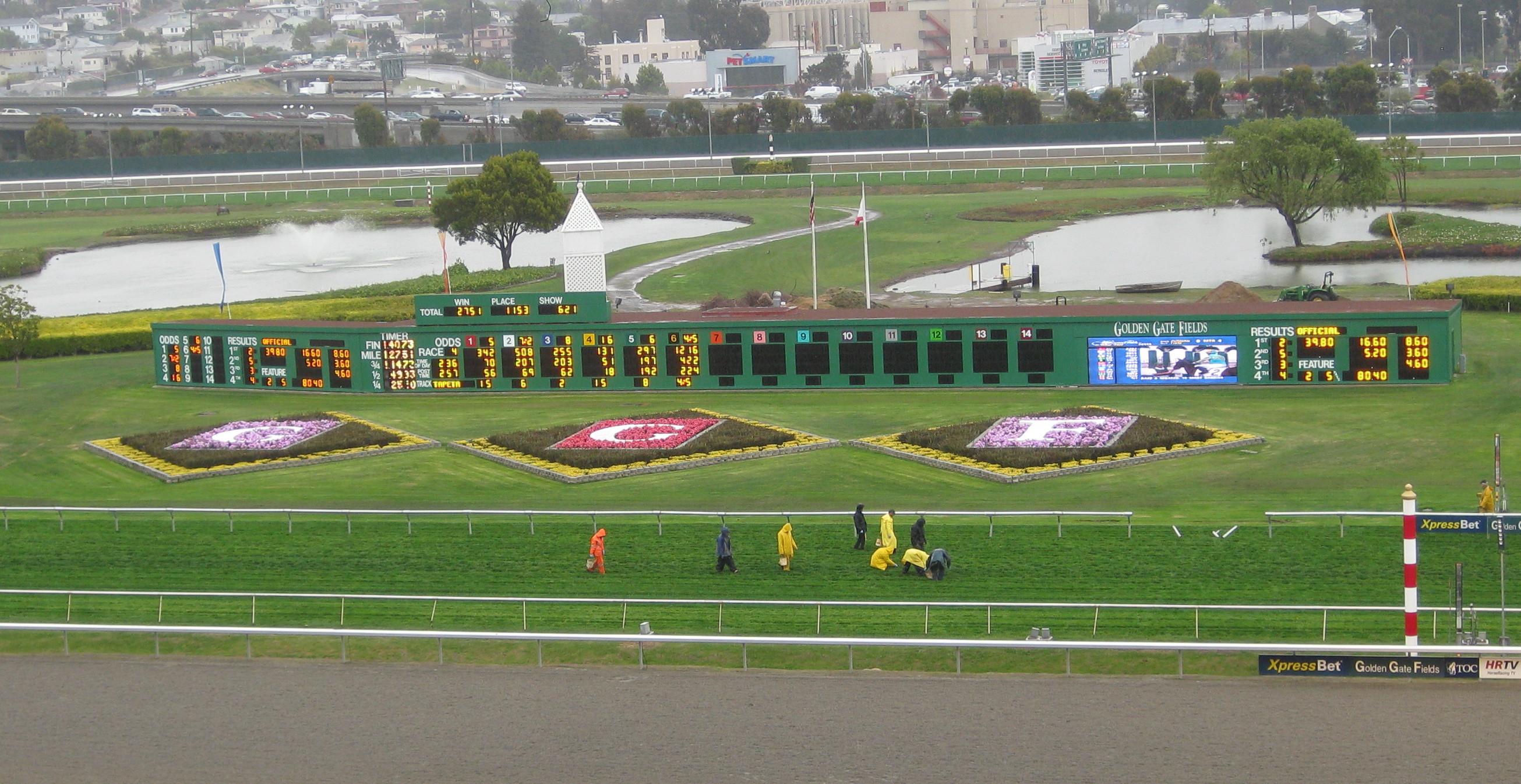
Golden Gate Fields
On June 9, 2024, a crowd of 5,936 people gathered at a racetrack on the edge of San Francisco Bay to watch eight horses run for the last time. They wagered $3,057,912 that afternoon -- a respectable sum for a farewell. Golden Gate Fields had been Northern California's last major thoroughbred track, a 140-acre crescent of grandstands and stables wedged between Fleming Point and Interstate 80, where the salt air off the bay mixed with the smell of horses and freshly raked dirt. For eighty-three years, the track had survived a world war, a dynamite factory's legacy, bankruptcy, and the slow erosion of horse racing's cultural hold. It could not survive real estate economics.
Dynamite, Cattle, and a Grandstand by the Bay
The land beneath Golden Gate Fields carried a volatile history long before the starting gates went up. The tract had originally been part of Rancho San Antonio, owned by Jose Domingo Peralta, who sold it in 1852 to John Fleming. Fleming used the rocky promontory as a transhipment point for cattle bound across the bay to San Francisco's slaughterhouses. Later in the nineteenth century, the Giant Powder Company set up operations on the same ground, manufacturing dynamite and nitroglycerin. Between 1879 and 1892, the plant blew up twice. Horse racing in the East Bay dated back to 1871, when the Oakland Trotting Track opened two miles south in what is now Emeryville. A statewide ban shuttered it in 1911, and a fire finished off its structures in 1915. When California repealed the ban in 1933, the stage was set for something grander. Just before World War II, Golden Gate Fields built its grandstand against Fleming Point's eastern slope and filled in adjacent marshland for the track. The inaugural meet ran on February 1, 1941.
Landing Craft and Thin Men
The track barely had time to establish itself before the U.S. Navy commandeered it. With the onset of World War II, Golden Gate Fields became the Naval Landing Force Equipment Depot, Albany -- a staging ground for hundreds of landing craft destined for the Pacific theater. The grandstand that had hosted its first race only months earlier now overlooked rows of military vessels instead of thoroughbreds. Hollywood had actually gotten there first: just before the war, the track served as a filming location for Shadow of the Thin Man, the 1941 mystery starring William Powell and Myrna Loy. When peace returned, so did the horses. The track resumed racing and began building the identity that would carry it through the next eight decades -- a bayshore venue where you could watch thoroughbreds run against a backdrop of San Francisco's skyline.
Legends in the Infield
Golden Gate Fields collected stories the way old racetracks do -- one memorable horse at a time. In 1950, the English-bred Noor defeated Citation, the great Triple Crown winner, in the Golden Gate Handicap. Citation's jockey Steve Brooks offered the racing world's most graceful concession: "We just can't beat that horse." Seven years later, Silky Sullivan arrived and brought a theatrical racing style that drew crowds wherever he ran. He became the first horse buried in the track's infield, a distinction he held until Lost in the Fog joined him there in 2006 after succumbing to inoperable tumors at age four. In 1984, the legendary gelding John Henry set a course record in the Golden Gate Handicap. And on February 1, 2008, jockey Russell Baze rode Two Step Cat to his 10,000th career victory -- an astonishing number built partly on the 5,765 races he won at Golden Gate Fields alone, along with 54 riding titles.
A Track Announcer Makes History
The track's story was not only about horses. In 2016, Golden Gate Fields hired twenty-nine-year-old Angela Hermann as its track announcer, making her the first full-time female race caller in the United States since Ann Elliott worked Jefferson Downs near New Orleans in the 1960s. The appointment was a quiet milestone in a sport that had remained stubbornly traditional about who narrated the action. Ownership, meanwhile, passed through a succession of hands that reflected horse racing's shifting fortunes: Kjell Qvale, a San Francisco car importer, ran the track for twenty-five years before selling to UK-based Ladbroke Racing in 1989. Magna Entertainment Corp. acquired it in 1999, then filed for bankruptcy in 2009. The Stronach Group took over in 2011 and ultimately decided to shutter the track, with president Belinda Stronach declaring that California racing's future depended on investment in Southern California.
Last Call at the Bay
When Bay Meadows closed in 2008, Golden Gate Fields became Northern California's sole major thoroughbred track -- a distinction that felt less like a promotion than a warning. The closure announcement came on July 16, 2023, and was delayed once before the final card ran in June 2024. Beyond the racing, the track had woven itself into the East Bay's cultural fabric. Jack Kerouac sent his alter ego Sal Paradise there in On the Road, losing all his money before the seventh race. Punk band Rancid wrote a song called "GGF" about lead singer Tim Armstrong's childhood near the track. Eddie Murphy's character in the 1997 film Metro is seen there blaming jockey Russell Baze for a bad bet. The 140 acres now sit quiet along the San Francisco Bay Trail, bordered by the Albany Bulb and Berkeley Meadow. What becomes of the land -- the same ground that held cattle, dynamite, landing craft, and eighty-three years of thoroughbred racing -- remains to be seen.
From the Air
Located at 37.885°N, 122.311°W on the eastern shoreline of San Francisco Bay, between Albany and Berkeley. The 140-acre track site is clearly visible from the air, bordered by Fleming Point to the west and Interstate 80 to the east. Nearby airports include Oakland International (KOAK) to the south and Buchanan Field (KCCR) to the northeast. At 1,500-2,000 feet AGL, the oval track layout and grandstand area are distinctive against the bayshore, with the Albany Bulb and San Francisco Bay Trail adjacent.