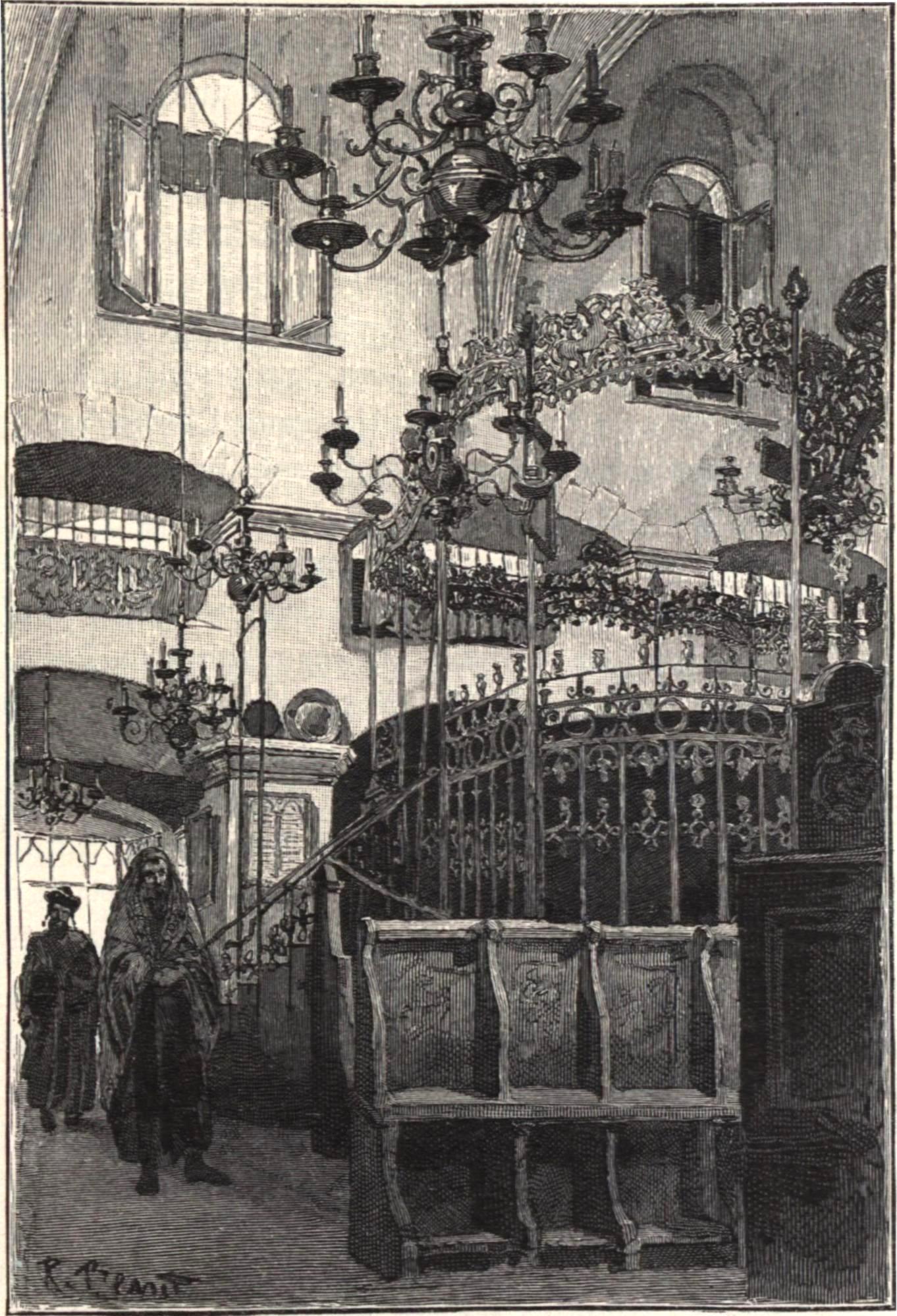
Golden Rose Synagogue (Lviv)
In 1609, after the Jewish community of Lviv paid 20,600 guilders to ransom their synagogue back from the Jesuits who had seized it three years earlier, a rabbi composed a Song of Deliverance. The poem compared the building's return to the liberation of the Jews from Babylon. Four centuries later, there is no building to return. The Golden Rose Synagogue -- the oldest in what is now Ukraine -- was desecrated in 1941 and reduced to ruins by the Nazis in 1943. What remains is a contested void: a few walls, a question about memory, and a restaurant next door that some visitors find offensive.
Paul the Fortunate's Masterwork
The synagogue was founded in 1581 by Yitzhak ben Nachman, known as Izak Nachmanowicz, a financier to Stefan Batory, King of Poland. He purchased a plot of land in the southeastern corner of Lviv, right beside the city walls, and commissioned the construction to a Swiss-born master builder named Paulus Italus -- Paolo the Italian -- from the village of Tujetsch in canton Graubunden. Paolo's guild nickname was Pawel Szczesliwy: Paul the Fortunate. The synagogue he built in 1582 was a Renaissance gem. Men prayed in a hall spanned by a cloister rib vault with pointed lunettes above the windows. An alabaster Torah ark stood against the eastern wall, and a bimah occupied the center of the prayer hall. The building was crowned by an attic in Mannerist style. In 1595, Paolo returned with a team of builders to add a vestibule and a women's gallery.
The Legend of the Golden Rose
The Jesuits confiscated the synagogue in 1606. Three years and 20,600 guilders later, the Jewish community won it back. A local legend, first published in 1863, credited the restitution to Rosa bat Ya'akov, Nachmanowicz's daughter-in-law, and from her the synagogue took the name by which it would be remembered: the Golden Rose. Rabbi Yitzhak ben Shemuel HaLevi marked the occasion by composing Shir Ge'ula -- a Song of Deliverance -- recited each year during the shacharit prayer on the Shabbat after Purim. The song cast the return of the building as an echo of ancient liberations, binding a small community's triumph to the deepest currents of Jewish history. Between 1654 and 1667, Rabbi David HaLevi Segal, known as TaZ after his major work Sefer Turei Zahav, prayed in this synagogue, giving it yet another name.
Destruction and Absence
In 1941, the Nazis desecrated the synagogue. By 1943, they had destroyed it entirely, along with the Great City Synagogue nearby. Both buildings had served the Jewish community for centuries; both were erased in months. Before the war, Jews made up roughly a third of Lviv's population. The Holocaust consumed that community almost completely, and the synagogue's destruction was part of a systematic obliteration of Jewish life across the city. A commemorative plaque now marks the site, describing the remnants of the building as the 'old temple called Di Goldene Royz.' The plaque notes the synagogue was 'destroyed by Nazis and burnt in summer 1942.' What survives are fragments of outer walls, enough to remember but not enough to rebuild.
The Space of Synagogues
The synagogue stood within Lviv's Old Town, designated a UNESCO World Heritage Site in 1998. In 2010, a coalition including the Lviv City Council and the Center for Urban History of East Central Europe announced the Space of Synagogues project, intended to commemorate the Golden Rose, the Great City Synagogue, and the Old Jewish Cemetery. The project has been shadowed by controversy. In 2011, a Guardian article reported that authorities were allowing a developer to build a hotel that could endanger the remaining walls and an underground mikvah. International pressure forced a halt, and the mayor announced plans for a Holocaust memorial. A landscape design by Franz Reschke opened in 2016, but the site remains incomplete, its future debated. Members of the Jewish community have expressed a desire to rebuild the synagogue 'as it once was,' but the city's official plan envisions a commemorative space, not a reconstruction.
Memory and Its Discontents
Adjacent to the site, a restaurant called Under the Golden Rose opened in 2008, presenting itself as a tribute to Lviv's Jewish past. Diners are offered black hats with artificial sidelocks. The menu has no prices; servers explain it is 'Jewish tradition' to bargain. Some local historians and members of the city's small remaining Jewish community find the establishment offensive, arguing it trades in antisemitic stereotypes while profiting from a history of destruction. Others view it as a well-meaning if clumsy attempt at cultural engagement. The disagreement captures something essential about how Lviv grapples with its Jewish heritage -- a heritage that was violently taken, is imperfectly mourned, and is sometimes reduced to kitsch by those who never knew what was lost.
From the Air
Located at 49.846N, 24.030E in Lviv's Old Town, within the UNESCO World Heritage zone. The site sits southeast of Rynok Square, near where the former city walls once stood. The nearest major airport was Lviv Danylo Halytskyi International (UKLL), though Ukrainian airspace is currently closed to civil aviation. From the air, the site is identifiable as an open memorial space amid the dense Old Town roofscape -- a visible gap where a building once stood.