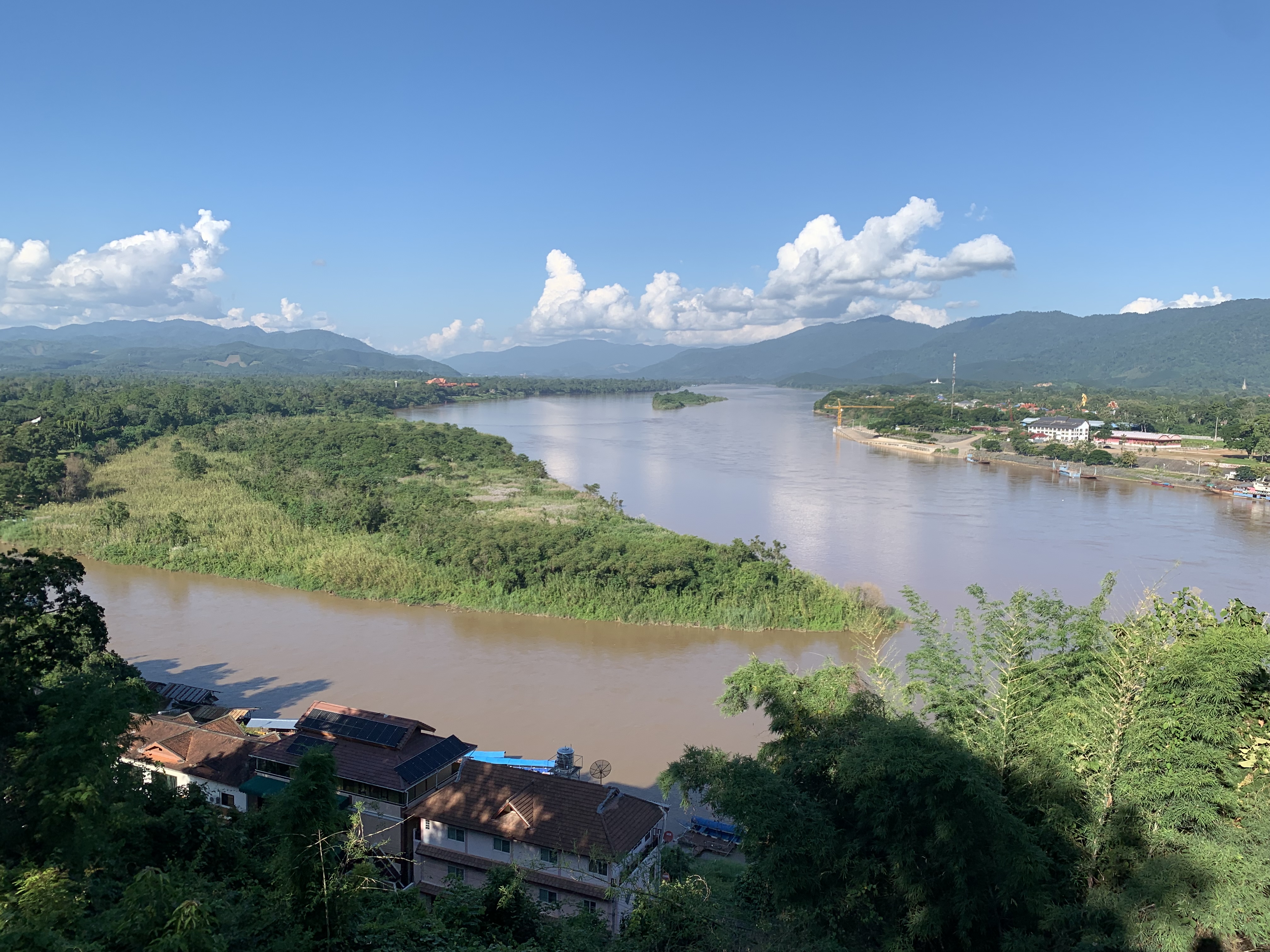
Golden Triangle (Southeast Asia)
The name was coined in 1971 by Marshall Green, a U.S. State Department official, during a press conference about opium. It stuck. The Golden Triangle, centered on the confluence of the Ruak and Mekong rivers where Myanmar, Thailand, and Laos meet, has spent the better part of a century as shorthand for the global drug trade. Today, the Thai side at Sop Ruak has reinvented itself as a tourist attraction, complete with the House of Opium Museum, a Hall of Opium, and a Golden Triangle Park. There is no opium grown here anymore. But in the mountains across the border, the industry that gave this region its name has not disappeared. It has evolved.
Soldiers, Farmers, and Poppies
Opium production in what is now Myanmar dates to the Konbaung dynasty around 1750, but it was small-scale, mostly for foreign consumption. The modern drug trade began with a political earthquake. When the Chinese Communist Party took power in the late 1940s, it forced ten million addicts into compulsory treatment, executed dealers, and replanted opium fields. Production shifted south across the border. Thousands of defeated Kuomintang soldiers fled Yunnan Province into Burma in 1949, seized control of the border regions, and discovered that opium was the easiest way to fund an army in exile. They taxed the farmers heavily, coercing local villagers for recruits, food, and money. An American missionary testified that the KMT tortured the Lahu people of Kengtung State for failing to comply. Annual production leapt from 30 tons at Burmese independence to 20 times that amount by the mid-1950s.
The Heroin Highway
Raw opium from Myanmar's northeast traveled by horse and donkey caravan to refineries along the Thailand-Burma border, where it was converted to heroin and shipped through Bangkok to international markets. The process itself was remarkably low-tech: farmers planted poppy fields in September, harvested pods in February, and scored them with a multi-bladed tool to collect the oozing latex. Fifteen kilograms of raw opium went into a 55-gallon drum of boiling water, then through a series of chemical steps involving calcium hydroxide and ammonium chloride to extract crude morphine. Further refinement with acetic anhydride produced heroin. When Turkey banned opium poppies in 1972 and disrupted the French Connection supply routes to America, production surged in Southeast Asia. Hong Kong became the transit hub. A syndicate controlled by Ma Sik-chun reportedly imported over 700 tonnes of opium into the city between 1968 and 1974.
Global Reach
By the 1980s, ethnic Chinese trafficking organizations had taken over the dominant role in heroin supply on the American East Coast. A Drug Enforcement Administration study found that Southeast Asian heroin's share of the New York street market rose from 3 percent in 1982 to over 40 percent by 1987. The seizures tell the scale: 1,280 kilograms of 97% pure heroin hidden in rubber bales at Bangkok's Khlong Toei Port in 1988, worth an estimated $2 billion on the street. In 1991, 545 kilograms concealed in boxes of plastic bags were discovered in a California warehouse, smuggled from Thailand through Taiwan's Kaohsiung port to Oakland. Drug lord Khun Sa's Mong Tai Army surrendered in 1996, but the infrastructure endured. A U.S. Embassy report from the same year noted that Myanmar's opiate exports appeared to be worth as much as all of the country's legal exports combined.
The Synthetic Shift
Poppy cultivation in the Golden Triangle dropped more than 80 percent between 1998 and 2006, but the drug trade did not shrink. It transformed. The region pivoted to synthetic drugs, particularly methamphetamine. Myanmar's Shan State is now believed to be the largest methamphetamine-producing area in the world. Countries across East and Southeast Asia seized over 171 tons of methamphetamine and a record one billion methamphetamine tablets in 2021 alone, more than any other region on earth. A 2025 UNODC report documented a record 236 tons seized the previous year. The syndicate known as Sam Gor, headed by Canadian-born gangster Tse Chi Lop, is alleged to control 40 percent of the Asia-Pacific methamphetamine market, earning up to $8 billion annually. Meanwhile, Myanmar's ongoing civil war has made law enforcement impossible in rebel-held territory, and armed groups have ramped up production to fund their campaigns.
The View from the River
At the confluence of the Ruak and Mekong, the Golden Triangle's geography is deceptively serene. Forested mountains roll toward the horizon across three countries. Tourist boats idle at the Thai shore, and vendors sell souvenirs where drug caravans once crossed. But the UNODC estimates that Myanmar produced over 1,000 metric tons of opium in recent years, exporting between 65 and 116 tons of heroin worth up to $935 million. The impoverished farmers who grow the poppies earn roughly $300 per kilogram of raw opium. Most of the tribespeople cultivating in Myanmar and the Thai highlands live below the poverty line, trapped between armed groups demanding production and a global market that keeps demanding supply. The golden part of the Golden Triangle's name referred to opium's color and value. For the people who grow it, the color has always been closer to dust.
From the Air
Centered at 20.354°N, 100.083°E at the confluence of the Ruak and Mekong rivers where Myanmar, Thailand, and Laos meet. The tripoint area is visually distinctive from the air, with the rivers forming a clear junction and the Thai village of Sop Ruak visible on the south bank. Chiang Rai International Airport (VTCT) lies approximately 60 km southwest. Mae Sai Airport (no ICAO) and the Golden Triangle SEZ with its newly built Bokeo International Airport are nearby landmarks. Best viewed at 5,000-8,000 feet AGL to appreciate the river confluence and the three-country panorama.