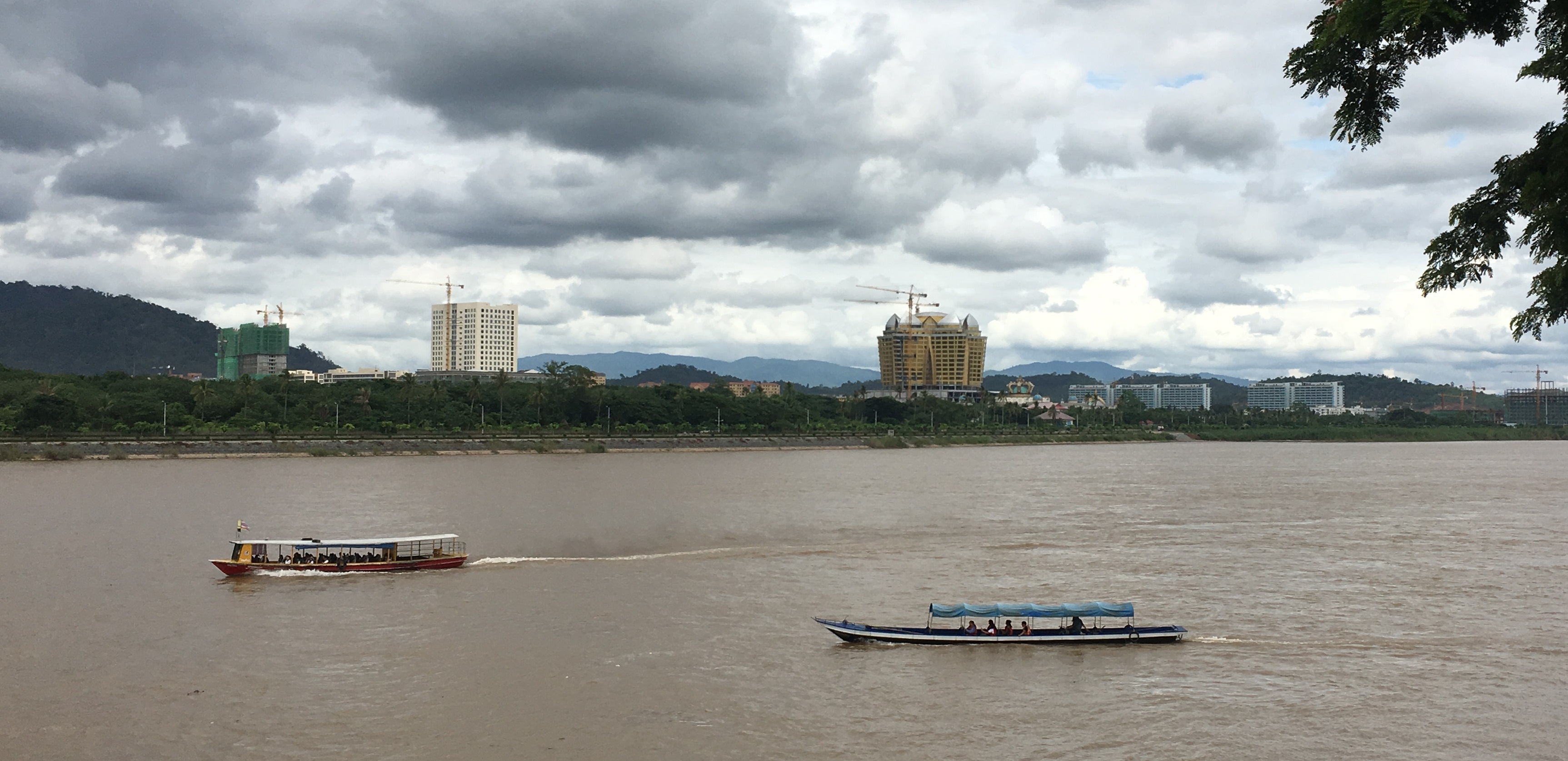
Golden Triangle Special Economic Zone
Clocks in the Golden Triangle Special Economic Zone run on Beijing time. Street signs are in Mandarin and Lao. The preferred currency is the Chinese yuan. Technically, this 3,000-hectare enclave sits in Bokeo Province, Laos, along the Mekong River where three countries meet. In practice, it operates as something else entirely. Since 2007, when the Hong Kong-registered Kings Romans Group secured a 99-year lease on 10,000 hectares of riverbank, the zone has become a casino destination, a development showcase, and the subject of international criminal sanctions, all at once.
A Village Erased, a Casino Raised
The land where the SEZ now stands was previously rural agricultural territory. Ban Kwan, a village whose inhabitants were relocated to make way for development, once occupied the area. In its place rose the Blue Shield Casino, hotels, apartment blocks, restaurants, a hospital, and the Laos and China Friendship Street, a pedestrian mall with trilingual signage. The Don Sao Market became a fixture on Mekong River boat tour itineraries from Thailand. Across the river, the Thai village of Ban Sop Ruak near Chiang Saen sits within sight of the zone's growing skyline. Ferry boats operated by Kings Romans Group run the ten-minute crossing between the Sam Liam Kham checkpoint and Thailand for 100 baht per trip, operating from 6 a.m. to 8 p.m. In 2024, the newly built Bokeo International Airport opened after three years of construction, giving the zone its own air link to Chinese cities.
Poverty's Steep Decline, Questions' Steep Rise
On paper, the SEZ has delivered on its economic promise. Since the zone launched, Bokeo Province went from being one of Laos's poorest provinces to one of its wealthiest, registering the steepest poverty reduction of any Laotian province since 2013. Investment projects span agriculture, manufacturing, hotels, golf courses, real estate, banking, and tourism infrastructure. But the prosperity has arrived alongside persistent allegations that the zone serves as a hub for illicit activity. A compound marked as a zoo on maps but closed to the public has been identified as an illegal breeding facility and slaughterhouse for tigers and bears. The U.S. Treasury Department does not mince words about what it believes happens behind the casino's doors.
The Sanctions
In January 2018, the United States Treasury Department sanctioned Kings Romans, its owner Zhao Wei, and the entity it designated as the Zhao Wei Transnational Crime Organization. The allegations were extensive: the casino was used to launder money and traffic drugs, among other serious crimes. Zhao Wei denied the charges. Lao authorities conducted some enforcement actions following the reports, shutting down illegal wildlife shops within the zone. But the underlying concerns have not subsided. Observers have documented million-dollar cash transactions at the casino's cashier desk conducted without documentation, with participants carrying away stacks of 100-yuan note bundles in large duffle bags. In 2020, a $50 million investment to build a port at nearby Ban Mom, made by a company linked to Zhao Wei, prompted the UNODC's regional representative to tell media: "To put a piece of infrastructure like this in the hands of this gentleman and his companies is, frankly, unbelievable."
The Mekong's Narcotics Corridor
The zone sits at the center of one of the world's most active drug trafficking corridors. Seizures of crystal methamphetamine traced to the Laos border increased over 200 percent in northeast Thailand in 2020. Dozens of large seizures have been made along Vietnam's mountainous 2,100-kilometer border with Laos. Precursor chemicals from across the region transit through Laos into autonomous special regions and drug-producing areas in neighboring Myanmar. The Ban Mom area, where the Zhao Wei-linked port was constructed, had already been confirmed as a location used for trafficking drugs and precursor chemicals. In 2024, the UNODC reported that methamphetamine seizures in the region reached their highest level ever recorded. Laos remains the key route into the Golden Triangle for precursors from China, and the finished synthetic products have been seized across the region and beyond. The SEZ, with its casinos, its cash economy, and its location at the nexus of three borders, occupies a geography that makes oversight extraordinarily difficult.
A Border That Blurs
From the air, the Golden Triangle SEZ reads as an anomaly: a cluster of high-rise apartment blocks, a casino complex, and a golf course carved into the Lao riverbank, facing the quiet Thai village of Ban Sop Ruak across the Mekong. Roads link the zone east to Houay Xay, 55 kilometers away along Lao Route 3, and from there via the Fourth Thai-Lao Friendship Bridge to Thailand's highway network. The route continues north through Luang Namtha to the China-Laos border crossing at Boten, 230 kilometers distant. Chiang Rai Airport in Thailand sits 60 kilometers from the crossing point. What was once a remote corner where three countries' authority faded to nothing has become a place where sovereignty itself seems negotiable. The zone operates under Lao jurisdiction in theory, but the language, the currency, and the time zone all point elsewhere.
From the Air
Located at 20.340°N, 100.105°E on the Lao bank of the Mekong River, directly across from the Thai village of Ban Sop Ruak near Chiang Saen. The casino complex and high-rise apartment blocks are visually distinctive from the air against the otherwise rural riverbank. The newly opened Bokeo International Airport is adjacent to the zone. Chiang Rai International Airport (VTCT) lies approximately 60 km to the southwest across the border in Thailand. Best viewed at 3,000-5,000 feet AGL where the contrast between the developed zone and surrounding rural landscape is most striking.