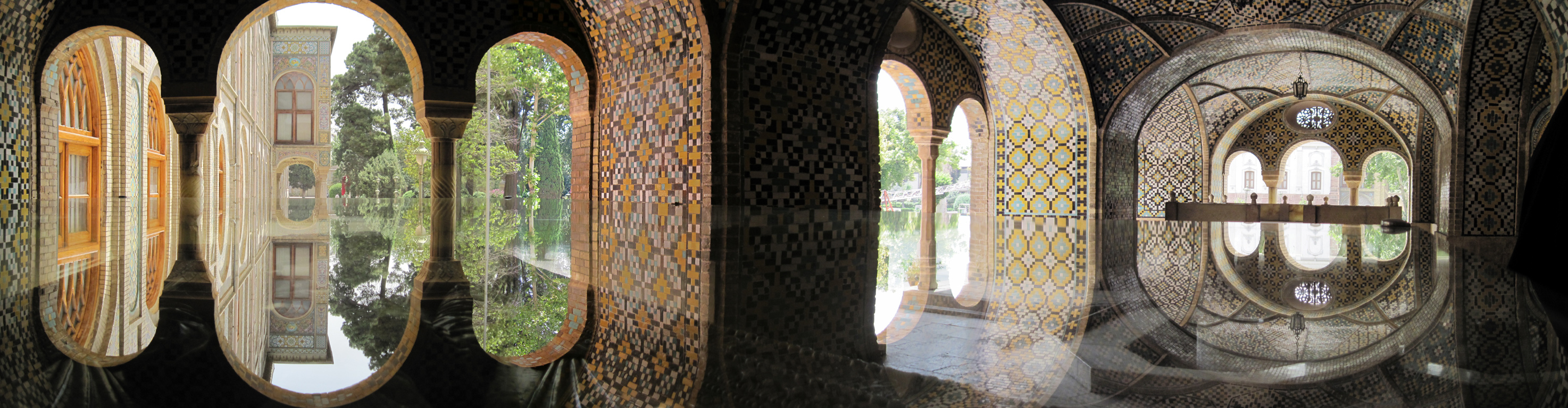
Golestan Palace
A clock gifted by Queen Victoria still ticks atop the Edifice of the Sun. Mounted in 1867 on the tallest building in Tehran, it has outlasted the dynasty that installed it, the dynasty that replaced it, and the revolution that swept both away. Below the clock, the Golestan Palace spreads across central Tehran in a constellation of tiled halls, mirrored chambers, and gardens that have served as the stage for Persian power since the Safavid era. This is not a palace frozen in one moment. It is a palimpsest, each dynasty writing over the last without fully erasing what came before.
From Citadel to Court of Roses
The story begins long before the palace earned its name. In 1404, a Spanish envoy named Ruy Gonzalez de Clavijo passed through Tehran on his way to meet Timur in Samarkand, lodging with a local elder whose home may have stood on the very ground the palace now occupies. By the time Tahmasp I of the Safavid dynasty built a proper citadel here between 1524 and 1576, Tehran was still a minor settlement. Abbas the Great added a walled garden to the north. Karim Khan of the Zand dynasty renovated the structures around 1750. But the palace's true transformation came when Agha Mohammad Khan of the Qajar dynasty chose Tehran as his capital in the 1790s. The citadel became a court, and the court became Golestan -- the "Palace of Flowers." Its current form dates to 1865, when the architect Haji Ab ol Hasan Mimar Navai rebuilt it for Naser al-Din Shah.
Halls of Light and Stone
Seventeen structures compose the complex, and each has its own personality. The Marble Throne, built between 1747 and 1751, is an open-air terrace of carved stone where shahs received dignitaries under the sky. Nearby, the Karim Khani Nook -- dating to 1759 -- offered a more intimate version of the same idea, a smaller terrace with a modest throne, a fountain fed by the shah's own qanat, and a quietness that Naser al-Din Shah reportedly favored above all other corners of the palace. Inside, the Brilliant Hall dazzles with ayeneh-kari, the Iranian art of mirror mosaic that fractures light into a thousand moving points. The Abyaz Palace, completed in 1883 and designed by Naser al-Din Shah himself, adopted neo-classical architecture to display Ottoman gifts: Louis XVI furnishings, velvet curtains, bronze statues. Its white facade gave it its name -- Abyaz means "white" in Persian.
The Shah Who Loved the Camera
Naser al-Din Shah was an unlikely pioneer. Fascinated by the new technology of photography arriving from Europe in the nineteenth century, he ordered the creation of a photographic archive at Golestan that became one of Iran's most remarkable collections. Photography grew so common at the royal court that the shah's wives and servants posed playfully in front of the camera, experimenting with the medium in ways that were rare anywhere in the world at the time. One surviving image shows a servant with flowers arranged across his head and shoulders -- a casual, human moment captured in a place built to project imperial grandeur. The archive remains at Golestan, a window into the private life of a court that otherwise presented itself in marble and mirrors.
Coronations and Demolitions
The Qajar dynasty fell in 1925, replaced by the Pahlavis, who built new palaces at Niavaran and Sa'dabad but kept Golestan for formal ceremonies. Reza Shah was crowned here in 1926. His son Mohammad Reza Shah and Empress Farah held their coronation in the same halls in 1967. Yet Reza Shah also ordered a large portion of the complex demolished between 1925 and 1945, believing that Qajar relics should not obstruct a modernizing capital. Commercial buildings in the style of the 1950s and 1960s rose where ornate halls had stood. It was an act of selective erasure -- keeping the rooms that served his legitimacy while destroying those that reminded Tehran of the dynasty he had displaced.
A Palace Against the Clock
UNESCO inscribed Golestan as a World Heritage Site in 2013, recognizing it as an outstanding example of the fusion of Persian crafts and Western architectural influences. But the palace faces pressures that no designation can fully resolve. Urban pollution eats at the tilework. Seasonal humidity drives salt crystals through centuries-old stone. Restoration teams have worked steadily since 2007, using lime-based mortars, nano-lime treatments, and boron biocides to stabilize structures without betraying their original materials. The Shams-ol-Emareh -- the Edifice of the Sun -- needed its corroded iron beams replaced with stainless steel. Traditional artisans restored damaged mirror mosaics by hand. The palace endures, but endurance here is active, not passive. Golestan survives because people keep choosing to save it.
From the Air
Located at 35.68N, 51.42E in central Tehran, Iran. The palace complex sits in the dense urban core, identifiable from the air by its garden spaces amid the surrounding city grid. Nearest major airport is Mehrabad International Airport (OIII), approximately 10 km to the west. Imam Khomeini International Airport (OIIE) lies about 50 km to the south. Best viewed at altitudes of 3,000-5,000 feet AGL. The Alborz Mountains provide a dramatic backdrop to the north.