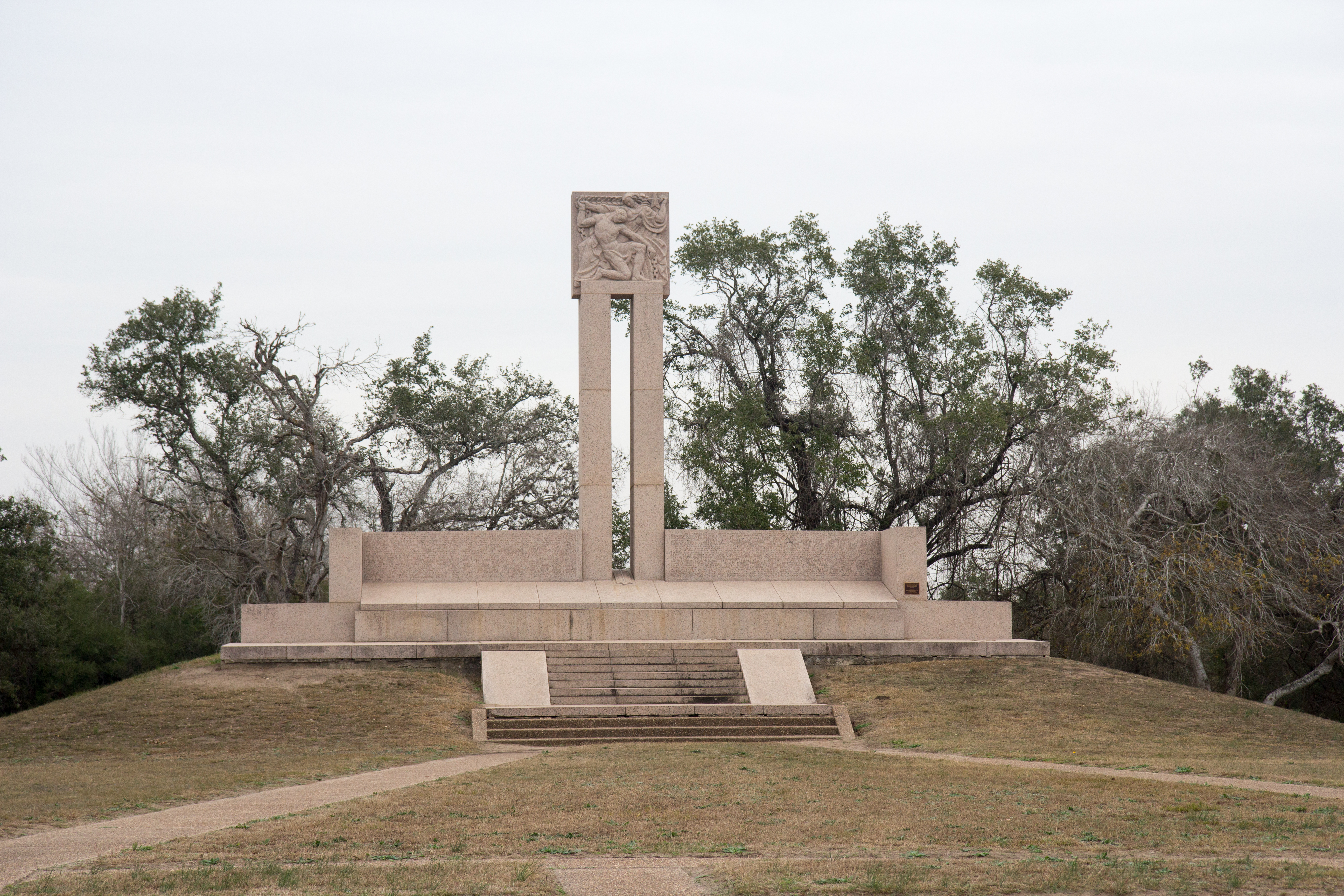
Goliad Massacre
Colonel James Fannin made three final requests: send his personal possessions to his family, shoot him in the heart and not the face, and give him a Christian burial. The Mexican soldiers took his belongings, shot him in the face, and burned his body. Fannin was the last to die at Goliad on March 27, 1836, after watching his men -- between 425 and 445 Texian prisoners of war -- marched out of Fort Defiance in three columns, told they were gathering wood, then turned to face away from their captors and gunned down at point-blank range. The Goliad Massacre killed more Texians than the fall of the Alamo three weeks earlier, and the cry of "Remember Goliad!" would ring across the battlefield at San Jacinto just 24 days later.
The Road to Fort Defiance
The path to Goliad was paved with bad luck, bad orders, and worse timing. After Santa Anna learned that Texas rebels were moving toward Matamoros, he sent General Jose de Urrea north along the coast with 188 cavalry and 205 infantry, augmented by roughly 200 Tejano volunteers. Urrea methodically dismantled the scattered Texian forces. At the Battle of San Patricio and the Battle of Agua Dulce in late February and early March, he captured or killed the forward detachments. Colonel Fannin, meanwhile, had fortified the old Presidio La Bahia at Goliad and renamed it Fort Defiance. He sent Captain Amon B. King and Lt. Colonel William Ward south to evacuate settlers at Refugio, but both missions ended in disaster -- King was captured and executed, and Ward's Georgia Battalion was shattered after a seven-day fighting retreat. On March 6, Santa Anna stormed the Alamo. Fannin, still waiting for his detachments to return, finally attempted to evacuate Goliad on March 19, far too late. Urrea's forces surrounded his 300 men on the open prairie near Coleto Creek.
False Promises
The two-day Battle of Coleto ended on March 20 when Fannin and the majority of his men voted to surrender. They were led to believe they would be paroled and released into the United States within weeks. Instead, they were marched back to their own fort, now their prison. Over the following days, more captives were added: 18 men from Albert Clinton Horton's company, 75 soldiers of the Miller and Nashville Battalion captured on March 20, and 55 survivors of Ward's Georgia Battalion who had surrendered on March 22. Urrea departed, leaving Colonel Jose Nicolas de la Portilla in command, and wrote to Santa Anna requesting clemency for the prisoners. Santa Anna's answer was unequivocal. Under the Tornel Decree, passed by the Mexican Congress on December 30, 1835, any foreigners captured fighting against Mexican troops were to be treated as pirates and executed. Santa Anna ordered Urrea to comply with the law. Urrea wrote in his diary that he "wished to elude these orders as far as possible without compromising my personal responsibility." Portilla, who received the execution orders directly, had no such room to maneuver.
Palm Sunday Morning
On the morning of March 27, 1836 -- Palm Sunday -- Portilla ordered the prisoners marched out of Fort Defiance in three columns along the Bexar Road, San Patricio Road, and Victoria Road, flanked on both sides by Mexican soldiers. The sick and injured remained in the chapel. The marching men were told they were gathering wood and supplies. When the columns halted, the prisoners were forced to turn away from the soldiers. Then the shooting started. Wounded survivors were clubbed and knifed to death. Inside the fort, 39 of the 40 men too injured to walk were killed under the direction of Captain Carolino Huerta of the Tres Villas Battalion; Colonel Garay saved one man, Dr. Jack Shackelford. The sick and wounded in the chapel were shot in their beds and against the chapel walls. Then came Fannin's turn -- the last man executed, forced to watch his entire command die before him.
The Angel and the Survivors
Not everyone died. Twenty-eight men feigned death and escaped, including Herman Ehrenberg, who later published an account of the massacre, and William Lockhart Hunter of the New Orleans Greys, who survived despite being bayoneted and clubbed with a musket. Four members of Shackelford's Red Rovers -- Dillard Cooper, Zachariah S. Brooks, Wilson Simpson, and Isaac D. Hamilton -- escaped after days on the run. Francita Alavez, the wife of Colonel Telesforo Alavez and known ever after as the Angel of Goliad, intervened to save 20 more men, including Shackelford, by assigning them as doctors, interpreters, and laborers. The 75 soldiers of the Miller and Nashville Battalion were given white armbands and ultimately marched to Matamoros rather than executed. Spared men were warned never to remove the armbands, as Mexican troops continued hunting for escapees from Coleto, Victoria, and the massacre itself.
Remember Goliad
The massacre ignited the Runaway Scrape, a panicked civilian flight across Texas. The Texians' charred remains were left in the open, exposed to vultures and coyotes. General Thomas J. Rusk found them in June 1836 and ordered a formal military burial southeast of the Presidio. The gravesite's exact location was then forgotten until 1930, when a group of Boy Scouts discovered human bone fragments. In 1939, sculptor Raoul Josset's Fannin Memorial Monument was erected on the spot, featuring an art deco relief inscribed with the known names of 371 of the dead. Walt Whitman memorialized the massacre in section 34 of Song of Myself, published in Leaves of Grass. But the most immediate legacy was forged on April 21, 1836, when Sam Houston's army shattered Santa Anna's forces at San Jacinto. The Texians charged across the field in under 18 minutes. Their battle cry carried both debts: "Remember the Alamo! Remember Goliad!"
From the Air
Located at 28.65N, 97.38W near Goliad, Texas on the South Texas coastal plain. The Presidio La Bahia (Fort Defiance) and Fannin Memorial Monument are both visible landmarks near the town. Flat ranchland and scattered trees dominate the terrain. Nearest airports include KGAD (Northeast Goliad Airport, local strip) and KVCT (Victoria Regional Airport, approximately 25 miles northeast). Low elevation, humid subtropical climate. The Goliad Campaign corridor extends south to Refugio (30 miles) and northeast to Victoria.