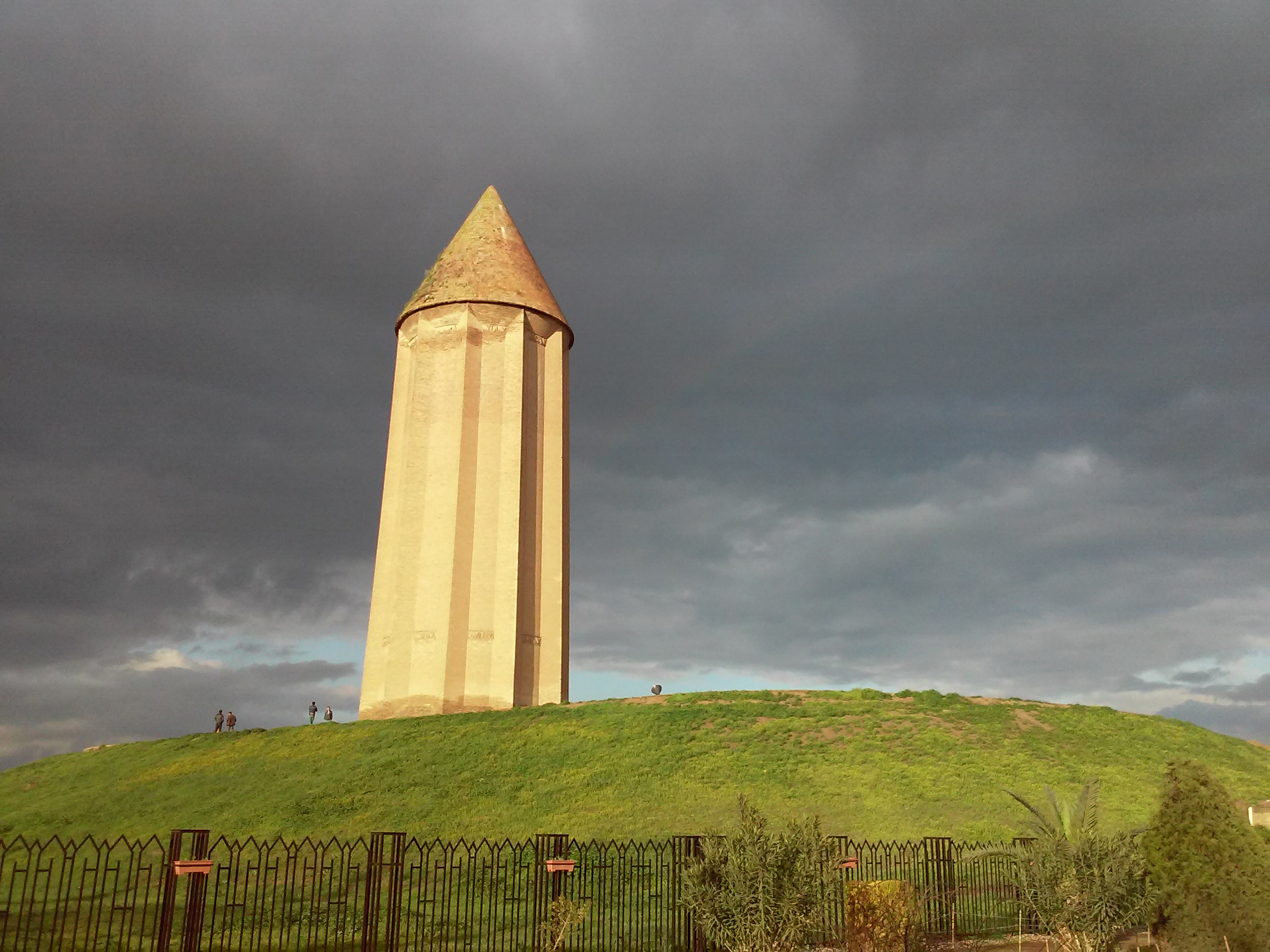
Gonbad-e Qabus Tower
Legend says Qabus ibn Vushmgir was buried in a glass coffin, suspended by chains from the ceiling of his tower. When archaeologists finally looked, they found no coffin, no chains, and no body. What they did find, rising from the Turkmen steppe near Iran's Caspian coast, was one of the most remarkable structures ever built from brick: a fluted cylinder soaring roughly 72 meters into the sky, visible from 30 kilometers in every direction. Completed in 1006 CE, the Gonbad-e Qabus tower has stood for over a millennium, a monument to a ruler whose ambitions were as vertical as his tomb.
A Prince Between Two Faiths
Qabus ibn Vushmgir ruled the Ziyarid dynasty from the historic Tabaristan region of northern Iran. He was no ordinary warlord. Astronomers, calligraphers, and poets gathered at his court. The philosopher and physician Ibn Sina -- Avicenna -- spent time under his patronage, as did the polymath al-Biruni. Qabus himself was a scholar and poet writing in both Arabic and Persian. He reigned from 978 until his death in 1012, a period when Tabaristan was still transitioning from Zoroastrianism to Islam. That tension between faiths shaped everything about his final monument. The inscription bands on the tower record its foundation date in two calendar systems simultaneously: Iranian solar and Islamic lunar. Neither faith, it seems, could fully claim him.
A Cylinder Transformed into a Star
The tower's form is deceptively simple. A circular plan, 17 meters in diameter, is broken by ten triangular flanges that rush upward from base to roofline, transforming the cylinder into a ten-pointed star when seen from above. The walls are three meters thick, built entirely from baked brick whose pale yellow color has been turned golden by centuries of sun. A conical roof caps the structure like, as the English travel writer Robert Byron put it in 1937, a candle extinguisher. Art historian Oleg Grabar described the result as achieving an "almost perfect balance between a purpose -- princely glory beyond death -- a form -- cylindrical tower transformed into a star -- and a single material: brick." The entrance contains some of the earliest known examples of muqarnas, the honeycomb vaulting that would become a signature of Islamic architecture across the Middle East.
Neither Zoroastrian Nor Muslim
The missing body is the tower's deepest puzzle. Though meant as a mausoleum, no remains have been found inside -- a pattern shared by other tomb towers across northern Iran. Scholar Melanie Michailidis argues these towers were used in a syncretic fashion. Bodies were placed inside but lifted off the ground, resting on platforms of impermeable material -- a compromise between Zoroastrian prohibitions against contaminating the earth with the dead and Islamic burial traditions. The tower satisfies many Zoroastrian criteria for disposal of the dead, yet it does not fit an orthodox Zoroastrian funerary structure, nor does it match a proper Muslim burial. Michailidis suggests the Ziyarids and their contemporaries built these towers to emulate the lost princely mausolea of the Sasanian Empire, adapting ancient forms to a world in religious flux.
Byron's Quest Across the Steppe
In 1933, the English travel writer Robert Byron saw a photograph of the tower and became obsessed. The resulting journey through Persia and Afghanistan became The Road to Oxiana, published in 1937, widely regarded as one of the great travel books of the twentieth century. Byron described the tower as a "tapering cylinder of cafe-au-lait brick" standing alone on the plain. For Byron, the tower represented something essential about the Central Asian roots of Islamic art -- a tradition he believed had been neglected by Western scholarship fixated on the Arab world. The tower was his grail, and reaching it was the purpose that organized his entire expedition. Today, the city that grew around the monument bears its name: Gonbad-e Kavus.
A Millennium of Standing
UNESCO inscribed the Gonbad-e Qabus tower as a World Heritage Site in 2012, recognizing it as a masterpiece of early Islamic architecture and the tallest brick tower in the world. A thousand years of earthquakes, invasions, and weathering have not toppled it. The structure's survival owes much to its engineering: those ten flanges are not merely decorative but serve as buttresses, distributing lateral forces across the cylinder's surface. Standing at its base in Golestan Province, the scale is difficult to absorb. The tower rises to roughly three times its own exterior diameter, a proportion that makes it feel less like a building and more like something geological -- a formation that simply emerged from the earth, aimed at something above.
From the Air
Located at 37.258N, 55.169E in Golestan Province, northeastern Iran. The tower stands roughly 72 meters tall and is visible from considerable distance across the flat Turkmen steppe. Nearest airport is Gorgan Airport (ICAO: OING), approximately 90 km to the southwest. Best viewed at altitudes of 2,000-5,000 feet for scale against the surrounding plains. The Caspian Sea coastline lies to the west and north, providing a useful navigational reference.