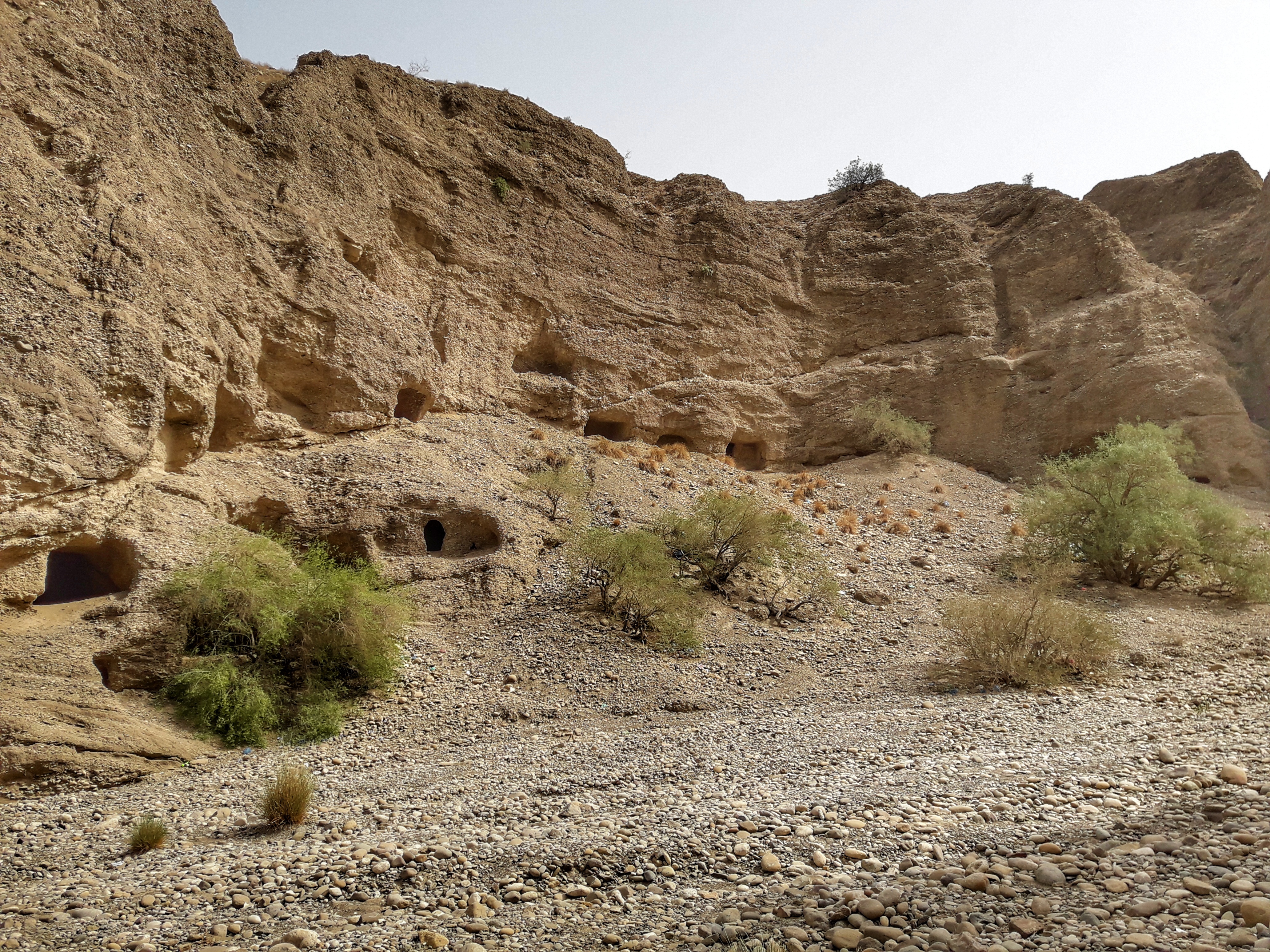
Gondrani
Twenty kilometers north of the town of Bela in Pakistan's Balochistan province, a hillside riddled with caves stares out over the Lasbela District like a honeycomb of vanished lives. Gondrani -- also known as Shehr-e-Roghan, the "City of Ghee" -- is an archaeological site whose origins no one can fully explain. Dozens of chambers have been carved into the rock face, some interconnected, others isolated, all empty of the people who once inhabited them. Historians believe this was a large Buddhist monastery dating to the eighth century, when the region was part of a Buddhist kingdom. But the exact identity of the builders, their reasons for choosing this hillside, and the circumstances of their departure remain subjects of scholarly debate.
Caves Without a Clear Past
The mystery of Gondrani lies in the gap between what can be seen and what can be proved. The caves show characteristics consistent with Buddhist monastic architecture, but according to the Journal of the Society for South Asian Studies, the site cannot be conclusively linked to Buddhist heritage. Andre Wink, in his book Early Medieval India and the Expansion of Islam: 7th-11th Centuries, places the site within the context of the Buddhist kingdoms that once flourished in Balochistan before the Islamic conquests of the region. The Geographical Journal agrees that the caves are of Buddhist origin. Yet no definitive inscriptions, no statuary, no texts have been recovered to seal the identification beyond doubt. The caves exist in a kind of historical limbo -- almost certainly Buddhist, but lacking the evidence that would transform probability into certainty.
The City of Ghee
The alternative name Shehr-e-Roghan -- City of Ghee, or clarified butter -- suggests a folk tradition about the settlement's former prosperity. In a region where animal husbandry has been central to survival for millennia, a city associated with ghee would have been a place of abundance, a settlement wealthy enough to produce surplus dairy. Whether this name reflects actual historical wealth or is a later embellishment by people looking at abandoned caves and imagining the prosperity that must have filled them, no one can say. The site sits approximately 218 kilometers from Karachi, within the Lasbela District, close enough to major population centers to have been visited and looted many times over the centuries, which may explain the absence of portable artifacts.
A Landscape of Lost Faiths
Gondrani's significance extends beyond its own mystery. It is part of a broader pattern of Buddhist presence along the Makran coast and in the interior valleys of Balochistan -- a presence that was largely erased by successive waves of conquest and conversion beginning in the seventh century. The cave monastery, if that is what it was, would have existed in the final decades of Buddhist culture in this region, before Islam transformed the religious landscape of South Asia's western reaches. Walking through the empty chambers, with their carved niches and smoothed walls, is to encounter a transition point in history: the moment when one faith gave way to another, leaving behind only stone and silence. Gondrani stands as evidence that Balochistan's religious history is far more layered than its present would suggest.
From the Air
Located at 26.39N, 66.21E, approximately 20 km north of Bela and 218 km from Karachi in the Lasbela District of Balochistan, Pakistan. The cave city is carved into a hillside and may be difficult to spot from high altitude. Nearest airports are Karachi (OPKC) to the southeast and the small airstrip at Bela. Best viewed at 1,500-3,000 feet AGL. The terrain is hilly with scattered vegetation. The town of Bela is visible to the south as a reference point.