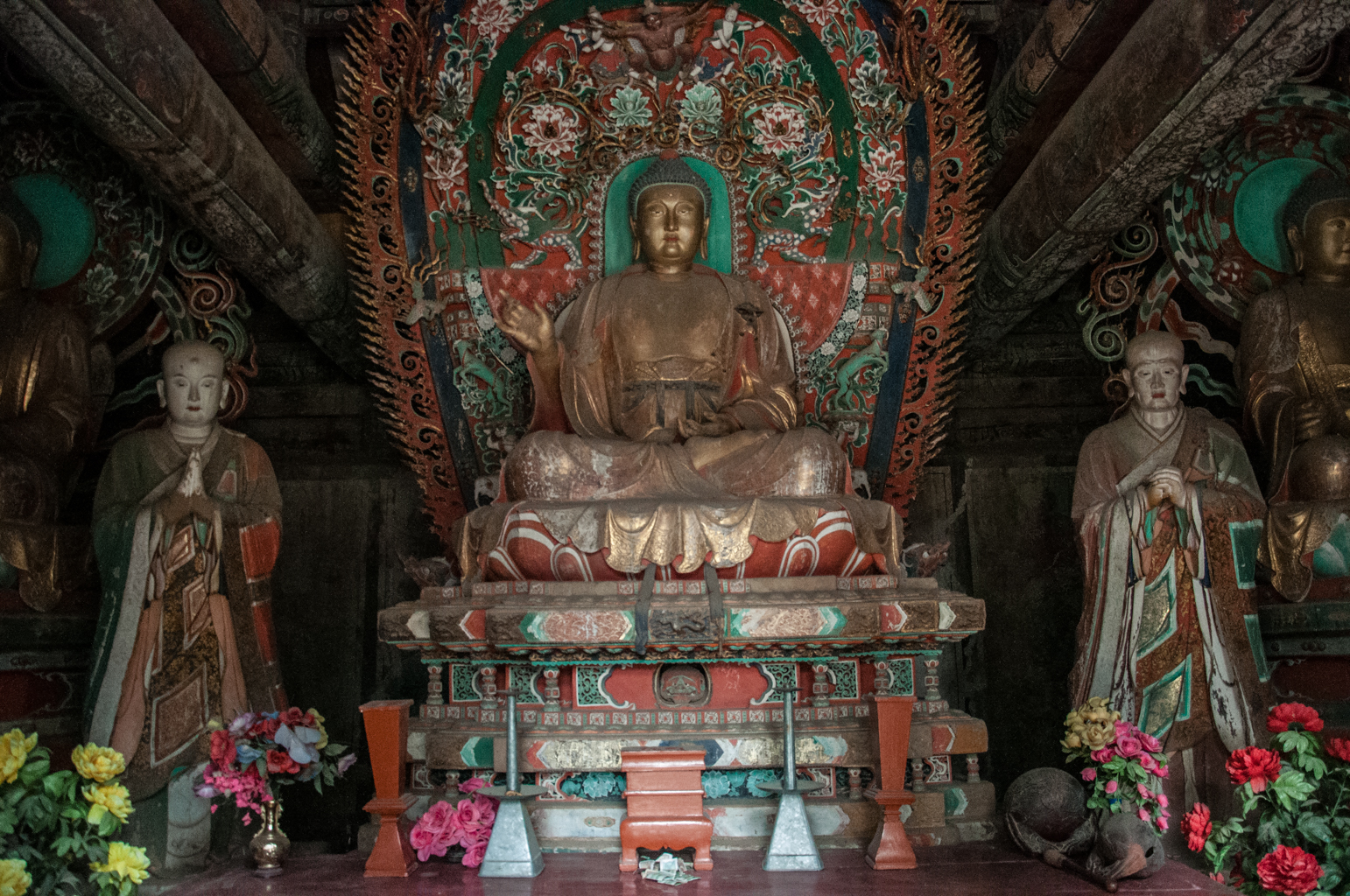
Gongzhu Temple
Legend names a princess as the temple's founder. Princess Chengxin, the fourth daughter of Emperor Wencheng of the Northern Wei, is said to have ordered Gongzhu Temple built in the fourth century AD, giving the site its alternate name: Princess Temple. Whether the legend is precisely true matters less than what it reveals about the temple's age and its connection to the ruling elite of one of China's most culturally transformative dynasties.
A Dynasty That Shaped Chinese Buddhism
The Northern Wei ruled from 386 to 534 AD, and their era proved pivotal for Buddhism in China. These Xianbei rulers became passionate patrons of the faith, commissioning the great cave temples at Yungang and Longmen that remain among China's finest Buddhist art. Gongzhu Temple belongs to that same cultural moment, though on a more intimate scale. Located in Xingyuan Township of Fanshi County in Shanxi Province, the temple fell under the jurisdiction of nearby Mount Wutai according to the Records of Qingliang Mountain, the historical chronicle of that sacred Buddhist site. This connection placed a small princess's temple within the orbit of one of the most important Buddhist pilgrimage centers in all of East Asia.
Painted Walls and Thirty Statues
The Mahavira Hall is the heart of Gongzhu Temple, and it has survived remarkably well. The hall preserves the architectural style of the Ming dynasty, with a single-eave overhanging gable roof set on a base just 35 centimeters high. Inside, the walls are covered with frescoes extending over 90 square meters, vivid scenes of devotional narrative painted directly onto plaster. Thirty statues from the Ming dynasty, dating to the period between 1368 and 1644, populate the hall in a careful arrangement. Sakyamuni Buddha occupies the central position, flanked by Amitabha on one side and Bhaisajyaguru, the Medicine Buddha, on the other. Ananda and Kashyapa Buddha stand before Sakyamuni, while the Eighteen Arhats sit in rows along the gable walls, their expressions individually carved.
Quiet Persistence on the Shanxi Plateau
Gongzhu Temple has none of the scale or fame of the great monasteries on Mount Wutai proper. It sits in a township rather than on a sacred peak, and its visitor numbers are modest compared to the pilgrimage sites nearby. What it offers instead is a sense of intimacy and continuity. The frescoes and statues have been here for centuries, maintained by generations of caretakers who understood the temple's significance even when the wider world paid little attention. The building was designated a Major National Historical and Cultural Site, a recognition that places it alongside China's most important heritage sites. For a small temple founded on a princess's devotion in a turbulent dynasty, that designation speaks to the enduring power of the art and architecture that survived within its walls.
Between Mountains and Memory
Visiting Gongzhu Temple today means stepping into a space where the fourth century and the fourteenth meet. The Northern Wei foundation story gives the site its narrative depth, while the Ming dynasty hall and statues give it visual splendor. The frescoes are of particular interest to scholars of Chinese Buddhist art, offering a substantial surviving example of temple wall painting from a period when many such works were lost to war, weather, or renovation. Standing inside the Mahavira Hall, surrounded by the calm faces of thirty statues and the painted stories on the walls, the distance between a princess's act of faith and the present moment seems to collapse. This is what temples do at their best: they fold time.
From the Air
Gongzhu Temple is located at 39.148N, 113.374E in Xingyuan Township, Fanshi County, Shanxi Province. It sits on the plateau west of Mount Wutai. The nearest major airport is Wutaishan Airport (ZBWT) in Dingxiang County. Taiyuan Wusu International Airport (ZBYN) is approximately 200 km to the southwest. The terrain is hilly upland with elevations around 1,000 meters. Look for the small settlement of Xingyuan amid agricultural land on the Shanxi plateau.