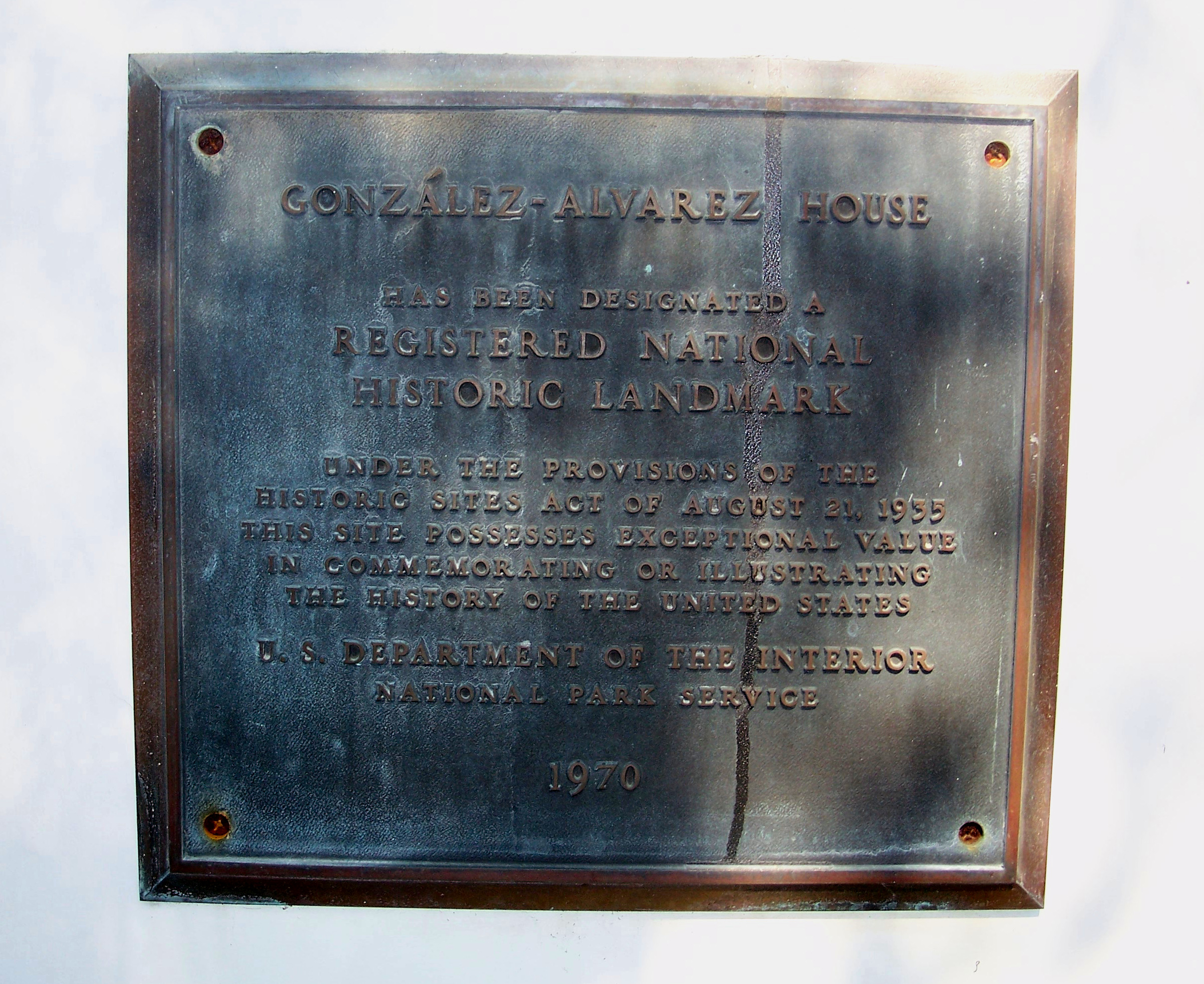
Gonzalez-Alvarez House
Three hundred years of St. Augustine live inside one house. The ground floor is built of coquina -- the same compressed-shell limestone that makes the Castillo de San Marcos nearly indestructible -- its thick walls oriented east to west so that prevailing southeasterly winds blow through the open loggia and cool the interior without any need for modern engineering. The second story is framed in wood, added by an Englishman who wanted glass windows instead of wooden shutters. A two-story coquina wing came later, built by the home's third family. Each generation of owners left their mark in the walls, and the walls kept every one. At 14 St. Francis Street in St. Augustine, the Gonzalez-Alvarez House -- known to nearly everyone as simply The Oldest House -- is the oldest surviving residence in the oldest European-founded city in the continental United States.
An Artilleryman's Home
The land at 14 St. Francis Street has been occupied since the seventeenth century, when Spanish colonial records document a building standing on the site. The present structure dates to about 1723, when the first floor was built for Tomas Gonzalez y Hernandez, an artilleryman stationed at the Castillo de San Marcos, and his wife Maria Francisco de Guevara. Gonzalez built his home the way Spanish colonial settlers had learned to build in northeast Florida: with readily available coquina limestone, tabby concrete floors, thick insulating walls, and an open covered loggia on the east side to catch the breeze. The design was simple and practical, born from the realities of a subtropical garrison town where summers were brutal and building materials were limited to what the land and sea provided. The Gonzalez family lived here through the final decades of the First Spanish Period, until 1763 changed everything.
Three Empires, One Address
When the Treaty of Paris transferred Florida from Spain to Britain in 1763, the Gonzalez family did what most Spanish residents of St. Augustine did: they left for Cuba. The house sat empty until 1774, when Major Joseph Peavett, an English officer, purchased it and immediately began renovating. Peavett added the wood-frame second story that still crowns the building, and he replaced the simple wooden shutters on the first floor with glass windows -- a small luxury that marks the transition from Spanish frontier practicality to British colonial comfort. When Spain reclaimed Florida in 1783, the house changed hands again. Geronimo Alvarez and his wife Antonia Vens acquired it around 1790 and expanded it with a two-story coquina wing. The Alvarez family remained for nearly a century, living through Florida's transfer to the United States in 1821 and the early decades of American statehood. Their name, paired with the original builder's, endures on the house today.
Walls That Remember
What makes the Gonzalez-Alvarez House remarkable is not just its age but its legibility. The coquina first floor, with its thick walls and tabby floors, is unmistakably Spanish colonial -- a style developed for the specific climate and materials of northeast Florida. The timber second story, with its clapboard siding and glass windows, speaks clearly of British tastes and British confidence in permanence. The Alvarez wing blends both traditions, using coquina in a form that owes as much to returning Spanish sensibilities as to the practical lessons learned from British modifications. Walk through the house and you are reading a physical document of colonial administration: who held power, what they valued, and how they adapted a building to suit their culture. The interior floors of tabby concrete -- a mixture of oyster shells, lime, sand, and water -- survive from the original 1723 construction, a material so durable it has outlasted every government that claimed authority over this street.
Preservation and the Alligator Farm
After the Alvarez family's long tenure ended in 1882, the house passed through several owners in quick succession: the William B. Duke family, Mary and Dr. Charles P. Carver, the James W. Henderson family, and -- in an only-in-Florida twist -- George T. Reddington, who operated the South Beach Alligator Farm on the property from 1911 to 1918. The St. Augustine Historical Society acquired the house in 1918, making it one of the earliest historic preservation efforts in the state. The society undertook a full restoration in 1959-60, carefully reversing later alterations to return the house to its late nineteenth-century appearance. The house was designated a U.S. National Historic Landmark in 1970. Today it anchors the Oldest House Museum Complex, where guided tours lead visitors through the same rooms where a Spanish artilleryman once cleaned his musket, a British major once installed his first pane of glass, and a Spanish-Minorcan family once raised their children under American rule.
From the Air
The Gonzalez-Alvarez House is located in the residential area south of downtown St. Augustine, at approximately 29.888N, 81.310W, on the north side of St. Francis Street between Charlotte and Marine Streets. From the air, the two-story structure with its hip roof and coquina-and-wood construction blends into the historic residential fabric south of the Cathedral Basilica. The Castillo de San Marcos is visible approximately three blocks to the north, and Matanzas Bay lies to the east. Nearest airports: St. Augustine Airport (KSGJ) approximately 4nm northwest, Jacksonville International (KJAX) 35nm north. Best viewed at lower altitudes (under 1,500 feet AGL) to distinguish the historic house from surrounding residential structures.