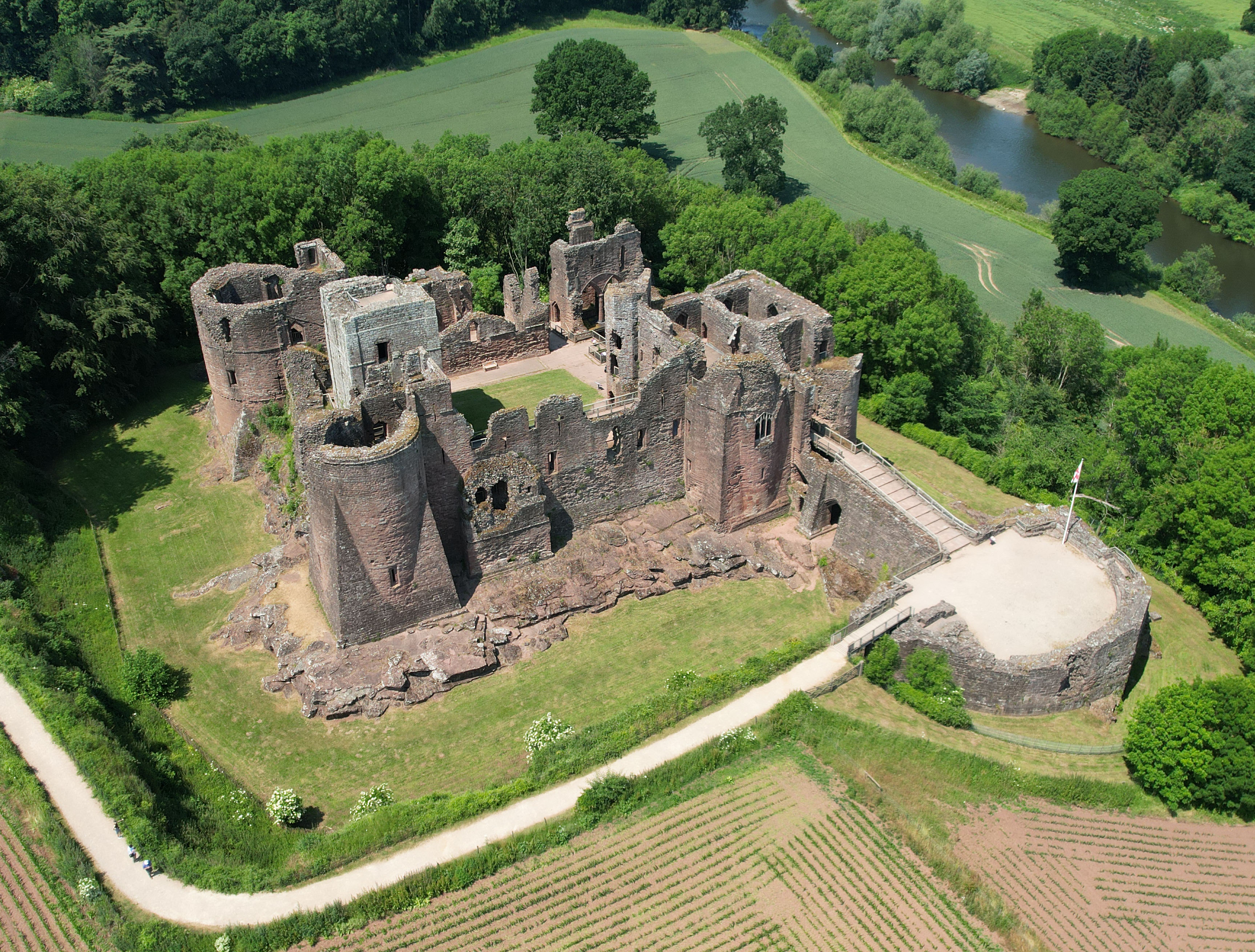
Goodrich Castle
The mortar was named Roaring Meg, and in 1646 it tore Goodrich Castle apart. Colonel John Birch's Parliamentary forces had hauled the enormous weapon into position to end a siege that conventional artillery could not. Its explosive shells -- reportedly among the first used in England -- breached the castle's medieval walls, and the garrison surrendered. Afterwards, Parliament ordered the castle slighted, and Goodrich began its long, elegant slide into ruin. Three centuries later, William Wordsworth would call it "the noblest ruin in Herefordshire."
Godric's Fort
Goodrich Castle takes its name from Godric of Mappestone, who probably built the first fortification here shortly after the Norman Conquest, initially as an earth and wooden structure controlling a strategic crossing of the River Wye between Monmouth and Ross-on-Wye. By the middle of the twelfth century, the wooden castle had been replaced with a square stone keep -- a rare survivor that still stands at the heart of the later fortress. Built of local grey sandstone, this keep is one of the best-preserved examples of mid-twelfth-century military architecture in England, its thick walls and small windows speaking to an age when a castle's primary virtue was impregnability.
A Fortress Fit for a Dynasty
In the late thirteenth century, the castle was dramatically expanded by the Valence family into a concentric fortress that combined military engineering with surprisingly comfortable living quarters. A curtain wall with round corner towers enclosed the keep, while a deep rock-cut ditch protected the approach. The design was sophisticated: attackers who breached the outer defences found themselves trapped in a killing ground between the inner and outer walls. But the castle was not all severity. The great hall, private chambers, and chapel incorporated large windows, carved decoration, and architectural refinements that reflected the wealth and status of its owners. The Talbot family later made Goodrich their seat, and the castle's influence on English military architecture was significant -- its concentric layout was widely imitated.
Siege and Slighting
The English Civil War brought Goodrich its most dramatic chapter. Initially held by Parliament, the castle was seized by Royalist forces and held as a garrison under Sir Henry Lingen. In 1646, Colonel Birch laid siege with a force of Parliamentary soldiers and the weapon that would decide the contest. Roaring Meg, a locally cast mortar weighing over two hundred pounds, lobbed explosive shells over the walls with devastating effect. The bombardment breached the castle's defences, and after a siege lasting several weeks, the Royalist garrison surrendered on terms. Parliament subsequently ordered the castle's destruction. Walls were undermined, towers toppled, and the great gatehouse partially demolished -- deliberate violence intended to ensure the fortress could never again serve as a stronghold.
Romantic Decay
What Parliament intended as destruction, the eighteenth century rediscovered as beauty. Goodrich became a celebrated stop on the Wye Tour, the fashionable scenic excursion that drew artists, poets, and tourists to the valley. Its red sandstone ruins, mantled with ivy and set against the wooded Wye Valley, embodied the Picturesque ideal. Wordsworth visited and was moved to praise. Turner sketched the castle from the river. The ruin even provided the setting for a novel -- Charles Heath's publication on the castle's legend of the lovers Alice Birch and Charles Clifford, separated by the Civil War. Today Goodrich is managed by English Heritage, its walls stabilised but not restored, its rooms open to the sky. Roaring Meg herself sits in the castle grounds, a squat iron cylinder that brought down walls designed to withstand anything the medieval world could throw at them.
From the Air
Located at 51.852N, 2.618W on a sandstone spur above the River Wye in Herefordshire, between Ross-on-Wye and Monmouth. The castle ruin with its round corner towers is visible from the air. Nearest airports: Gloucestershire Airport (EGBJ) approximately 20nm east, Shobdon Airfield (EGSS) approximately 15nm north. Best viewed from 1,500-2,500ft for context with the Wye Valley.