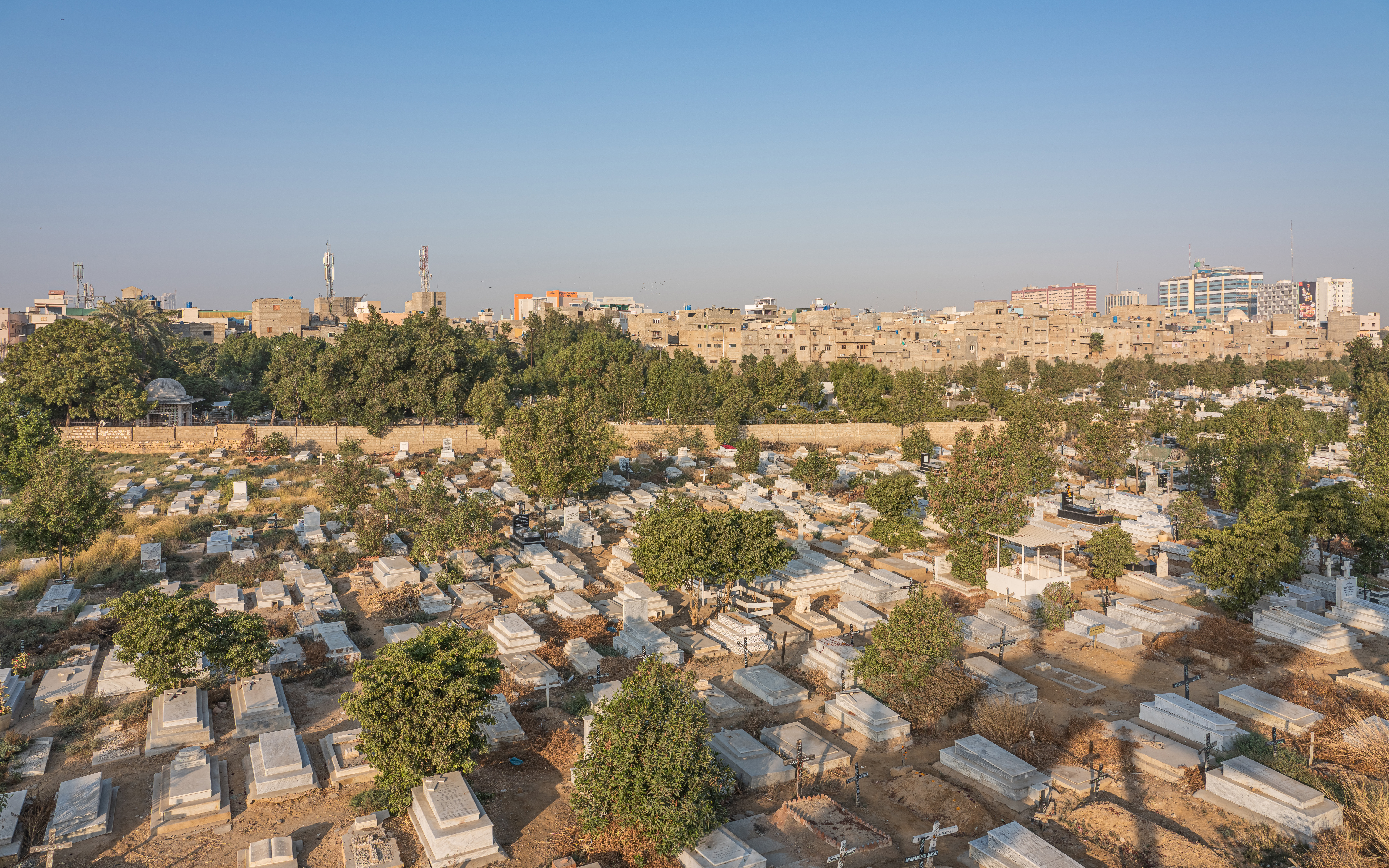
Gora Qabaristan, Karachi
Each grave in Gora Qabaristan has been used, on average, one hundred times. With 300,000 registered burials packed into space for only 3,000 plots, this twenty-acre cemetery on Shahrah-e-Faisal tells the story of Karachi's Christian community through sheer density. The name translates literally as "white man's graveyard," a colonial-era label that has outlasted the empire that coined it. Officially known as Maseehi Qabraistan, or Christian Cemetery, it is Karachi's only operational Christian burial ground.
Graves Older Than the City
The cemetery was formally consecrated in 1845 during British colonial rule, but a tombstone set into the wall near the main gate bears the date 1843, predating even the official founding. Evidence suggests an even older Christian cemetery once existed on Muhammad Ali Jinnah Road near an area called Eidgah, but it fell into disuse and was eventually built over with commercial establishments. After independence in 1947, the British High Commission invited members of various Christian bodies to form the Karachi Christian Cemeteries Board. Since 1885, burial services were performed by a family firm, Anthony Coutinho and Company, whose office still exists on Shahrah-e-Iraq near St. Patrick's Cathedral, though the firm has largely ceased operations. The St. Joseph's Association has since taken over funeral arrangements.
Polish Refugees on Pakistani Soil
Among the cemetery's most unexpected features is a memorial to 58 Polish citizens who died in Karachi during the 1940s. Following the German and Soviet invasions of Poland in 1939, hundreds of thousands of Poles were deported to Soviet labor camps. Between 1942 and 1945, approximately 28,000 Polish refugees found shelter in Karachi, then still under British rule. The memorial, erected by the Polish government, lists each of the 58 who did not survive to see the war's end. Their names, carved in stone thousands of kilometers from home, represent one of the more unlikely intersections of twentieth-century displacement.
A Cross Above the Skyline
In 2014, a giant cross was constructed just inside the cemetery wall, rising approximately 43 meters and reportedly one of the tallest in the region. The construction was funded by Christian businessman Parvez Henry Gill. The cross now serves as a visible landmark along Shahrah-e-Faisal, one of Karachi's busiest arterial roads. Its scale was intended as both a statement of faith and a marker for a community that has long navigated life as a minority in Pakistan's largest city.
The Weight of History
Gora Qabaristan has witnessed moments that extend well beyond its function as a burial ground. In May 2002, the mutilated remains of American journalist Daniel Pearl were discovered in Gadap, roughly 30 miles north of Karachi. The cemetery has also faced ongoing challenges of desecration, with reports from 2006 describing damage to graves from cricket and football games played by boys from surrounding neighborhoods. Despite these pressures, the cemetery endures as a place where Karachi's Christians bring their dead, stacking generations upon generations in earth that has been receiving bodies for nearly two centuries.
From the Air
Located at 24.856N, 67.050E along Shahrah-e-Faisal, one of Karachi's main arterial roads. The 43-meter cross constructed in 2014 may be visible at lower altitudes. The nearest major airport is Jinnah International Airport (OPKC), approximately 10 km to the east along the same road. The cemetery's 20-acre footprint stands out as a green pocket amid dense urban development.