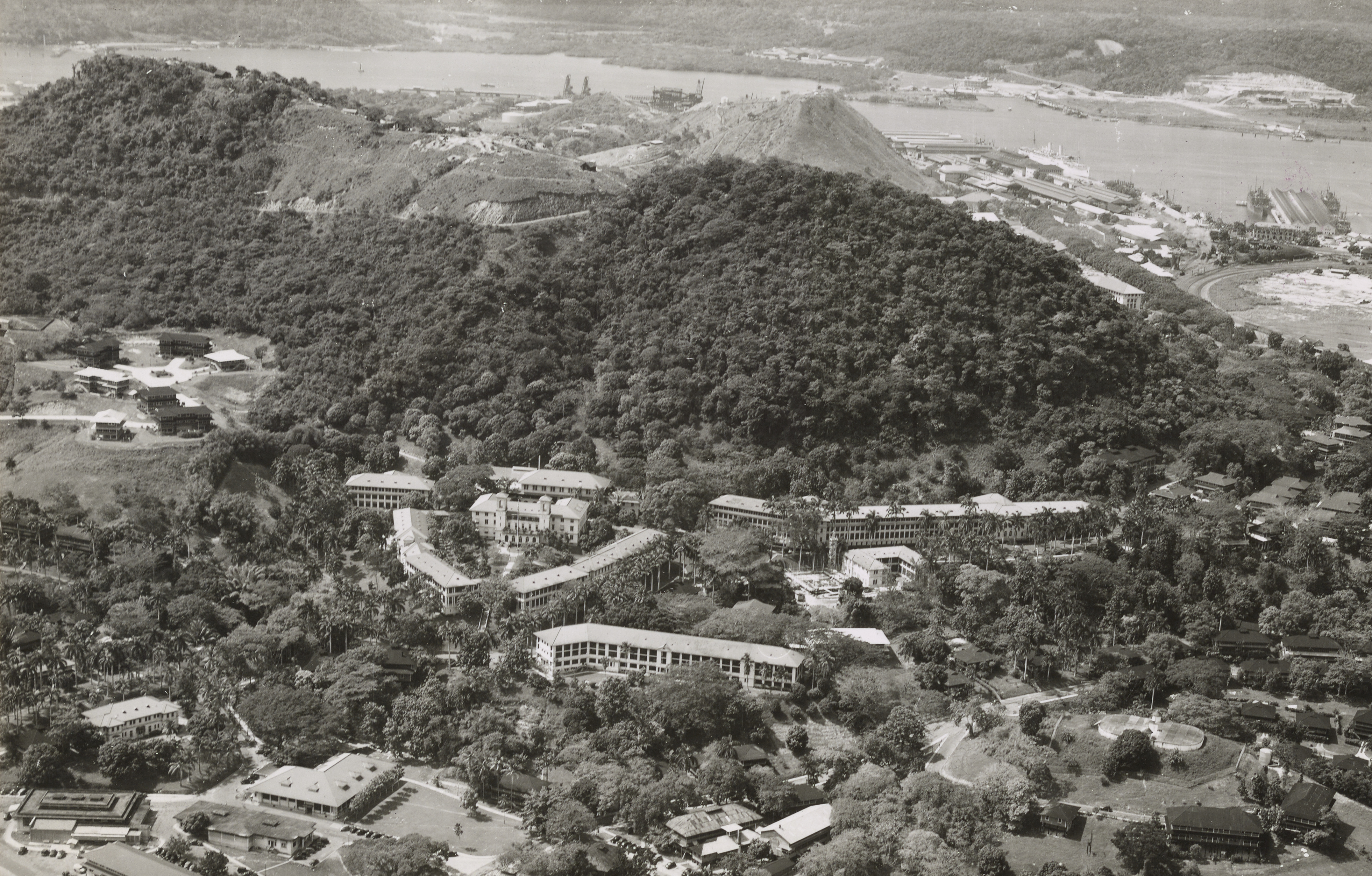
Gorgas Hospital
Three out of four patients died. That was the grim arithmetic at L'Hospital Notre Dame de Canal when the French canal company operated it on Ancon Hill in the 1880s. The doctors were dedicated, the facility state-of-the-art for the tropics, but nobody understood why malaria and yellow fever tore through the wards with such ferocity. The hospital's flower gardens, kept lush and watered in decorative pots, were breeding grounds for the very mosquitoes that carried death from bed to bed. It was a place where medicine's best intentions collided with its blindest ignorance -- and where, two decades later, an American army surgeon would turn that ignorance into understanding.
The Doctor Who Drained the Swamps
When the United States bought the French canal company in 1904, it inherited the Ancon hospital along with the colossal engineering challenge. Dr. William C. Gorgas, the Army surgeon placed in charge, had already proven in Havana that yellow fever spread through mosquitoes. In Panama he applied that knowledge with relentless discipline: screens on every door and window, sealed rooms for fumigation, drainage of standing water throughout the Canal Zone. The hospital, originally built of wood, was rebuilt in concrete in 1915 by architect Samuel Hitt. Gorgas transformed a death trap into a functioning medical center, and the plummeting mortality rates among canal workers owed as much to his war on mosquitoes as to any feat of engineering. The hospital was renamed in his honor in 1928, eight years after his death. Among the notable physicians who served there was George Whipple, who would go on to win the Nobel Prize in Medicine in 1934.
A Hilltop Between Two Worlds
Perched on Ancon Hill, Gorgas Hospital occupied a peculiar position -- literally above Panama City, yet administratively part of a foreign country. The French had chosen the elevation for its breezes and distance from the sewage below. The Americans kept it for the same reasons, and for most of the twentieth century the U.S. Army managed the facility while Panamanian neighborhoods pressed against its boundaries. Generations of American military families knew it as the place where their children were born, canal workers recovered from injuries, and tropical diseases were studied. During the 1964 Martyrs' Day protests, demonstrators surged near the hospital grounds. The building stood at the seam where American authority and Panamanian sovereignty rubbed raw against each other, a daily reminder that a foreign power controlled the hilltop.
Under Fire in Operation Just Cause
In December 1989, when the United States invaded Panama to oust Manuel Noriega, Gorgas Hospital found itself in the crossfire. La Comandancia, the headquarters of Panama's Defense Forces, stood only blocks away. On the night of the invasion, a small group of PDF troops attacked the hospital complex, attempting to take hostages. Military police on site repelled them and were reinforced by infantry from Fort Drum and Fort Polk. For days afterward, sniper fire and at least one mortar attack struck the grounds. Navy Lieutenant Roberto Paz, whose shooting by Panamanian paramilitaries had helped trigger the invasion, had been brought to Gorgas after being shot. Though military planners had not designated it as a casualty collection point, the hospital became exactly that -- receiving American soldiers, PDF fighters, and Panamanian civilians wounded in the surrounding chaos.
A Second Life on the Same Hill
The Torrijos-Carter Treaties of 1977 set the timetable. By October 1999, the hospital passed into Panamanian hands entirely, and its concrete corridors found a new purpose: the Instituto Oncologico Nacional, Panama's national cancer institute, took up residence in the old wards. The building that had once battled yellow fever now fights cancer. Panama's Ministry of Health and its Supreme Court also occupy the former complex. The last American commander, Colonel William F.P. Tuer, lowered the flag; the first Panamanian oncologists raised new ones. Walk the halls today and the architecture still speaks of its layered past -- French ambition, American pragmatism, Panamanian sovereignty -- all stacked on the same hillside, looking out over the canal that brought them all here.
From the Air
Gorgas Hospital sits on Ancon Hill (8.96N, 79.55W) at approximately 200 feet elevation, overlooking Panama City and the Pacific entrance to the Panama Canal. The hill is a prominent green landmark amid urban development. Nearby airports include Marcos A. Gelabert International Airport (MPMG) approximately 3 km south, and Tocumen International Airport (MPTO) 24 km east. Best viewed at 2,000-3,000 feet AGL approaching from the south over the Bay of Panama.