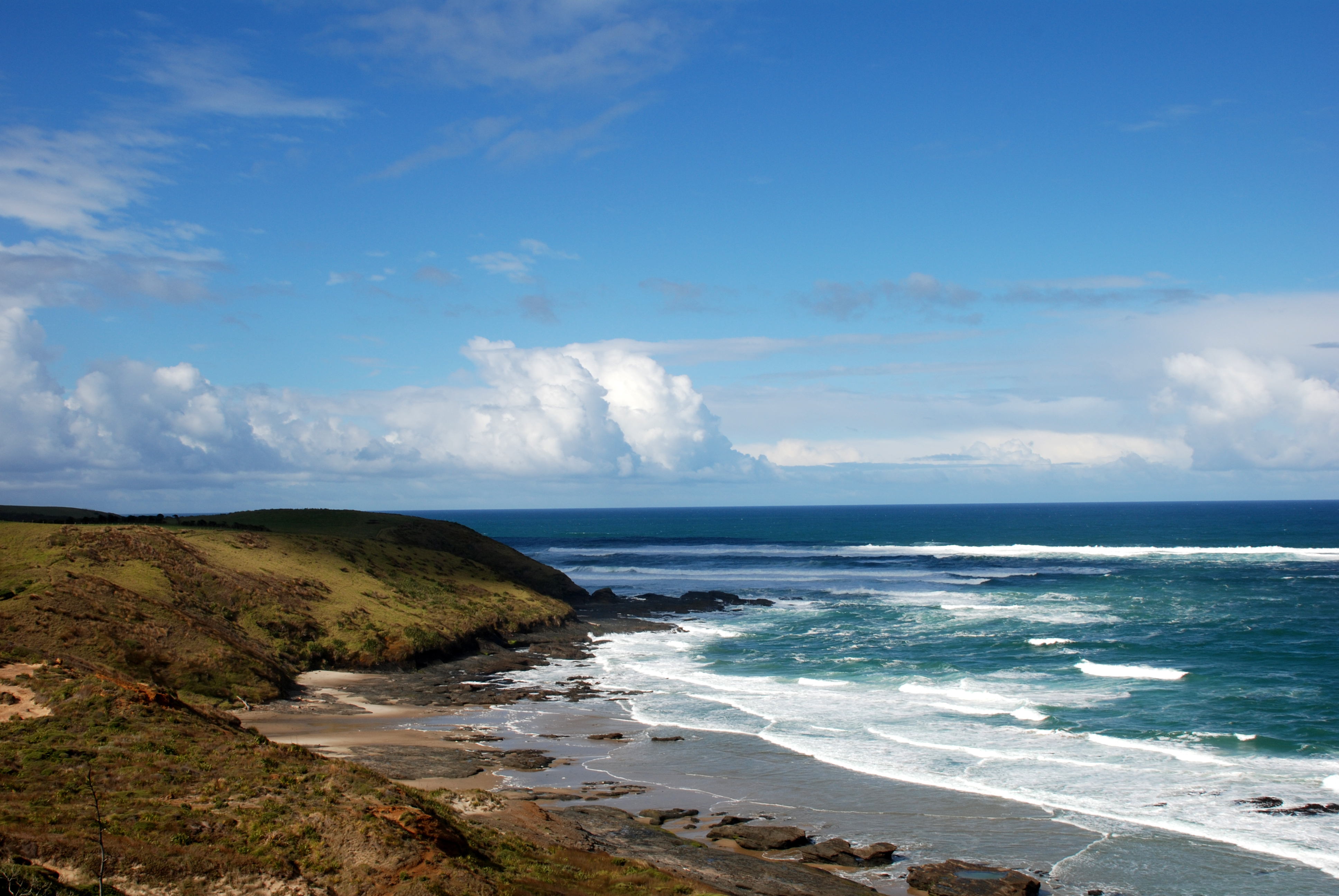
Gorge River
Robert Long dropped out of medical school in 1980 and walked into the bush. Not for a weekend, not for a gap year - for good. He followed the West Coast of the South Island south past Haast, past the last road, past the last track, until he reached the mouth of a river that empties into the Tasman Sea roughly 15 kilometres northeast of Awarua Point. He built a hut. He stayed. The nearest town - Haast, population barely three figures - is a two-day walk away. A helicopter or light plane visits perhaps once a month. For more than four decades, the mouth of the Gorge River has been home to the family that locals and journalists call "New Zealand's most remote."
Where the Mountains Meet the Sea
The Gorge River begins in the Hope Blue River Range, gathering water from steep, forested catchments before flowing southwest through the Cascade Forest and into the Tasman Sea. Its tributaries - the Duncan River and Jerry River - contribute their own volumes, and by the time the main channel reaches the coast, it has become a fast tidal river whose mood changes with every tide cycle. The Gorge Islands, tiny scraps of rock and vegetation, sit just off the river mouth where fresh water meets salt. This is South Westland at its most uncompromising: dense podocarp forest pressing down to the shoreline, rainfall measured in metres rather than millimetres, and a coastline so rugged and undeveloped that it looks much as it did before European settlement. The mountains behind rise sharply into cloud. The sea in front stretches uninterrupted to Australia. Between the two, the river carves its way through a landscape that actively resists human presence.
The Long Family
Robert Long - known locally as "Beansprout" - is a man of varied talents pressed into service by isolation. He is a painter, a carver, a custodian of the Department of Conservation's Gorge River hut, and an occasional deckhand on fishing boats when he needs cash. His wife Catherine joined him at the river, and their children, Christian and Robin, grew up there - educated by correspondence, entertained by the bush, and shaped by a childhood that involved no shops, no classmates, and no roads. The family lives self-sufficiently, growing what they can, fishing what they need, and making the two-day walk to Haast when circumstances demand it. Robert documented their life in a book titled A Life on Gorge River: New Zealand's Remotest Family, published by Penguin. It is a matter-of-fact account of what it takes to live in a place that most New Zealanders would consider uninhabitable, written by a man who chose it deliberately and has never shown signs of regretting the choice.
Self-Sufficiency at the Edge
Living at the Gorge River means solving every problem yourself, because help is not coming quickly. Medical emergencies require a helicopter. Supplies arrive by air or on your back after that two-day walk. Weather determines everything - when you can fish, when you can travel, when the river is safe to cross. Robert makes a living from his art, selling paintings and carvings that capture the landscape he inhabits, and the DOC custodian role provides a modest income while keeping the hut maintained for the occasional tramper who makes it this far south. The family's life is a rebuke to the idea that remoteness equals deprivation. They chose this, they sustain it, and they find in the isolation something that Robert once went looking for when he left medical school: a life defined by the place rather than by the obligations that accumulate in more connected settings. The river provides food, the forest provides shelter, and the distance from everything else provides what Robert Long apparently values most - silence, and the freedom to fill it however he sees fit.
The Wildest Coast
South Westland's coastline, where the Gorge River reaches the Tasman Sea, is among the least accessible stretches of shoreline in New Zealand. There are no roads south of the Haast-Jackson Bay highway, no cell phone coverage, no power lines. The forest is dense with rimu, kahikatea, and rata trees, the understory thick with ferns and moss. Rain falls frequently and heavily - this is one of the wettest regions in the country, with annual totals that can exceed five metres. The coast itself is a mix of rocky headlands, driftwood-strewn beaches, and river mouths that shift with storms and tides. Awarua Point, 15 kilometres to the southwest, marks one of the most exposed promontories on the West Coast. For the rare tramper who reaches the Gorge River mouth, the reward is a landscape of extraordinary wildness - the kind of place where the horizon is empty in every direction except behind you, where the mountains stand, and above you, where the weather is almost certainly coming.
From the Air
The Gorge River is located at 44.18S, 168.20E on the West Coast of the South Island, emptying into the Tasman Sea roughly 15 km northeast of Awarua Point. From the air, the river mouth is identifiable as a break in the dense forest canopy along an otherwise uninterrupted coastline. The Gorge Islands are tiny features just offshore. There are no nearby airports - the closest airstrip is at Jackson Bay or Haast. Milford Sound Airport (NZMF) lies to the south. The terrain is low-lying at the coast but rises rapidly inland toward the Hope Blue River Range. Expect frequent low cloud, heavy rain, and limited visibility typical of South Westland. This is extremely remote coastline with no facilities. Best viewed at 2,000-4,000 feet AGL on the rare clear day.