Goryeo
The English word "Korea" is not Korean. It comes from "Goryeo" -- the name that Arab and Persian traders carried westward along the Silk Road, rendered as "Cauli" by Marco Polo and eventually softened into the word maps still use today. The dynasty that lent its name to an entire peninsula ruled from 918 to 1392, a span of nearly five centuries during which a fragmented land became a unified nation, a Buddhist civilization produced some of East Asia's most refined art, and a kingdom survived Mongol occupation by sheer cultural tenacity.
Forging One Korea from Three
When Wang Geon founded Goryeo in 918, the Korean Peninsula was fractured into the Later Three Kingdoms -- successor states squabbling over the ruins of the old Silla dynasty. Wang Geon, a military commander from a powerful merchant family, established his capital at Kaesong and spent the next two decades conquering his rivals. By 936, he had unified the peninsula. But Goryeo achieved something deeper than military conquest. Korean historians describe it as the first "true national unification" because Wang Geon deliberately incorporated the ruling classes of all three kingdoms, including refugees from the northern kingdom of Balhae, whose roots traced back to the even older Goguryeo. The separate identities of Goguryeo, Baekje, and Silla were, over generations, woven into a single Korean identity that persists to this day.
Jade Light from the Kilns
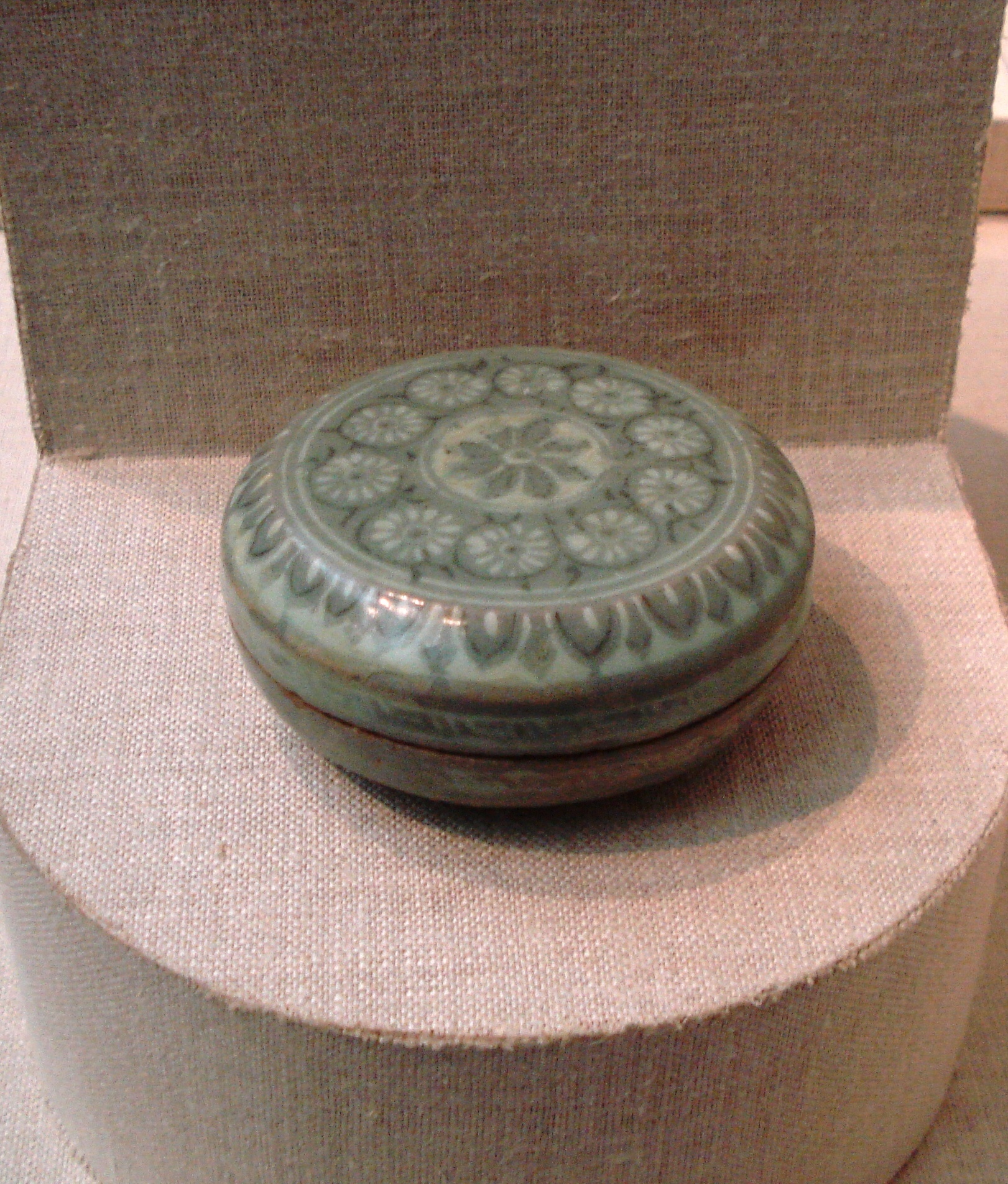
Goryeo's most celebrated artistic legacy glows a luminous jade green. The dynasty's celadon ceramics -- produced from the tenth through the fourteenth centuries -- are considered among the finest small-scale works of art in Korean history. Potters achieved their distinctive color through iron oxide in both clay and glaze, fired in reduction kilns that starved the flames of oxygen. The technique of sanggam, or inlaid decoration, was a Goryeo innovation: artisans carved designs into leather-hard clay, filled the incisions with white or black slip, then glazed and fired the piece to produce intricate patterns of cranes, clouds, chrysanthemums, and geometric scrollwork visible beneath the translucent green surface. Chinese connoisseurs of the Song dynasty, not easily impressed, ranked Goryeo celadon among the finest ceramics in the world.
Eighty Thousand Prayers in Wood
When the Mongols invaded in the thirteenth century, Goryeo's response combined military resistance with an extraordinary act of faith. In 1251, King Gojong ordered the carving of the Tripitaka Koreana -- the entire Buddhist canon rendered on approximately 80,000 wooden printing blocks. The project was both devotional and practical: by preserving the complete Buddhist scriptures, the court hoped to invoke divine protection against the invaders. The blocks, carved with remarkable precision, are still stored at Haeinsa temple in South Gyeongsang Province, where they have survived for over 750 years. They were designated a National Treasure of South Korea in 1962 and inscribed in the UNESCO Memory of the World Register in 2007. Goryeo's printers also developed the world's oldest known movable metal type, predating Gutenberg by roughly two centuries.
Surviving the Mongol Shadow
The Mongol invasions that began in 1231 devastated Goryeo for decades. The court retreated to Ganghwa Island, using the narrow sea channel as a natural moat against Mongol cavalry. Eventually, Goryeo submitted and became a vassal state of the Mongol Yuan dynasty, a relationship enforced through royal marriages -- Goryeo kings were required to marry Mongol princesses, and the court adopted Mongol customs and dress. Yet the dynasty survived where others did not. Its cultural institutions endured, its Buddhist monasteries continued to produce scholarship, and the Goryeo identity held firm beneath the overlay of Mongol authority. When the Yuan dynasty weakened in the mid-fourteenth century, King Gongmin launched reforms to reassert Korean independence, purging pro-Mongol officials and reclaiming lost territory.
The Name That Outlasted the Dynasty
Goryeo fell in 1392 when General Yi Seong-gye -- later known as Taejo of Joseon -- overthrew the last king and established the Joseon dynasty, which would rule until 1897. But the name Goryeo proved more durable than the kingdom itself. Through centuries of trade contacts, the word had embedded itself in languages from Arabic to Portuguese, and no subsequent dynasty managed to dislodge it from the Western vocabulary. Today, both North and South Korea trace their national identity to the cultural synthesis that Goryeo achieved -- the merging of regional kingdoms into a single civilization, the Buddhist art and Confucian scholarship, the celadon and the printing blocks. The dynasty's capital of Kaesong, now in North Korea, still holds the royal tombs and the ruins of Manwoldae palace, monuments to a kingdom whose name became the world's word for an entire peninsula.
From the Air
Goryeo's capital Kaesong is located at 37.97N, 126.55E, just north of the Korean DMZ. The city is visible from altitude as an urban area surrounded by hills dotted with royal tomb sites. Kaesong is approximately 60 km northwest of Seoul. The nearest airports are in South Korea: Gimpo International Airport (RKSS) at roughly 55 km south, and Incheon International Airport (RKSI) at about 70 km southwest. The DMZ is clearly visible as a narrow, heavily vegetated strip running east-west.