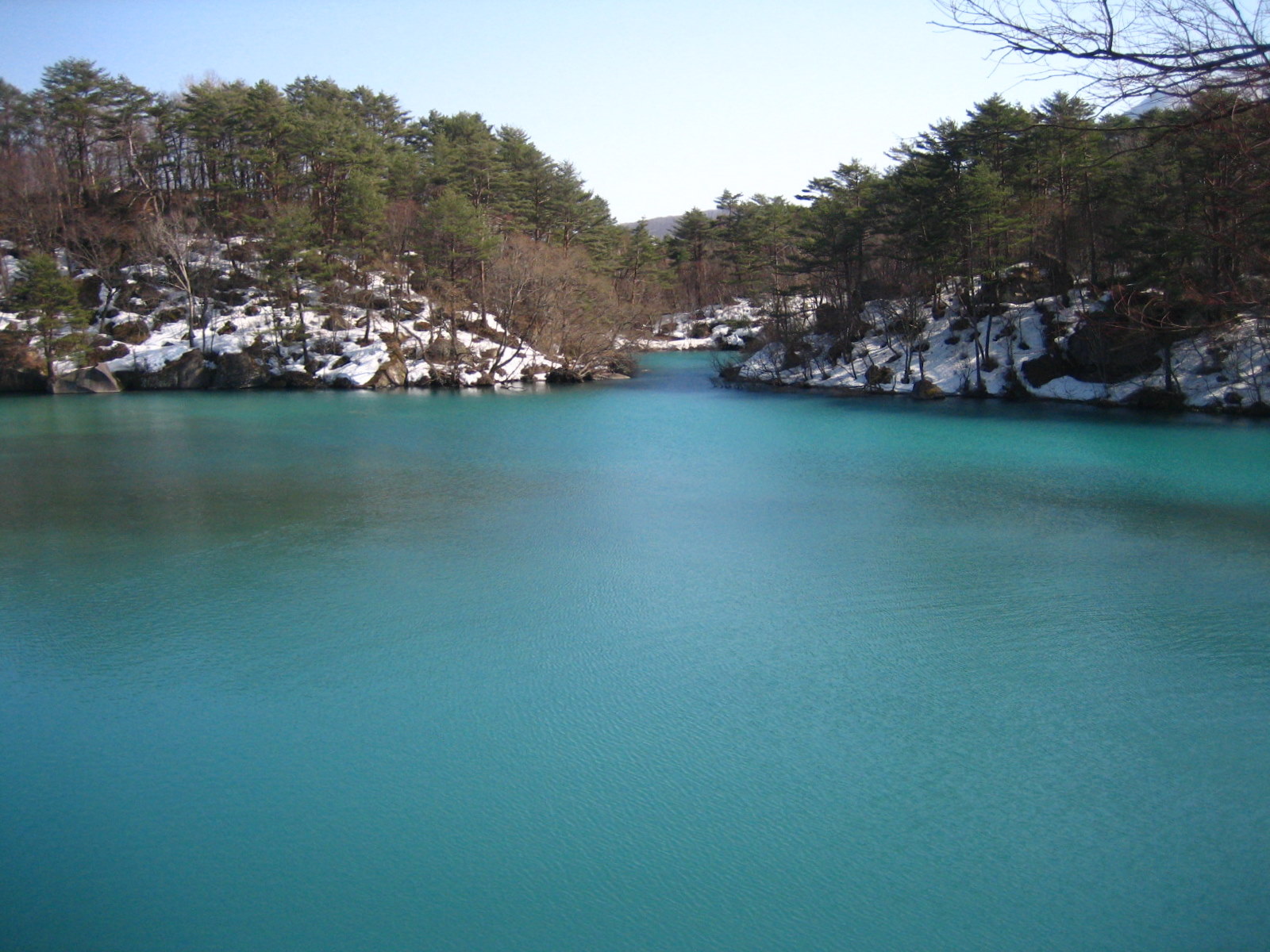
Goshiki-numa
The colors should not exist. Lakes do not naturally glow cobalt blue, or shift to emerald green, or blush a strange reddish hue depending on the time of year and the angle of the light. But at the foot of Mount Bandai in Fukushima Prefecture, five small lakes do exactly that -- each one a different color, each one changing with the weather and the seasons in ways that scientists still do not fully understand. The Japanese call them Goshiki-numa, the Five Colored Ponds, and they owe their existence to a single catastrophic morning: July 15, 1888, when Mount Bandai tore itself apart and rearranged the landscape of an entire highland.
The Mountain That Collapsed
Mount Bandai's eruption on July 15, 1888, was not a typical volcanic event. Rather than spewing lava, the north face of the mountain simply collapsed in a massive phreatic explosion -- a steam-driven blast triggered when groundwater met superheated rock. The landslide that followed destroyed dozens of villages and killed 477 people. It also completely reshaped the terrain north of the volcano, damming rivers and streams with volcanic debris to create the Bandai-kogen plateau and hundreds of new lakes and tarns scattered across it. The eruption was one of the most destructive in modern Japanese history, and the landscape it left behind -- raw, mineral-rich, and studded with water -- became the foundation for an entirely new ecosystem. Among the hundreds of bodies of water that formed, five would prove extraordinary.
A Different Color in Every Pool
The five main lakes -- Bishamon-numa, Aka-numa, Ao-numa, Benten-numa, and Midoro-numa -- each contain a distinct combination of volcanic minerals deposited by the 1888 eruption. These minerals interact with sunlight, water depth, and algae to produce strikingly different colors in each pond. Bishamon-numa, the largest of the five, tends toward deep blue-green. Aka-numa leans reddish, true to its name (aka meaning red in Japanese). Ao-numa runs toward blue. But what makes the ponds genuinely mysterious is that their colors are not fixed. They shift throughout the year, responding to temperature, weather conditions, dissolved mineral concentrations, and biological activity in ways that remain incompletely explained. A pond that looks turquoise in summer might turn a murky green in autumn. Visitors who return in different seasons see what appears to be an entirely different set of lakes.
Walking Through a Volcanic Palette
A four-kilometer nature trail connects all five lakes, running from Bishamon-numa to Lake Hibara through dense forest and along boardwalks that skirt the pond edges. The path is gentle enough for casual hikers and takes roughly 70 to 90 minutes to complete at a leisurely pace. Each pond appears suddenly through breaks in the trees, and the effect is startling -- stepping from the cool shade of forest into a clearing where the water blazes an impossible shade of blue or green. The surrounding forest, largely regrown since the eruption, is a mix of deciduous and coniferous trees that adds its own seasonal color. In autumn, the contrast between fiery red maple leaves and the mineral blues and greens of the ponds creates combinations that look almost artificial. The area is part of the broader Bandai-Asahi National Park and sits at the heart of the Urabandai lake district, one of the most popular outdoor recreation areas in the Tohoku region.
Beauty from Catastrophe
There is something unsettling about how beautiful Goshiki-numa is. The ponds exist because hundreds of people died, because a mountain exploded, because the rivers were blocked by debris from one of Japan's worst volcanic disasters. The villages that once occupied this highland are gone, buried under meters of volcanic sediment. Yet the landscape that replaced them draws hundreds of thousands of visitors each year -- hikers, photographers, and families on holiday. The Bandai-kogen plateau, which did not exist before 1888, is now one of Fukushima Prefecture's most beloved natural areas. The Five Colored Ponds, born from destruction, have become symbols of renewal. Japan has long understood this duality -- that the same volcanic forces that destroy also create -- and Goshiki-numa embodies that understanding in five small, impossibly colorful pools of water.
From the Air
Located at 37.65N, 140.09E on the Bandai-kogen plateau, north of Mount Bandai in Fukushima Prefecture. From the air, the lakes appear as small, distinctly colored pools clustered at the base of Bandai's collapsed northern face. The volcanic debris field from the 1888 eruption is still visible as lighter terrain amid the surrounding forest. Nearby Lake Hibara, a much larger lake also created by the eruption, serves as a useful reference point. Nearest airport: Fukushima Airport (RJSF) approximately 50nm to the south-southeast. Sendai Airport (RJSS) lies approximately 80nm northeast. Inawashiro Lake, a large and prominent visual landmark, sits about 10km to the south. Mountain weather around Bandai can shift rapidly; clear mornings offer the best aerial views of the colored lakes.