Gothenburg
The Dutch called it their masterpiece in the north. When King Gustavus Adolphus needed a port city to rival Amsterdam, he turned to the master canal builders of the Netherlands to raise it from the marshes. In 1621, at the mouth of the Gota River where Sweden's largest drainage basin meets the sea, Gothenburg rose on a web of canals and fortifications. The city council's first meetings were conducted in Dutch. For three centuries since, this has been Sweden's window on the Atlantic, its gateway to everywhere else.
An International Experiment
The founding of Gothenburg was an act of strategic desperation and architectural audacity. Wedged between Danish Halland to the south and Norwegian Bohuslan to the north, Sweden had just a narrow corridor to the open sea. Previous attempts to build here had failed, burned by Danish invaders in 1611. Gustavus Adolphus learned from defeat. He recruited Dutch planners who drained the wetlands and laid out streets in the Amsterdam style, with canals for thoroughfares and sturdy merchant houses along the banks. Germans and Scots joined the project, each community contributing skills and capital. The city council of 1641 tells the tale: four Swedes, three Dutch, three Germans, two Scots. This wasn't merely Swedish, it was a consortium of Northern European enterprise, purpose-built for trade.
Scottish Fortunes, Swedish Futures
The Scots who came to Gothenburg didn't just settle, they shaped the city for generations. William Chalmers, son of a Scottish merchant, donated his entire fortune to establish what became Chalmers University of Technology, now one of Europe's leading technical institutions. Alexander Keiller, another Scotsman, founded the Gotaverken shipyard in 1841, which built vessels until 1989. His son James gave the city Keiller Park in 1906. These weren't immigrants seeking refuge but entrepreneurs recognizing opportunity. The Scottish influence runs through Gothenburg like a second current beneath its canals, a reminder that cities are built by those who bet on them.
From Sailing Ships to Ball Bearings
The Treaty of Roskilde in 1658 changed Gothenburg's destiny. When Denmark ceded Halland and Norway surrendered Bohuslan, Sweden's strip of coastline suddenly widened. The city could breathe. Its harbor grew into the nation's primary western port, the departure point for the great Swedish emigration to America. The impact echoed across the Atlantic, where Gothenburg, Nebraska still bears the name. But the 20th century brought new industry. SKF began manufacturing ball bearings here in 1907. Volvo assembled its first car in 1927. Both companies still headquarter on Hisingen island, where foundries and assembly lines replaced the old wooden wharves.
Canals and Cobblestones
Walk through modern Gothenburg and the layers reveal themselves. The Haga district preserves wooden houses from an era when the city walls still stood, torn down by soldiers in 1810. Kungsportsavenyn, the main boulevard, stretches from the cultural center at Gotaplatsen to the old town, a product of 1860s urban planning that created Gothenburg's highest concentration of cafes, galleries, and nightlife. Liseberg amusement park, the largest in Scandinavia by number of rides, occupies the city center with the improbable cheerfulness of a fairground that never left. The canals remain, though they carry tourists now instead of cargo.
Port of Nordic Ambitions
Today Gothenburg handles more cargo than any other Nordic port, some 37 million tonnes annually moving through its terminals. Container ships bound for North America and East Asia queue alongside ferries to Denmark and Germany. The city has accumulated universities, film festivals, and Michelin-starred restaurants without losing its essential character as a place of transit and exchange. Every November 6th, Gothenburg celebrates its founder with a special pastry shaped like King Gustavus Adolphus, a sweetness commemorating the strategic gamble that created Sweden's second city on land where nothing should grow.
From the Air
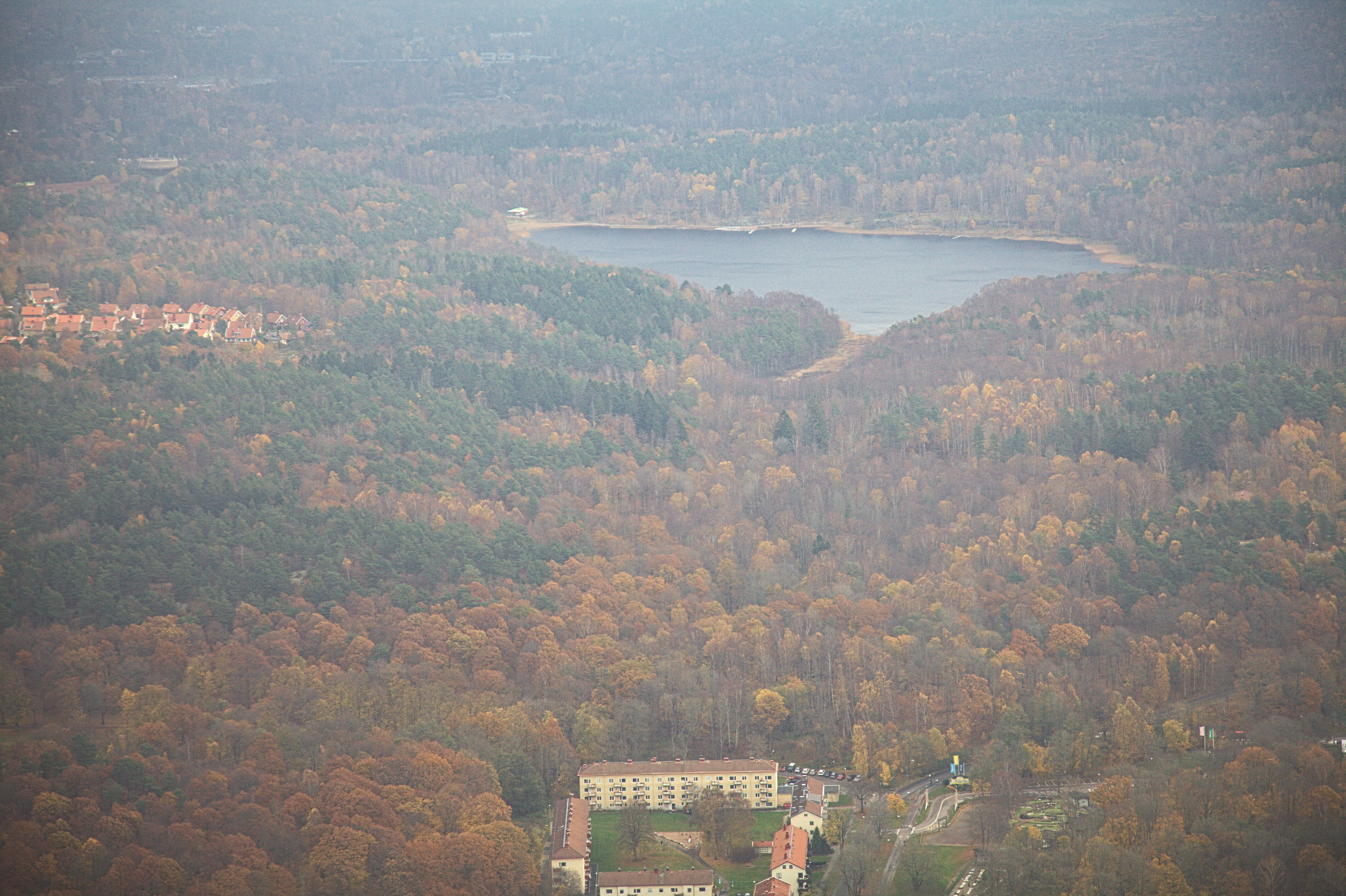
Located at 57.71N, 11.97E on Sweden's west coast at the mouth of the Gota River. Goteborg Landvetter Airport (ESGG) lies 20km east of the city center, Sweden's second busiest airport. The former Goteborg City Airport (ESGP) 10km northwest is now closed to commercial traffic. The city sits on the Kattegat strait, with the distinctive canal network and harbor visible from altitude. Look for Liseberg amusement park in the city center and the industrial areas of Hisingen island to the north.