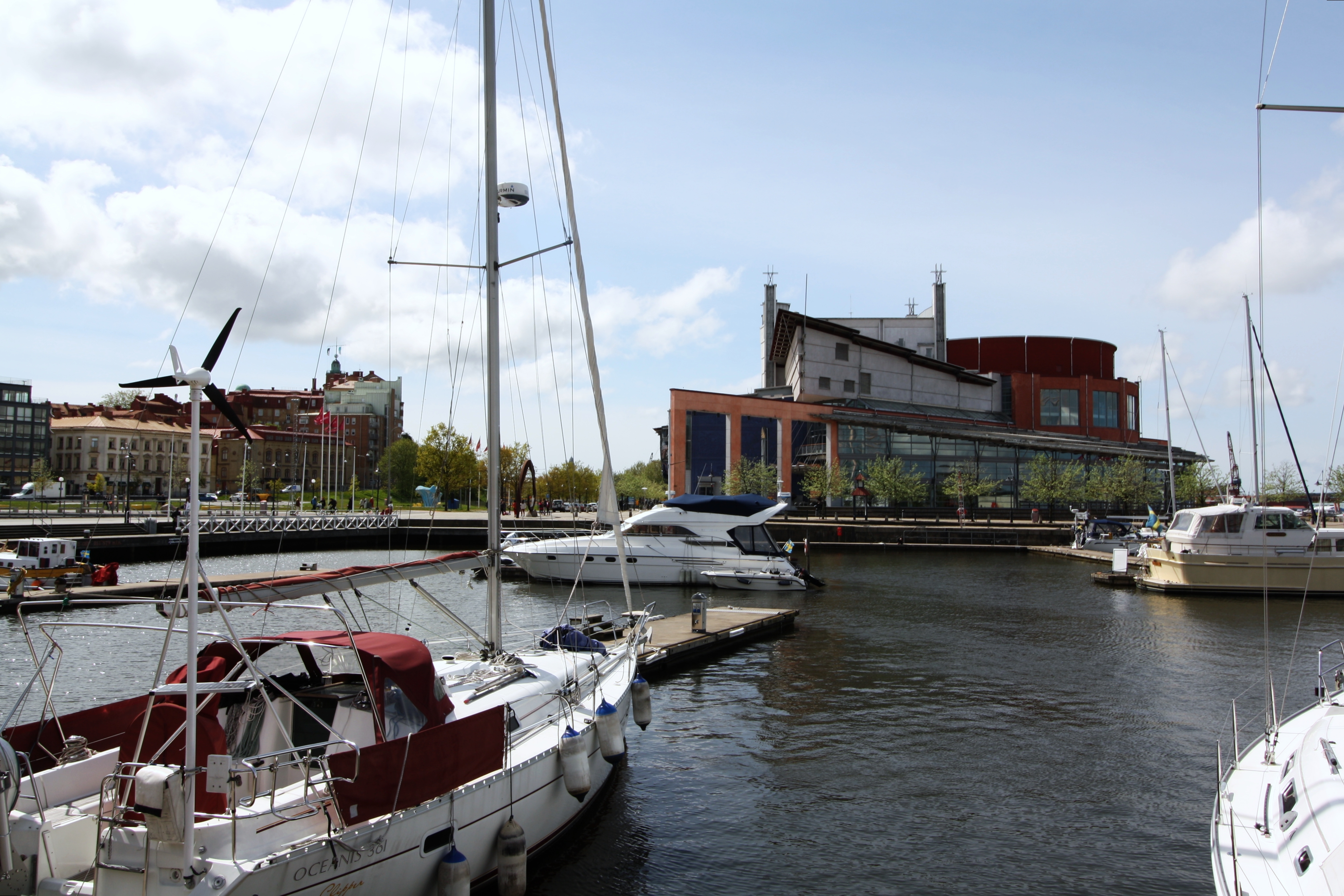
Gothenburg Opera House
Six thousand people donated money to build an opera house. Not wealthy patrons writing large checks, but ordinary citizens of Gothenburg who wanted their city to have a world-class performing arts venue. Their collective commitment in the late 1980s launched one of the fastest major opera house constructions in modern history: groundbreaking in June 1991, inauguration in October 1994, and a building that looks like it might take flight from its harbor perch. The Gothenburg Opera House rises from the waterfront at Lilla Bommen, its sweeping rooflines and angular facades capturing the maritime spirit of Sweden's second city.
Wings Over the Harbor
Architect Jan Izikowitz designed the building as a love letter to Gothenburg's relationship with the sea. "The building should be possessed by an airiness that sends your mind soaring across the meandering landscape like wings of seagulls," he wrote. The structure draws inspiration from harbor cranes, suspension bridges, ship hulls, and sails, translating these industrial and nautical forms into an architectural composition of extraordinary lightness. At 160 meters long and 85 meters wide, with a height of 32 meters, the building encompasses nearly 29,000 square meters of floor space, yet manages to suggest weightlessness through its angular geometries and transparent elements.
A Theater of Transformation
The auditorium seats 1,276 in a classical arrangement of stalls and balconies, with an orchestra pit accommodating up to 100 musicians. But the real magic happens backstage. Five storage areas, each matching the 500-square-meter main stage, allow complete productions to stand ready for rapid deployment. Four movable platforms can each carry 15 tons of scenery. This infrastructure enables the house to shift from opera to ballet to musical to operetta on consecutive nights, a flexibility that justified consolidating activities previously scattered across six different locations throughout the city.
Light and Drama
The stage technology reads like a technical specifications sheet for dreams: a 20-meter-high and 9-meter-wide stage opening, 1,000 spotlights, 250 automatic color scrollers, and 900 dimmer lights. Izikowitz conceived the fly towers as "gigantic lighting towers" and the rear stage wall as "a large set piece," blurring the boundary between the architecture that houses performances and the performances themselves. The colonnade becomes "a series of symbolic gates and stage openings." The auditorium's shape and color pays homage to opera house traditions while the surrounding structure speaks an emphatically modern language.
Sweden's Stage
In February 2000, the building played host to Melodifestivalen, the annual competition that selects Sweden's entry for the Eurovision Song Contest. This national spotlight confirmed the opera house's position as one of Scandinavia's premier performance venues. Under the artistic direction of Henning Ruhe for opera and Katrin Hall for the Gothenburg Opera Dance Company, the house continues to fulfill the vision that inspired those 6,000 original donors: a place where the performing arts flourish at the edge of the sea, in a building designed to make spirits soar.
From the Air
Located at 57.711N, 11.964E on the waterfront at Lilla Bommen in Gothenburg's harbor area. The distinctive angular roofline and sweeping forms are unmistakable from the air, especially when approaching from the west over the harbor. The building sits near the Barken Viking sailing ship and the Gothenburg City landmark crane. Gothenburg City Airport (ESGP) is 10km northwest. Best approached at 1,500-2,500 feet AGL for full appreciation of the building's relationship to the waterfront and harbor infrastructure.