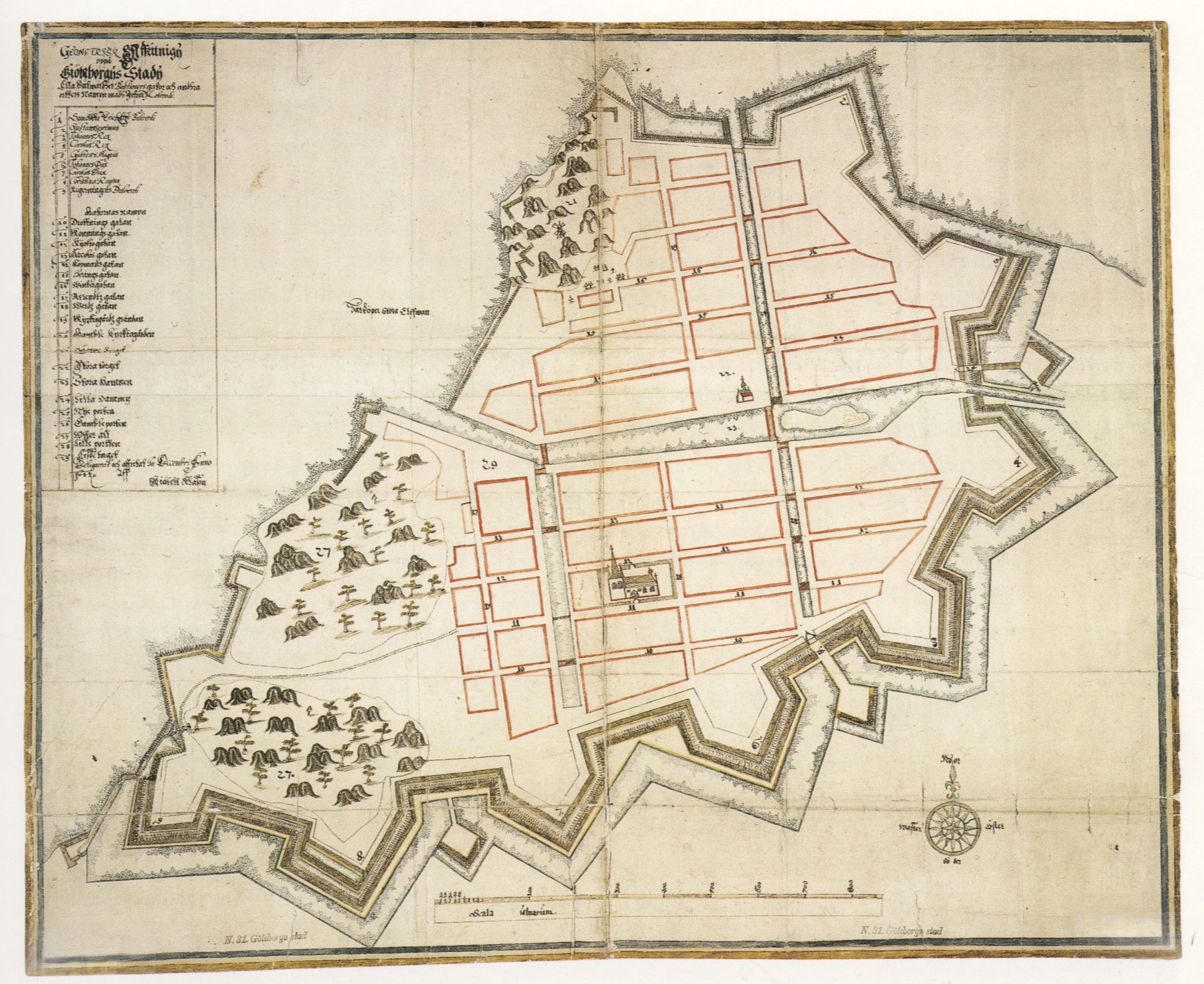
Gothenburg Stave Church
Before entering church in 17th-century Gothenburg, visitors had to surrender their weapons. An entry porch served as an impromptu armory where worshippers left swords and knives before passing through to prayer. This practical arrangement tells you something about the rough-and-tumble nature of Sweden's newest city, founded in 1621 with an urban plan that included space for a grand cathedral but, in the meantime, required a humble wooden church to serve the faithful. The Gothenburg stave church stood for just twelve years before being deliberately disassembled, but its brief existence marks the spiritual birth of Sweden's second-largest city.
A City Taking Shape
Gothenburg's city plan was ambitious from the start. Drawn up by Dutch engineers familiar with canal cities, it designated specific blocks for specific purposes, including one prime location for religious life. But cathedrals take time and money. The stave church filled the gap, completed in 1621 on the same plot that would eventually host Gothenburg Cathedral. The modest wooden structure measured roughly 16 meters by 12 meters, its gable roof and timber construction typical of Scandinavian stave church traditions. A narrow bell tower stood at the southwest corner, capped with a cupola and pointed spire, visible in the oldest known drawing of the young city.
The First Shepherd
Sylvester Johannis Phrygius became Gothenburg's first pastor and state-appointed superintendent on July 26, 1619, even before the stave church was completed. Formerly the religious leader of Skovde, Phrygius served his new congregation until his death in 1628, witnessing both the construction of the temporary church and the early work on its permanent replacement. The superintendent held both religious and civil authority in the Swedish Lutheran system, making Phrygius one of the most powerful figures in the fledgling city during its crucial first decade.
Planned Obsolescence
The city's founders never intended the stave church to last. The original site plan deliberately offset the wooden structure from the planned cathedral's footprint, allowing construction to proceed without requiring demolition first. When Superintendent Anders Prytz consecrated the new cathedral on August 10, 1633, the stave church's purpose was fulfilled. Workers disassembled the timber building shortly thereafter. But the bell tower proved too useful to destroy immediately. It remained standing, serving double duty as both church tower and municipal watchtower for the city guard, until 1643 when the cathedral's own tower was finally completed.
Echoes in Stone
Today, no physical trace of the stave church remains. Gothenburg Cathedral, rebuilt several times since 1633, occupies the site, its current structure dating primarily from the early 19th century. But the stave church lives on in historical records and in the oldest surviving images of Gothenburg, where its modest profile represents the first chapter of the city's religious life. The entry porch where weapons were collected, the narrow tower with its cupola, the simple gable roof, all vanished before the city was two decades old, yet they established the sacred geography that persists in the heart of Gothenburg today.
From the Air
The historical site is located at 57.704N, 11.964E, now occupied by Gothenburg Cathedral in the city's old town. The cathedral's distinctive tower marks the location where the stave church once stood. The site lies on the block bounded by Kungsgatan, Vastra Hamngatan, Kyrkogatan, and Korsgatan. Approach from the harbor to trace the route that 17th-century visitors would have taken. Gothenburg City Airport (ESGP) is 10km northwest. The cathedral tower provides a visual reference point at 1,500-2,000 feet AGL.