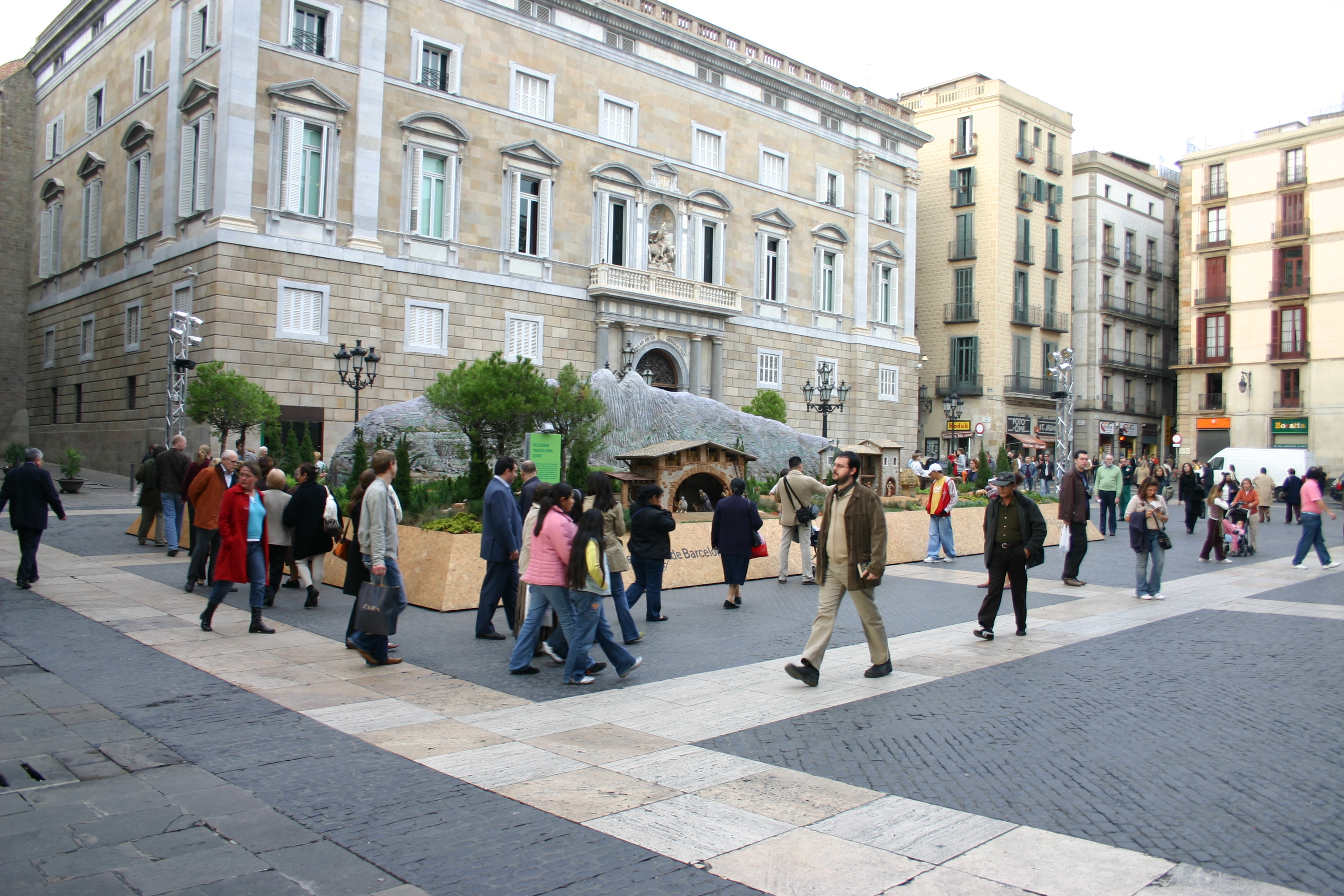
Gothic Quarter, Barcelona
Behind the Cathedral of Santa Eulalia, tucked inside a building basement on Carrer del Paradis, four Corinthian columns rise from the floor. They are the remains of a Roman temple to Augustus, built when this neighborhood was Barcino, a colony established around 15 BC. The columns have been standing here for over two thousand years. Many of the Gothic buildings surrounding them have been standing for less than a hundred. The Gothic Quarter's great secret is that a substantial portion of its medieval character was manufactured in the late 19th and early 20th centuries, a deliberate reinvention of the past designed to give Barcelona a tourist attraction worthy of international attention.
The Genuine and the Constructed
The quarter does contain authentic medieval fabric. Sections of the Roman wall survive, incorporated into later buildings, Roman stones shouldering Gothic arches. The cathedral, begun in 1298 and dedicated to Saint Eulalia, is genuinely medieval, though its neo-Gothic facade was added in the 1880s. El Call, the medieval Jewish quarter, preserves the street pattern of one of Europe's significant Jewish communities before the pogrom of 1391. The Sinagoga Major, one of the oldest synagogues in Europe, still exists within these streets. But the Gothic Quarter as visitors experience it today is largely the product of a massive restoration and construction campaign timed for the 1929 International Exhibition. City officials wanted Barcelona to project Catalan identity and historical grandeur to the international press, so they transformed a sombre, decaying neighborhood into a showcase of medieval architecture, adding neo-Gothic facades, creating new arched passageways, and building structures that looked medieval but were entirely modern.
Layers Beneath Your Feet
Walk through the Placa del Rei and you stand above the Palau Reial Major, the medieval royal palace where Ferdinand and Isabella received Columbus after his first transatlantic voyage. The Salo del Tinell, the palace's great hall, was built in the 14th century with stone arches spanning 17 meters without interior columns. Below the plaza, excavations have revealed layers of Roman Barcino: houses, workshops, a garum factory where fish sauce was produced for export across the empire. The archaeology continues to deepen the neighborhood's complexity. Each renovation reveals more of what lies beneath, creating a vertical history that the surface barely hints at. The Placa de Sant Felip Neri, a small square where shrapnel scars from Civil War bombs mark the church walls, adds a 20th-century layer of violence to the palimpsest.
The Labyrinth
The street plan is medieval in the truest sense: designed for pedestrians and handcarts, not automobiles. Narrow lanes twist between buildings, opening unexpectedly into small squares where orange trees grow and restaurants spill tables onto the stone. Most of the quarter is closed to regular traffic, though taxis and service vehicles still thread through. The effect is disorienting by design. You lose your bearings quickly, which is the point. The labyrinth forces you to discover rather than navigate. The Portal de l'Angel, once a gate in the medieval walls, is now a commercial street. The Placa Reial, a 19th-century square ringed with arcades and palm trees, features lampposts designed by a young Antoni Gaudi. Els Quatre Gats, the cafe where Picasso held his first exhibition in 1900, still serves coffee in its Modernisme interior.
Living in the Set
The tension between authenticity and performance defines the Gothic Quarter today. It is Barcelona's most visited neighborhood and simultaneously a place where people live, shop for groceries, and argue with their neighbors. The Basilica of La Merce honors Barcelona's patron saint. The Palau de la Generalitat de Catalunya, on the Placa Sant Jaume, houses the Catalan government, facing the Casa de la Ciutat, Barcelona's city hall, across the same square where political demonstrations have been gathering for centuries. The quarter is dense with meaning that tourism both reveals and obscures. Visitors photograph the Gothic facades without knowing many were built in the 1920s. Residents navigate the crowds without thinking about the Roman walls embedded in their buildings. Both experiences are authentic, in their way. The Gothic Quarter is a neighborhood that constructed its own past so convincingly that the construction became real through the sheer passage of time. After a century, the invented Gothic is as much a part of Barcelona's history as the Roman columns beneath it.
From the Air
The Gothic Quarter (41.38°N, 2.18°E) occupies the eastern half of Barcelona's Ciutat Vella, bounded by La Rambla to the west and Via Laietana to the east, with the Mediterranean to the south. From the air, the dense, irregular medieval street pattern contrasts sharply with the Eixample grid to the north. The Cathedral of Barcelona is identifiable by its large cloister. Barcelona-El Prat (LEBL) is 13km southwest. The quarter is adjacent to the port area and the Columbus Monument at the foot of La Rambla.