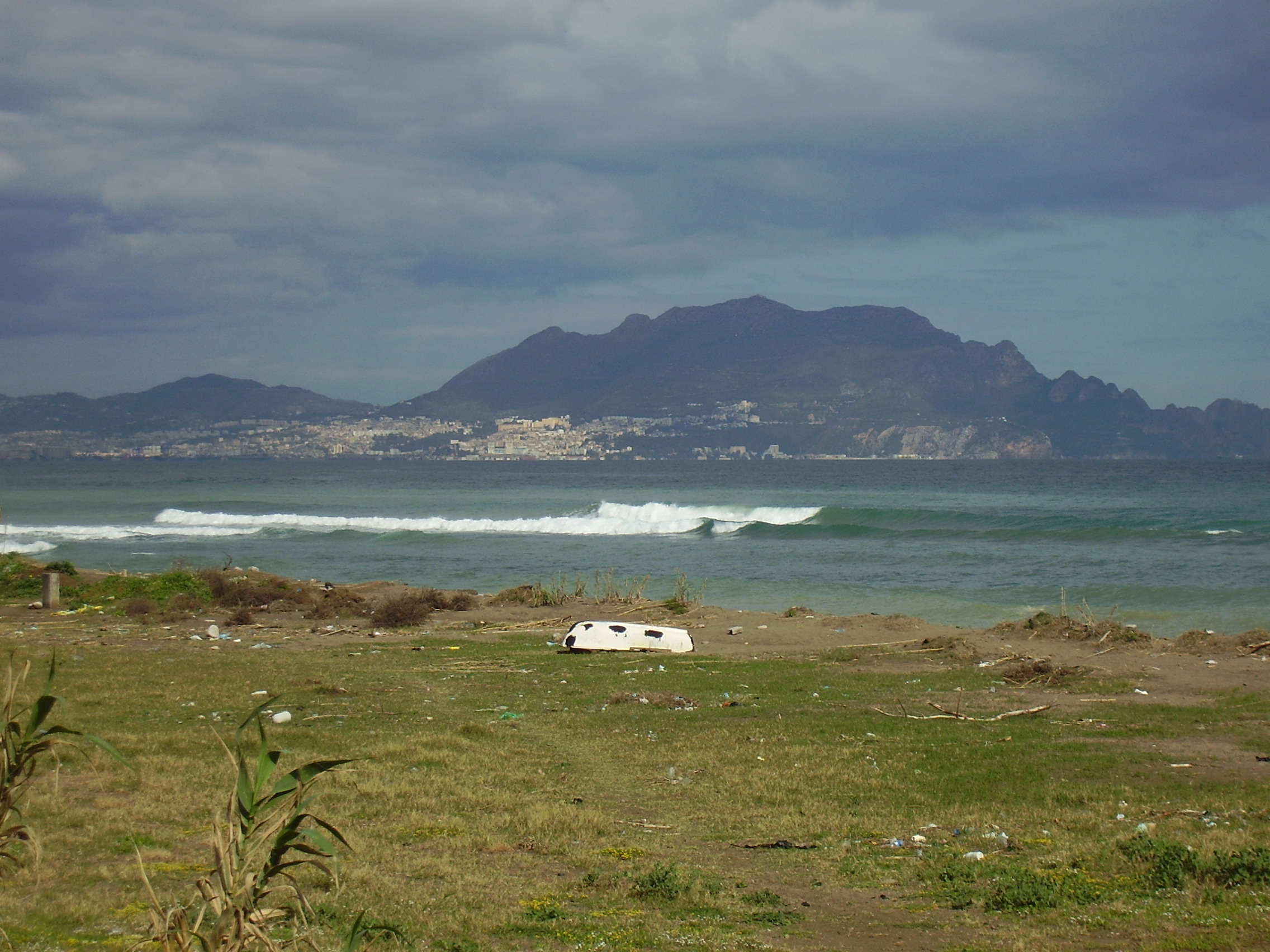
Gouraya National Park
The Barbary macaques of Gouraya peer at you from the trees with an unsettling intelligence, as though they know something about these cliffs that you do not. They are among the last of their kind -- one of the few primate populations remaining in North Africa, clinging to existence in a coastal park where the mountains plunge into the Mediterranean and the limestone dissolves into grottos beneath the waves. Gouraya National Park, tucked against the city of Bejaia on Algeria's eastern coast, is a place where the wild and the urban coexist in uneasy proximity, separated by little more than a road and centuries of Berber stewardship.
Where Mountains Meet the Sea
The park's terrain is extravagant in its contrasts. Elevations swing from 135 meters below sea level to 660 meters above it, all within a compact coastal zone northeast of Bejaia. The ground is calcaro-dolomitic -- limestone and dolomite sculpted by water and time into cliffs, caves, and coves. Fort Gouraya crowns the highest point at 672 meters, while the Pic des Singes -- Monkeys' Peak -- juts above Cap Carbon, where the Mediterranean crashes against rock faces that drop vertically to the water. Beaches alternate with cliff walls along the coast, drawing swimmers from across Algeria to water so clear it seems lit from below. Lake Mezaia sits within the park's interior, a pocket of stillness in a landscape that otherwise tends toward the dramatic.
The Macaques and Their Neighbors
The Barbary macaque, Macaca sylvanus, is the park's most celebrated resident and its most vulnerable. Once widespread across North Africa, the species now survives only in isolated populations in Algeria, Morocco, and the introduced colony on Gibraltar. In Gouraya, the macaques inhabit the park's forests alongside golden jackals, wildcats, and the Algerian hedgehog. Offshore, the marine life is equally significant: sperm whales, short-beaked common dolphins, bottlenose dolphins, and harbour porpoises have been documented in the park's coastal waters. A 2011 study by France's Institut National de la Recherche Agronomique identified seven vegetation groups within the park, from the holm oak forests of Quercetea ilicis to the salt-tolerant plants of the coastal cliffs. Protected species include tree spurge and prickly juniper.
Thirteen Villages, One Park
Gouraya is not uninhabited wilderness. Thirteen villages of Berber origin, home to 1,655 permanent residents, sit within the park's boundaries. These communities have lived in the region long before the park was designated in 1984, and their presence complicates the standard narrative of national parks as places set aside from human use. The relationship between the villagers and the park is one of mutual dependence: the Berber communities maintain traditional land practices that have shaped the landscape over centuries, while the park's protected status offers some defense against the urban sprawl that presses in from Bejaia. UNESCO recognized this balance in 2004, designating Gouraya as a biosphere reserve -- an acknowledgment that the park's ecological value is inseparable from the human cultures embedded within it.
Yemma Gouraya's Watch
The mountain of Yemma Gouraya looms over Bejaia like a sentinel, its silhouette visible for miles along the coast. Near its peak stands the shrine of Sidi Touati, a site of local veneration that predates the park's formal designation by centuries. For the Berber communities, the mountain is not simply a geographic feature but a presence -- maternal, protective, woven into the identity of the region. From the air, the park reads as a dark green crescent pressed against the blue Mediterranean, the cliffs dropping away to water on three sides while the city of Bejaia fills the lowlands to the southwest. It is a landscape that has survived Roman occupation, Ottoman governance, French colonization, and the pressures of modern development, sustained by the macaques in its trees, the dolphins off its shores, and the people who have never quite left.
From the Air
Located at 36.77N, 5.10E on the Mediterranean coast northeast of Bejaia. The park's dramatic cliffs, Cap Carbon, and Fort Gouraya at 672 meters are prominent visual landmarks from the air. Nearest airport: DAAE (Soummam - Abane Ramdane Airport at Bejaia), approximately 8 km southwest. Best viewed at 2,000-4,000 feet from over the sea.