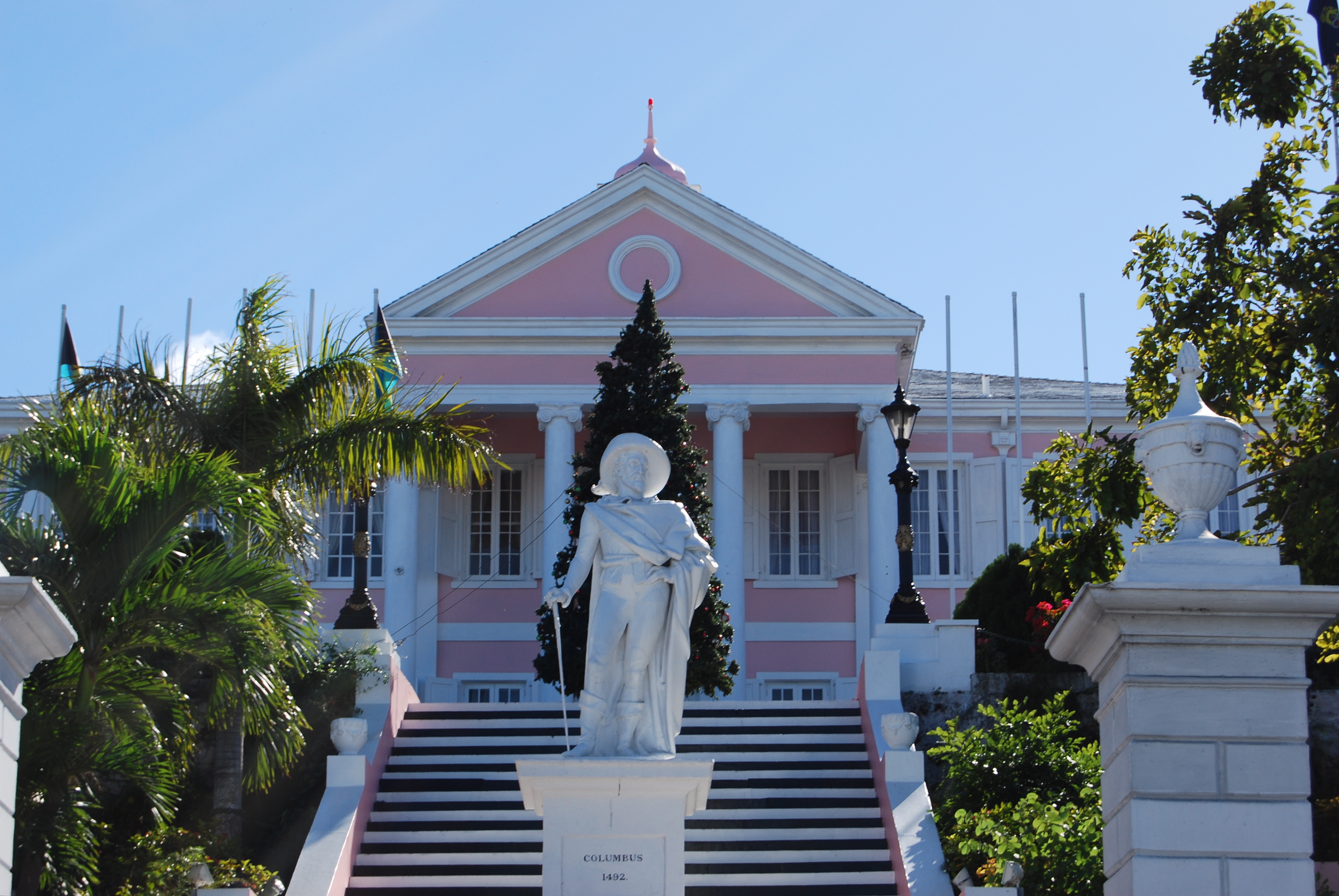
Government House, Nassau
The statue is labeled, which is fortunate. Visitors approaching Government House in Nassau encounter a 12-foot figure at the harbourside entrance wearing a slouch hat cocked at a rakish angle, a toga draped over one shoulder, looking less like the Admiral of the Ocean Sea and more like a pirate who raided a costume shop. It is meant to represent Christopher Columbus. An aide to Washington Irving reportedly designed it in London, and Governor James Carmichael Smyth installed it in 1830. As one contemporary observer noted, without the nameplate, no one would ever guess who the swaggering figure was supposed to be. Behind this improbable sentinel rises Government House itself, painted a shade of brilliant conch-pink, its Ionic columns and cupola presiding over Nassau from the crest of Mount Fitzwilliam. The building has served as the official residence of whoever governs these islands since the 1730s, surviving Spanish attacks, hurricanes, and - perhaps its greatest test - the interior decorating ambitions of the Duchess of Windsor.
Coral Rock and Loyalist Ambition
The original Government House on Mount Fitzwilliam was completed in 1737 for Governor Richard Fitzwilliam, a modest structure suited to a modest colony. But the Bahamas changed after the American Revolution, when thousands of Loyalists fled the new United States and brought with them both enslaved people and architectural expectations. Their influence shifted Bahamian building from painted wood to stone, from the practical to the neoclassical. The structure that replaced Fitzwilliam's house, completed in 1806, reflected this transformation: more than 100 feet long, two stories of stuccoed coral rock, its harbour-facing facade dominated by a full-length upper gallery on ten columns. The Oriental Herald declared it in 1825 the finest government building in the West Indies, built for upwards of 20,000 pounds from the colonial treasury. Bahamian touches softened the European severity - louvred wood shutters to catch the trade winds, that distinctive conch-pink paint job. The building became an emblem of the colony's contradictions: Georgian formality under a subtropical sun, British authority on a coral island.
The Hurricane and the Duchess
The hurricane of 1929 tore the eastern wing's roof off on three sides. Restoration dragged on until 1932, replacing the original harbour gallery with the temple-like entrance and cupola-topped roof that define the building today. But the more dramatic renovation came a decade later, courtesy of the Duke and Duchess of Windsor. The Duke, formerly King Edward VIII, arrived as governor in 1940 - widely understood as a wartime exile to keep the Nazi-sympathizing royal out of Europe. His wife, Wallis Simpson, took one look at the interior and rendered her verdict in a letter to her aunt: "Together we are going to dish this shack up so that at least one isn't ashamed of asking the local horrors here."
The Duchess and her decorator friend, socialite Isabel Bradley, went to work. They introduced New York wallpapers, painted one room the exact shade of the Duchess's favorite face powder, and installed a table ornamented with a three-foot replica of Wallis's own signature. Baseboards were fashioned from natural rattan. The result was described as "frankly smart and modernistic, with Regency touches." The budget, set at $6,000 by the House of Assembly, ballooned to $21,000 - much of the overrun paid by the Windsors themselves.
The Door That Won
One element of Government House defeated the Duchess entirely. The front door, a relic from an even older building on the site, had survived every hurricane to hit Nassau, including the devastating storm of 1929. Wallis wanted it removed. The door refused, or rather the colonial authorities did, denying her request. She was, however, permitted a compromise: the upper half of the battered wood was covered with a black glass panel shipped from the Windsors' home in France. On it, printed in white, was the motto of the Order of the Garter - Honi soit qui mal y pense, "Shame on him who thinks evil of it." The glass plaque remains in place, the door beneath it still standing, still hurricane-proof, still outlasting anyone who tries to replace it.
The so-called Windsor Wing, built during their tenure to house staff and offices, now serves the Royal Bahamian Defence Force. Every succeeding governor's wife, it was said, blessed the Duchess for her renovations. The door, presumably, keeps its own counsel.
From Colony to Commonwealth
Government House survived its most consequential transition not through renovation but through continuity. When the Bahamas gained independence from the United Kingdom on July 10, 1973, the building simply changed tenants. Where colonial governors had resided, the governor-general of the newly sovereign nation moved in. The conch-pink paint stayed. The Columbus statue kept its post. The louvred shutters still caught the trade winds, as they had since American Loyalists first insisted on building with coral rock instead of wood. Today the building sits at the intersection of Nassau's past and present, a Georgian Colonial mansion that has housed representatives of the British Crown, an exiled king and his American wife, and now the head of state's representative in an independent Caribbean nation. Mount Fitzwilliam still offers one of the best views of Nassau harbour, and the statue at the entrance still looks nothing like Columbus.
From the Air
Located at 25.08°N, 77.34°W on Mount Fitzwilliam in central Nassau, New Providence island. The conch-pink building is visible from low altitude on approach to Nassau's Lynden Pindling International Airport (MYNN/NAS), roughly 10 nautical miles to the west. Look for the prominent hilltop structure with its cupola and Ionic columns overlooking Nassau Harbour. Paradise Island and its bridge are visible to the northeast. The area is well-served by VFR approaches; expect tropical weather with occasional afternoon convective activity. Nassau Harbour and the cruise ship terminals provide excellent visual references.